“But we had to eat.”

So begins the Washington Supreme Court’s opinion in Washington Food Industry Ass’n v. City of Seattle, No. 99771-3 (Feb. 9, 2023), wherein the court held that a takings challenge to Seattle’s ordinance requiring Co-19 combat pay for food delivery workers may proceed. 

There’s a lot in the opinion about the crisis and the early days of the response. And about the various claims brought by the WFIA challenging the city’s ordinance, including a statutory claim under Washington law (this is a prohibited tax or fee on groceries), equal protection, takings, contracts clause, section 1983, a “police power” claim, and a privileges and immunities claim.

The opinion is long (39 pages, plus concurring opinions and dissents, adding up to 67 pages), so here’s your scorecard:

I. The chapter 82.84 RCW claim is dismissed; we affirm.
II. The equal protection claim is dismissed; we reverse.
III.

Continue Reading Seattle’s Hazard Pay For Food Delivery Gig Workers Might Be A Penn Central Taking
40th ALI-CLE

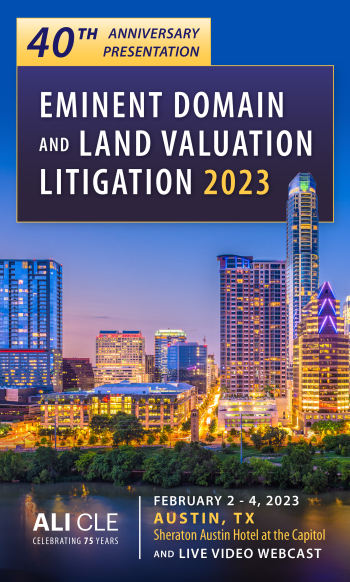
We were eagerly anticipating 40th American Law Institute-CLE Eminent Domain and Land Valuation Litigation Conference. The 2022 Conference in Scottsdale was one of the first meetings where everyone was back in-person (and was a smashing success), but that conference was early in the game so not everyone could or would attend. But in the past year most of us got back to some semblance of “normal,” and the turnout promised to be good.

We had record registrations: with over 300 attendees, faculty, and staff signed up, things were shaping up.

Plus, we were headed to Austin, Texas. The last time we held the Conference there in 2016, we loved it so much it has been in-demand for a return visit. And this year is the debut Conference for some new planning co-chairs for both the main tracks as well as the “Condemnation 101” tracks, so the buzz for the

Continue Reading Ice Ice Baby: A Report From The 40th ALI-CLE Eminent Domain & Land Valuation Litigation Conference, Feb 1-4, 2023, Austin

LUI

Land users: come join us online for the 36th Annual Land Use Institute. Yes, the venerable program is back again, with the usual line up of dirt law experts covering all you need to know and bringing you up to speed on the latest. Here’s the description of the program:

This Annual Land Use Institute program is designed for attorneys, professional planners, and government officials involved in land use planning, zoning, permitting, property development, conservation and environmental protection, and related litigation. It not only addresses and analyzes the state-of-the-art efforts by government to manage land use and development, but also presents the key issues faced by property owners and developers in obtaining necessary governmental approvals.

This outstanding program features:

• Preeminent faculty of practitioners and academics who provide nationwide perspective without losing sight of state-specific issues.
• Critical review and analysis of the most important new cases;
• Practice-oriented discussion

Continue Reading We’re Remote, So It’s Easy To Join Us For The 36th Annual Land Use Institute

Screenshot 2023-02-07 at 09-17-30 Emerging Issues in Property Rights

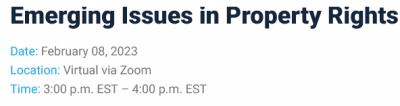
Join our Pacific Legal Foundation colleagues Jon Houghton, Daniel Woislaw, Kady Valois, and Sam Spiegelman (moderating) tomorrow, Wednesday, February 8, 2023, at 3:00 – 4:00 p.m. ET for a free webinar, “Emerging Issues in Property Rights.”

Here’s the agenda:

Protecting private property rights has been at the heart of PLF’s work since our founding in 1973. Our view, and that of the American Founders, is that property rights are foundational to all other constitutional rights.

Our relentless defense of property rights has secured many precedented victories, including 12 property rights wins at the U.S. Supreme Court—and counting.

Unfortunately, even today, the need for property rights champions remains critical.

Government officials too often relegate property rights to second-class status among Americans’ constitutional rights—cloaking their assaults in erroneous assertions of environmental protection or cleverly constructed land use restrictions.

To learn more about property rights’ legal landscape in

Continue Reading “Emerging Issues In Property Rights” – Wednesday, February 8, 2023, 3-4pm ET (Free!)

You remember, don’t you? In the early days of the Co-19 epidemic, government and public health authorities were scrambling to do something … sometimes anything! … to respond.

Dare County, North Carolina might have been one of those local governments that went maybe just a bit too far in the precaution vs effectiveness departments: it banned nonresident property owners from entering the county (and apparently didn’t ban anyone else from coming and going, only outsiders).

Dare County announced the restrictions on March 16 and implemented them over three phases. Phase one, which took effect immediately, declared a state of emergency and prohibited mass gatherings. Phase two, which took effect one day later, prohibited non-resident visitors from entering the county. Phase three, which took effect four days after the restrictions were announced, prohibited non-resident property owners from entering the county. In effect, Dare County told non-resident property owners: “If you

Continue Reading CA4: Being Blocked From Accessing Your Beach House For 45 Days Isn’t A Physical Taking (Or Any Kind Of Taking)

Screenshot 2023-01-28 at 11-23-31 Are zoning laws the cause of Hawaii’s housing crisis (Oahu)

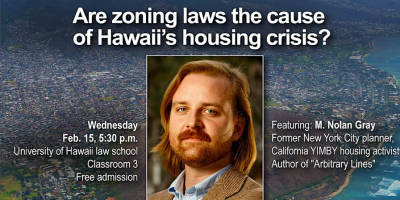
Here’s your chance to spend some time with the author of one of the hottest land use and public policy books out there, Nolan Gray.

RSVP now (admission free, but space is limited) to join our Land Use class when we welcome Mr. Gray to respond to the question in the title of this post. Details:

Date: Wednesday, February 15, 2023

Time: 5:30pm – 7:00 pm, Hawaii Time

Location: University of Hawaii Law School (2515 Dole Street, Honolulu), Classroom #3.

Cost: Free, courtesy of Grassroot Institute of Hawaii

RSVP: You must register here to reserve your place in the room.

Parking: modest fee, available at the adjacent UH parking structure.

As we noted when we featured his book “Arbitrary Lines: How Zoning Broke the American City and How to Fix It” (Island Press 2022) at the top of our dirt lawyer holiday gift guide recently, his work

Continue Reading Hey Honolulu, RSVP To Join Us: Nolan Gray, “Are zoning laws the cause of Hawaii’s housing crisis?” Feb 15 @5:30, U.H. Law School

If your first reaction to the Texas Court of Appeals (First District)’s decision in City of Houston v. The Commons of Lake Houston, Ltd., No. 01-21-00369-DV (Jan. 12, 2023) is scratching your head, then please come join us in bewilderment.

After all, the court held that a takings claim failed because the city is immune from inverse condemnation. Say what? We thought that the self-executing nature of the just compensation requirement of the U.S. Constitution (and the Texas Constitution) means that claims of sovereign immunity don’t hold water in inverse cases.

The Commons wants to develop “The Crossing,” one of those big master-planned communities. The usual development activities entailed: master plan, subdivision plats, city approvals for infrastructure, and even some actual site work. “By April 2018, The Commons had invested millions of dollars in planning and infrastructure for The Crossing.” Slip op. at 2.

But in

Continue Reading An Ordinance Isn’t A Taking Because It’s A Valid Exercise Of Police Power?: What The Heck Is Going On In The Texas Court Of Appeals (First District)?

We really want you there…

One (nearly) last reminder that there’s still time to register for your space at the 40th ALI-CLE Eminent Domain & Land Valuation Litigation Conference, February 1-4, 2023, in Austin. In the past several years, we have sold out due to the conference room capacity and the conference hotel block. But there’s still space, although we are nearly full. So register now – don’t delay any further! 

Here’s the brochure with the complete agenda, schedule, and faculty listing. But to tempt you, here are some of the highlights of the program:

  • Everything Old is New Again: Why Today’s Practitioners Need to Understand the Original Meaning of the Takings and Just Compensation Clauses
  • When the SWAT Team Comes (No) Knocking: Police Power Takings
  • Private Utility Takeovers – Lessons From a 67 Day Trial

  • “Contraband”: How Property Rights Helped Pave the Way for Civil Rights

  • Valuation


Continue Reading (Nearly) Last Call: There’s Still Time To Join Us For The 40th ALI-CLE Eminent Domain & Land Valuation Litigation Conference, Feb 1-4, Austin

Screenshot 2023-01-13 at 14-15-26 Search - Supreme Court of the United States

Here at inversecondemnation.com, we were all set to call it a week and take a break from posting until Monday.

But SCOTUS had other ideas.

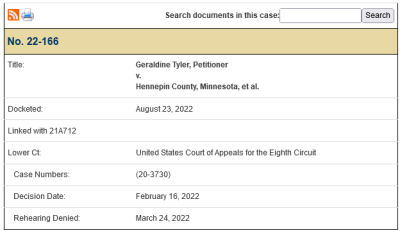
In this Order issued today, it agreed to review Tyler v. Hennepin County, No. 22-166, a case and an issue we’ve been following closely.

The Questions Presented by the petition:

Hennepin County confiscated 93-year-old Geraldine Tyler’s former home as payment for approximately $15,000 in property taxes, penalties, interest, and costs. The County sold the home for $40,000, and, consistent with a Minnesota forfeiture statute, kept all proceeds, including the $25,000 that exceeded Tyler’s debt as a windfall for the public. In all states, municipalities may take real property and sell it to collect payment for property tax debts. Most states allow the government to keep only as much as it is owed; any surplus proceeds after collecting the debt belong

Continue Reading Lucky Friday The Thirteenth: SCOTUS Grants New Takings And Excessive Fines Case

PXL_20221211_163406631.MP

We continue our series on the 100th anniversary of the mother lode of takings case, Pennsylvania Coal Co. v. Mahon, 260 U.S. 393 (Dec. 11, 1922), with this short essay recently published in the “Notice & Comment” feature of the Yale Journal on Regulation.

In “A Landmark Centennial From a Land Marked By the Past,” our law firm colleague Sam Spiegelman tells us why the Mahon case – despite some weathering over the past century – still is important:

For property-rights advocates, Pennsylvania Coal has become both a blessing and a curse. Though it subjects governmental abuses and overregulation to constitutional scrutiny, in practice it has proven too easy to manipulate in favor of government overreach. Why is this? Because Holmes’s “too far” formula focused on the extent of the of harm to the aggrieved individual. But without his saying more, the Supreme Court ran in

Continue Reading Mahon At 100: “A Landmark Centennial From a Land Marked By the Past” (Sam Spiegelman, Yale J. Reg.)