Here are the amici briefs supporting the property owner’s cert petition in a case we’ve been following for a long time, Eychaner v. City of Chicago, No. 20-1214.

This is the one in which the Illinois courts concluded that Chicago’s desire to prevent “future blight” is enough of a public use to support the taking of private property. Yes, you read that right: future blight.


Continue Reading SCOTUS Amici: Preventing Future Blight Is Not Public Use
IMG_4261
Come at me!
(Bolick, J., dissenting)

We have a Wexis alert for “Kelo,” because that’s one of the ways we keep up on the latest developments in this area. That alert doesn’t ping all that often, so we were all excited when yesterday, we received an alert notifying us of the Arizona Supreme Court’s opinion in State of Arizona v. City of Tucson, No. CV-20-0244-SA (Apr. 14, 2021)? Was it a case of government-to-government takings? Prior public use? 

So imagine our disappointment when in reading the opinion, it turns out to be a question of municipal home rule, and election law. Now don’t get us wrong: we are muni law nerds as well as takings nerds, so we dig any opinion in which a court is looking at a local government’s power to frame its own “constitution” and how (or whether) it conflicts with state law. But

Continue Reading What Is A Kelo Reference Doing In An Opinion About Elections And Municipal Home Rule?

You remember that Seventh Circuit case challenging (as, inter alia, a no-public-use taking) the location of the Obama Center in Chicago’s Jackson Park under the public trust (from the home of the American public trust doctrine, Chicago)? We wrote about it in “Friends Without Benefits: CA7 Rejects Takings Claim For Obama Center Because Citizen’s Group Lacks Property Interest In Public Park.”

This was then-Seventh Circuit Judge Amy Barrett’s first (and only) takings or property rights opinion she authored prior to her promotion to the Supreme Court.

A citizen’s group asserted it has a property interest in Jackson Park by virtue of being the beneficiary of the public trust, and that the handing over of the Park to the Obama Foundation was a private benefit regulatory taking. The plaintiff sought an injunction stopping the transfer, and did not seek just compensation.

The district court and the

Continue Reading New Cert Petition: Judge Barrett’s (Sole) CA7 Takings Opinion Is Wrong

Check out the unusual facts in the West Virginia Supreme Court of Appeals’ opinion in Scherich v. Wheeling Creed Watershed Protection and Flood Prevention Comm’n, No. 19-1065 (Mar. 15, 2021).

This started back in 1990, when the Commission instituted a condemnation action to take two parcels belonging to the Scheriches for a dam, as part of a flood prevention project. Okay, nothing too unusual there. The Commission deposited $97k (its estimate of just comp), the owners objected to the amount, and the court approved the quick take. Defeasible title transferred to the Commission, subject to the adjudication of the actual just compensation owed. The owners withdrew the deposit. Again, nothing out of the ordinary there.

But “[f]ollowing such payment, nothing further occurred in the matter for nearly three decades.” Slip op. at 4. Twenty-eight years to be exact. Flash forward to 2018. Someone noticed something. Hey, whatever happened in

Continue Reading West Virginia: Thirty-Year-Old Quick-Take Wasn’t That Quick

For you original MTV folks

Here’s the latest in a case we’ve been following for a while (even since before the last time it went up to the Court). See this post (“The Chicago Way: City Taking Non-Blighted Property For Economic Development Was Not Pretextual Because…Studies“) and this one (“Illinois App: We Haven’t Changed Our Mind – Chicago’s Sketchy Redevelopment Taking Is Still For Public Use“), for example.

After the latest ruling from the Illinois Appellate Court, we guessed that we had not seen the last of the case. And it turns out that our prognostications were accurate: the property owner has filed a cert petition asking once again for the Supreme Court to take up (ha) a Public Use Clause case.

Have I got your attention now?

Five years ago, in City of Chicago v. Eychaner, 26 N.E.3d 501 (Ill. Ct. App. 2015), the

Continue Reading The Future’s So Blight, I Gotta Wear Shades: New Cert Petition Asks To Reconsider Kelo In A Case Where The Stated Public Use Is To Avoid Possible Future Blight

We’ve been meaning to post this one, a short per curiam opinion from the Ohio Supreme Court, for some time. Not because it deals with earth-shattering substantive eminent domain issues, but because it highlights a somewhat niche, but pretty important, procedural issue. 

Say an owner challenges the take, either by way of a public use or a necessity challenge. Some jurisdictions, Ohio included, permit the owner whose challenge is initially denied, to an immediate interlocutory appeal. The question before the court in State ex rel. Bohlen v. Halliday, No. 2020-1245 (Jan 27, 2021) was whether, while that appeal was being considered by the court of appeals, the trial court could move forward and determine just compensation. The trial court thought it could, and set a trial date. The property owners thought otherwise, and sought a writ in the Supreme Court.

This mostly turned on a question of how Ohio’s

Continue Reading Ohio: It Doesn’t Make A Whole Lot Of Sense To Have A Compensation Trial When The Necessity Question Is Being Appealed

IMG_20180720_152126

If you are ever in Boston, it is worth a few minutes of your time to pay a visit to the John Adams Courthouse. The interior architecture is pretty neat, it is full of history (Oliver Wendell Holmes was here), and it is one of the few places in the country where the state’s supreme court is actually below the intermediate appellate court. 

On that last one, we’re being very technical and a bit cheeky: yes, the Massachusetts Supreme Judicial Court is indeed the “supreme” court jurisdiction-wise, but it is located on the second floor, while the Appeals Court is on the third.

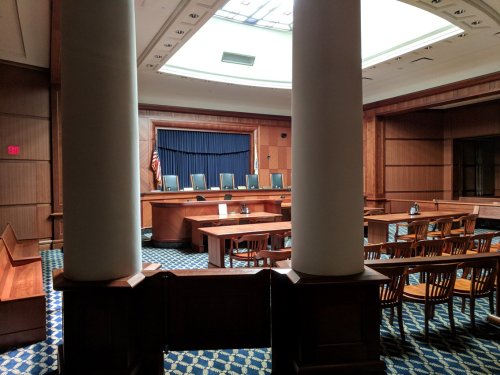
Our story today takes place in the SJC (courtroom depicted above).

In Abuzahra v. City of Cambridge, No. SJC-12920 (Feb. 17, 2021), the court was faced with what to do in a quick take: can an owner who accepts the pro tanto payment

Continue Reading Mass SJC: In Quick Take, Owner Can Accept The Pro Tanto Payment (Deposit) And Also Challenge The Take

Goofus-gallant

Yes, it starts tomorrow, Thursday, January 28, 2021, but we’re “remote” this year, so it is not too late to register to join us for the 38th Annual ALI-CLE Eminent Domain & Land Valuation Litigation Conference. This is the “big one” where the nation’s best practitioners, scholars, jurists, and other industry professionals gather to talk shop about the subjects we know and love.

Details here (ALI-CLE’s page with faculty, agenda, and times), or here (a recent episode of Clint Schumacher’s Eminent Domain Podcast, where we preview the Conference). Here’s your chance to be a part of what is the best conference on these topics.

We have set it up to take advantage of the remote format, and tuition has been reduced (thank you to ALI-CLE for recognizing this, and for our sponsors for being so generous). We’re seeing a lot of first-time registrations, and this is a great opportunity

Continue Reading Still Time To Join Us: ALI-CLE Eminent Domain & Land Valuation Litigation Conference (Online!) This Thursday & Friday. Tuition Deals! #EminentDomain2021

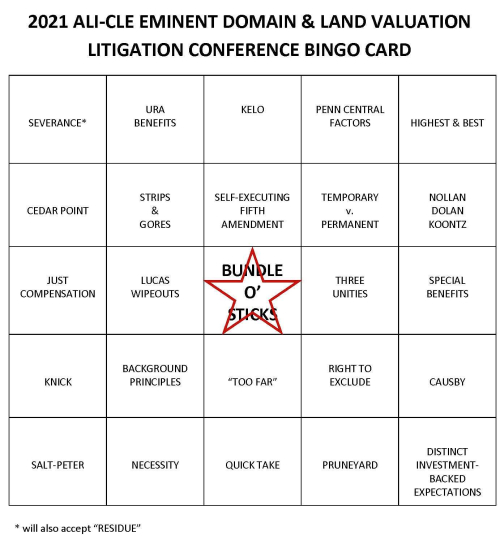
ALI-CLE 2021 Bingo card

If you “get” this, you should be registered for the 38th Annual Eminent Domain & Land Valuation Litigation Conference, to be held remotely on Thursday and Friday, January 28-29, 2021.

The list is growing rapidly, and you need to join us!

This is the “big one” where the nation’s best practitioners, scholars, jurists, and other industry professionals gather to talk shop about the subjects we know and love. We’re having programs with intriguing subjects such as “Planning to Win: Practical Strategies for a Successful Inverse Condemnation Case,” “How Do I Keep My Firm’s Doors Open When the Courthouse Doors Are Closed? Making Your Practice More Efficient When You Can’t Try Cases,” “Where Is the Supreme Court Headed on Takings Cases? Regulatory Takings Update and Cedar Point Preview,” “No Show and All Tell: Breaking News in Property Rights and Takings,” “More Than the Fifth Amendment: Other Tools for Upholding

Continue Reading Your 2021 ALI-CLE Eminent Domain & Land Valuation Litigation Conference (Jan 28-29, Remote) BINGO Card

If you are lacking good things to read, fear not: thanks to amici curiae, you now have boocoo merits-stage friend-of-the-court briefs (16!) on your plate.

This is the case in which the U.S. Supreme Court is considering the nature of physical invasion takings, and how permanent a permanent intrusion must be in order to qualify for Loretto and Kaiser Aetna-ish per se treatment. In Cedar Point Nursery v. Shiroma, 923 F.3d 524 (May 8, 2019), a 2-1 panel of the Ninth Circuit affirmed the dismissal of a complaint for failure to plausibly state a takings claim under Twombly/Iqbal. At issue was a regulation adopted by California’s Agricultural Labor Relations Board which requires agricultural employees to open their land to labor union organizers. The regulation is framed as protecting the rights of ag employees to “access by union organizers to the premises of an agricultural

Continue Reading No Shortage Of Amicus Briefs In SCOTUS Physical Invasion Takings Case