Here’s the video of the oral arguments held earlier today in the Iowa Supreme Court in a high-profile pipeline case. In Puntenney v. Iowa Utilities Board, the court is considering a case at the intersection of the law of public utilities, and condemnation law. The basic question the court is trying to solve is whether a finding by the IUB that the pipeline serves a “public convenience and necessity” makes a determination of the public use supporting the resulting condemnations unnecessary? 

Here’s a description of the issues from the court’s web site:

The district court denied petitions for judicial review of the Iowa Utilities Board’s (IUB) decision to grant a permit to Dakota Access, LLC, for the construction of a hazardous liquid pipeline pursuant to Iowa Code ch. 479B. On appeal, the petitioners argue the district court erred in affording the IUB the authority to define the term “public
Continue Reading Iowa Supreme Court Oral Argument Video: Does A Finding Of Public Necessity And Convenience For A Pipeline Also Solve The Question Of Public Use In Eminent Domain?

Before last week’s Judiciary Committee hearings on the nomination of Brent Kavanaugh to be an Associate Justice of the Supreme Court, we wrote that the issue of property rights and eminent domain may come up during the hearing, even though Judge Kavanaugh’s actual judicial record on that topic is pretty thin. 

We were busy during most of the hearings, and the portions we viewed did not focus on Kelo, but rather on a host of important other topics. But thanks to the efforts of our colleague Elaine Mittleman (the lawyer who argued and won the sole opinion in Judge Kavanaugh’s Public Use and Eminent Domain repertoire, Rumber v. District of Columbia, 487 F.2d 941 (D.C. Cir. 2007)), who sent us the video from the key portion of the hearings, we now have Judge Kavanaugh talking a bit about Kelo and property rights, and related (sort of) topics.  

Senator

Continue Reading Your Kelo Moments From The Kavanaugh Hearings

Come on, let’s be candid here. When we pick up an opinion filled with statutory and regulatory jargon — replete with agency acronyms — our eyes see the words, but our brains process them like they are being spoken by the adults in the Peanuts cartoons.

But then we spot the words “eminent domain” and BAM! we’re all in. 

So it is with the U.S. Court of Appeals’ opinion in Delaware Riverkeeper Network v. Secretary Pennsylvania Dep’t of Environmental Protection, No. 16-2211 (Sep. 4, 2018), which does not disappoint it the jargon department: PADEP, NGA, FERC, Water Quality Certification, EHB, &c. But this is a challenge to a pipeline and also involves eminent domain (if only peripherally), so yeah, we’re diving in despite the buzzing sound.

Short story: natural gas pipelines need Federal Energy Regulatory Commission permission before they can start taking property under the Natural Gas Act.

Continue Reading Third Circuit: Takings Challenge To Pipeline Belongs In FERC

20151204_140514

In case you were on Mars yesterday, you are aware that putative frat boy Brett Kavanaugh is up for a seat at the most exclusive club in law land, Alpha Alpha Alpha, otherwise known as the U.S. Supreme Court.  

We said pretty much all we’re going to say about what Judge Kavanaugh becoming Justice Kavanaugh might mean for the stuff we’re interested in in this post, “What Might A Justice Kavanaugh Mean For Takings, Land Use, And Other Issues?” We certainly can’t add much more to the deep, probing insights the confirmation hearing has provided so far. 

But we also noticed that we haven’t actually gone back through the decade-plus of his opinions from the D.C. Circuit or our blog archives to see if any decision in which he participated provided a clue on how he might lean on the property-related question of the day. Especially the one

Continue Reading Kavanaugh On Kelo?

20180126_111558_HDR

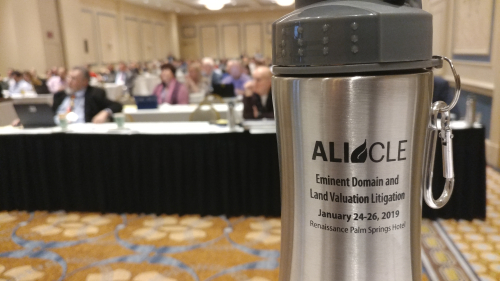
You’ve known for a while that Palm Springs, California, specifically the Renaissance Palm Springs Hotel (a resort facility, but right in town, so you will have many options for “off campus” activities like art museums, the aerial tram, golf, and whatever suits your fancy, and close-in to the Palm Springs Airport), is the venue for our 2019 ALI-CLE Eminent Domain and Land Valuation Litigation, January 24 through 26, 2019.

Of course, you also knew that the programming would be the usual spread of topical and cutting-edge topics, presented by some of the nation’s experts. But we didn’t give you the details. So here are some of the programs we’re having: 

  • Keynote Address: “Property Rights: Foundation for a Free Society” – Taylor Revley, most recently the past President of the College of William and Mary, and also former law school Dean (as well as a


Continue Reading ALI-CLE 2019 Eminent Domain And Land Valuation Litigation Conference, Palm Springs Agenda – Register Now!

TR

We usually don’t cover trial court orders, but this one is short, and, we think, worth your time reading. 

The issue before the North Dakota District Court (Ward County) was the award of attorneys’ fees following a successful necessity challenge by a landowner. In North Dakota, the award of fees and costs to a defendant is within the trial court’s discretion.

The condemnor didn’t object to the award of fees, but the court undertook its own review to determine the complexity and difficulty of the case. The judge correctly noted that “[i]n most eminent domain cases, the issue of necessity never arises.” Order at  7. The order continued:

In his brief in support of his motion for fees, attorney Boughey cites to recent United States Supreme Court authority to support his argument that questioning the necessity of a taking, and standing up to the often heavy-handed authority

Continue Reading “A Lawyer May Spend A Lifetime Working For That One Magnificent Hour” – ND Court Awards Fees For “A Good Day”

Here’s the opinion in a case we’ve been following. In Berkley v. Mountain Valley Pipeline, LLC, No. 18-1042 (July 25, 2018), the U.S. Court of Appeals for the Fourth Circuit held that the federal Natural Gas Act allows the Federal Energy Regulatory Commission to delegate eminent domain authority to Mountain Valley, and that any challenges to that authority must be done via the NGA’s administrative review process.

Under the NGA, once FERC makes a finding of future public convenience and issues a certificate, a pipeline company like Mountain Valley which has been issued a certificate is automatically transferred the power to take private property as a plaintiff in a federal court condemnation action. The NGA provides for an administrative process to challenge the issuance of a certificate, which begins with the request for a rehearing in FERC. If FERC denies that, the next step is judicial review of the administrative record

Continue Reading Fourth Circuit: Challenge To Natural Gas Act Delegation Of Eminent Domain Power Must Go Through Admin Process First

Clare Trapasso has a Realtor.com piece on what a Justice Kavanaugh could mean for real estate, property, and land use issues, “What Supreme Court Nominee Brett Kavanaugh Could Mean for Real Estate,” where she correctly notes that “while commentators have been scrutinizing Kavanaugh’s record on hot-button topics like abortion and immigration, there’s been little discussion of what a more conservative court could mean for home buyers, sellers, and owners.”

She asked us for input, and here’s what we said:

“The Supreme Court has done some very interesting things on land use law that affect homeowners,” says Robert Thomas, a real estate attorney specializing in land use and eminent domain at the Honolulu-based law firm of Damon Key Leong Kupchak Hastert.

Thomas expects more property-related cases will make their way to the Supreme Court, brought by people hoping that the new bench will increase their odds of a

Continue Reading What Might A Justice Kavanaugh Mean For Takings, Land Use, And Other Issues?

20180717_135234_HDR

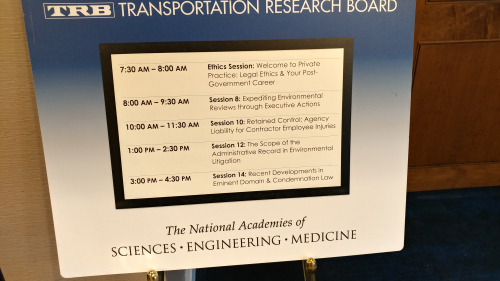
Here are the cases and other items I either spoke about or mentioned at today’s Transportation Research Board‘s 57th Annual Workshop on Transportation Law in Cambridge, Massachusetts:


Continue Reading Links And Materials From Today’s Transportation Research Board Session