ABA State and Local 2017-2017 conferences image

Mark your calendars for this Friday, June 16, 2017, at 2:00 p.m. Eastern Time for a free talk we’ll be giving, “Regulatory Takings: Emerging Issues.” 

Yes, it’s free, but there’s a catch: this talk is sponsored by the ABA Section of State and Local Government Law’s Land Use Committee, and you have to be a Section member (or be willing to join us). One of the benefits of being a member is that you can sign on to these bi-monthly calls and learn about the latest developments in the broad range of topics the Committee covers. Ping me if you want to sign up.  

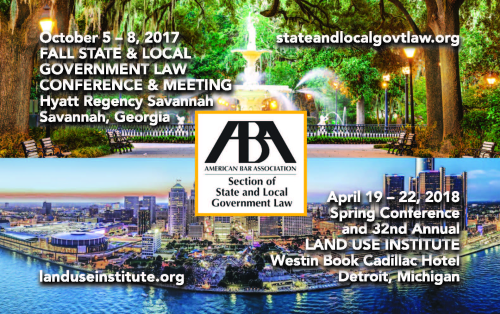
And what’s the deal with the graphic above? Well, starting in August 2017, I’ll be taking over as Chair of the Section (assuming my ABA colleagues do not come to their senses before then), and the big focus of the Chair is to

Continue Reading Upcoming Free Takings Talk (Friday, June 16, 2017). But There’s A Catch…
A fascinating case from the U.S. Court of Appeals for the Tenth Circuit involving an attempt by a private utility company to take property which is now tribal land. 

In Public Service Co. of New Mexico v. Barboan, No. 16-2050 (May 26, 2017), there wasn’t a question that a federal statute prohibited a utility company from taking “tribal land.” The big issue was what land fell within that definition.

The Navajo Nation owned undivided fractional interests in two parcels which the utility claimed it needed for a electric transmission line. The problem wasn’t that the land was currently owned by the Navajos, and thus was tribal land, but that it originally had been allotted to individual Navajos during the time in which the federal government was making such individual allotments. Eventually, the Nation obtained fractional interests in the two parcels via a “buy back” consolidation program (14% for one

Continue Reading 10th Circuit Not Bothered By Holdouts: No Condemnation Of Tribal Land, Even If Formerly Allotted To Individuals

Update 6/6/2017: LA denizen Professor Gideon Kanner wrote about this case a couple of years ago on his blog.

* * * *

For those of you in the Los Angeles area, you may want to check out an upcoming lecture at the Central Library.

On Thursday, June 8, 2017 at the Mark Taper Auditorium, the library is presenting “Siege at Fort Anthony,” about a 1964 eminent domain battle stemming from the “ill fated” Hollywood Museum, a vanity project of “motion picture industry heavyweights headed by Sol Lesser, Gregory Peck, Mary Pickford and Walt Disney, decided to create a museum showcasing the history of movies, radio and television to be located across the street from the Hollywood Bowl.”  

Everyone but Mr. Anthony left on their own:

The place: The Cahuenga Pass, opposite the Hollywood Bowl.

The conflict: An eminent domain showdown between, on

Continue Reading Upcoming Lecture: LA Eminent Domain Showdown – To Condemn A Mockingbird

A small but critical mention in the cinema’s greatest closing argument (Dennis Denuto, Esq., above, in The Castle) for the Australia High Court’s decision in Mabo v. Queensland (No. 2), (1992) 175 CLR 1 (1992):

Denuto: It’s the vibe of it.

Judge: Allright, taken. Do you have a precedent which supports this … “vibe?”

Denuto: Yes, yes I do. Just one moment. [confers with client] … Mabo.

Judge: What about it?

Denuto: That’s your classic case of big business trying to take land … and they couldn’t.

Judge: Mr. Denuto, the Mabo decision pertains to the specific issue of native land title and terra nullius.

Denuto: Yeah!

Judge: So what part of the judgment is relevant to this case?

Denuto: Again … it’s just the vibe of it.

Which prompts us to note that it is the 25th anniversary of the date on which the Mabo decision was handed down

Continue Reading “It’s the Constitution. It’s Mabo. It’s Justice…” 25 Years On For Australia’s Mabo Decision

IMG_20170526_144554

Welcome to a new entry in the eminent domain and takings blogosphere, Texas colleague Clint Schumacher‘s Eminent Domain Podcast. Yes, you don’t have to read to get your takings updates, you can listen while you work, while you work out, or while you drive or fly. Go here to subscribe or download episodes via his website, or here for iTunes.

Clint has formatted his program very cleverly, with an Opening Statement, Direct Examination (in-depth discussion of the topics), Cross-Examination (a “lightning round” quick-question-and-answwers), and Closing Arguments.

He was kind enough to ask me to be his inaugural guest, and we spent some quality time discussing the Honolulu rail project, recent interesting cases, the “three unities” test, the annual ALI-CLE Eminent Domain Conference, and … Kevin Bacon. Don’t miss that.

Click here to open this first episode in a new window

Clint and his firm also produce

Continue Reading Clint Schumacher’s New Eminent Domain Podcast

Seattle

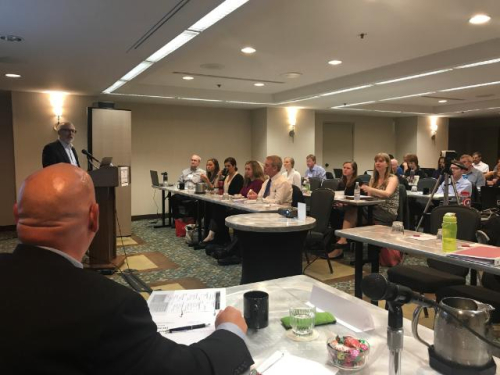
My thanks to Bart Freedman (K&L Gates) and Kinnon Williams (Inslee Best Doezie & Ryder) for asking me to speak on national takings and inverse condemnation issues at yesterday’s Eminent Domain conference in Seattle.

As you can see, the room was packed and standing room only. Here are the cases and issues I mentioned during my talk, “National Takings Trends, Hot Practice Areas, and Property Rights in the Age of Trump:”


Continue Reading Cases And Links From Washington Eminent Domain Conference

Do you really need an excuse to visit Seattle? If you do, and want to earn some CLE credit while you’re at it, check it out the brochure for the upcoming Eminent Domain seminar on May 18, 2017. This is a one-day program that focuses on the hot topics in our area of law. We’ll be speaking about “Changes in National Public Policy” and the latest developments in eminent domain and takings law. 

Agenda and full registration information here

Come, join us. 

7th Annual Eminent Domain Seminar, Seattle, Washington, May 18, 2017 

Continue Reading Seattle Eminent Domain Conference, May 18, 2017

Under Nebraska law, Natural Resource Districts possess the power of eminent domain, delegated to them by the state legislature. The question in Estermann v. Bose, No. S-15-1022 (Apr. 7, 2017) was whether four of those NRD’s could, in turn, re-delegate that power to a new agency which they jointly formed under the Interlocal Cooperation Act, a Nebraska statute which allows such things.

This new agency — the only-could-be-named-by-government “N-CORPE” (Nebraska Cooperative Republican Platte Enhancement) — was formed to regulate and manage water to comply with the Republican River Compact. Part of its duties included a “stream flow augmentation project” to manage ground and surface water, a portion of which required it to institute condemnation proceedings to take a portion of Estermann’s land for a flowage easement.

In a separate lawsuit, Estermann sued, seeking an injunction prohibiting the taking because N-CORPE did not possess the power of eminent domain.

Continue Reading Nebraska: OK To Delegate Eminent Domain Power From Natural Resource Districts To Join Agency

When most jurisdictions reacted to the U.S. Supreme Court’s decision in Kelo v. City of New London, 545 U.S 469 (2005), they — naturally being aghast at the result — adopted legislation that either purported to make it easier on landowners, or harder on condemnors. Understandable, as the public uproar which Kelo caused has yet to settle down completely even a decade later.

But not Louisiana. Oh no, that state’s legislature apparently decided that Kelo was a good opportunity to make it harder for a property owner to recover compensation. We’re not even going to pretend to understand all that is going on in South Lafourche Levee District v. Jarreau, No. 2016-C-0788 (Mar. 31, 2017),  with its differences between “expropriation” and “appropriation,” compensation measured by “full extent of the loss” versus merely “just compensation,” and the like. Louisiana, after all, can be a whole ‘nother brand of law, sometimes.

Continue Reading La: “Something is wrong” – Post-Kelo Amendments Reduced Compensation For Levee Servitudes From “Full Extent Of The Loss” To Fair Market Value

IMG_20170323_095056

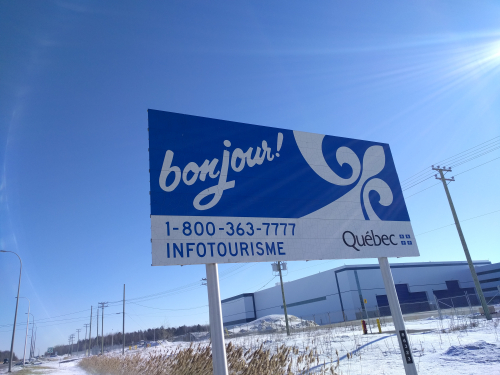
We were in the neighborhood recently, so our Canadian colleague Shane Rayman suggested we pay a visit to the site of the largest expropriation (taking) of land in that country’s history, and what has been described as “the largest population displacement … since the 18th-century expulsion of the Acadians from the Maritimes.” 

We’re talking about Montreal’s Mirabel International Airport, located about an hour north of the city.

You’ve flown into Montreal and don’t know this airport, you say? Well, here’s the (short) story and some pictures. For the longer tale, start with the wikipedia entry, the hit up these news reports:

In the 1960’s, Montreal was booming. It was Canada’s

Continue Reading “A Total Disaster From Start To Finish” – Expropriation And Economic Development, Canadian Style