There’s a lot of pages in the Pennsylvania Supreme Court’s opinion (and two concurring opinions) in Robinson Township v. Commonwealth of Pennsylvania, No. J-34A-2016 (Sep. 28, 2016), and the good stuff from the headline starts on page 78. But to understand the case, you need a bit of background.

Pennsylvania has been one of the hotbeds of property owner objections to natural gas (including the related fracking extraction method) and other pipeline projects, and this case was a lawsuit by several townships and municipal officials challenging a state statute which made fracking and eminent domain easier for the gas companies. The townships asserted this went beyond what the state legislature had the power to allow, because it was “special legislation” designed to help a particular industry, and not applicable to all, and allowed an unconstitutional taking of private property for private use. The court held the statute was special
Continue Reading Pennsylvania Supreme Court: Delegation Of Eminent Domain Power To Pipeline Companies Violates Fifth Amendment’s Public Use Clause

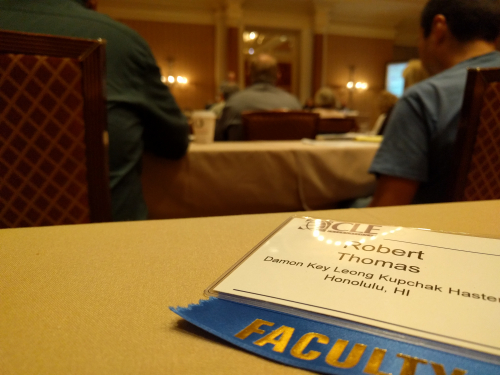
 IMG_20160929_102807
During. Good crowd.

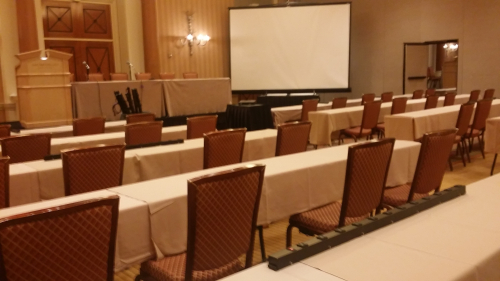
20160929_074511
Before. Note the power strips on the tables.
Well played, Caesar’s, well played
.

To supplement your written materials, here are the decisions and other materials which we spoke about this morning at the CLE International Eminent Domain seminar:


Continue Reading Links And Notes From Today’s Las Vegas Eminent Domain Seminar

2016 BrighamKanner Property Rights Conference Program_Page_01

As we noted here, this year’s Brigham-Kanner Property Rights Conference honoring Hernando de Soto will to be held in The Hague, Netherlands, at the International Court of Justice on October 19-21, 2016.

To push out word, the Owners’ Counsel of America kindly produced a press release announcing our participation in two of the panel discussions, “Property’s Role in the Fundamental Political Structure of Nations,” and “Defining and Protecting Property Rights in Intangible Assets.” 

We mention it here only to note, as this post’s headline states, this may be the only press release (ever?) to mention Hugo Grotius. Left unanswered: how to pronounce “Grotius.”

“I am honored to have been invited to speak at the Brigham-Kanner Conference, especially when the Conference is honoring Hernando de Soto, whose work on property rights has had such international influence,” said Thomas. “I’m also glad the Conference will be held at

Continue Reading Maybe The Only Press Release Ever To Cite Hugo Grotius

Eminent Domain Las Vegas print brochure--final - Copy

Do you really need an excuse to visit Las Vegas in the interregnum between its brutally hot summers and the winter high season? Probably not.

But if so, here’s your opportunity. Plus, you can earn CLE credit.

CLE International is putting on “Eminent Domain 2016: Current and Emerging Issues for Litigators” at Caesar’s Palace, September 29-30, 2016.

The Planning Chairs for the program, our colleagues Darius Dynkowski, Autumn Waters, and Kermitt Waters, have assembled a great lineup of topics and speakers, including panels on highway projects, power lines, pipeline takings, and municipal takeovers of local utilities. As if to prove the “international” part of its name, the program will also include a session on “Injurious Affection and the Canadian Approach to Damages for Partial Takings” presented by our Toronto colleague Shane RaymanWe’ll kick off the conference, speaking about “Eminent Domain

Continue Reading Eminent Domain Conference, Las Vegas (September 29-30, 2016)

Check this out, a follow-up to our earlier post about the Texas Supreme Court opinion in which the property owner pushed back against a taking of a part of his ranch by a water district by forming his own water district, thus creating a situation where one governmental entity was trying to take another governmental entity’s property by eminent domain. And you know what that means: a “superior public use” issue. Created from whole cloth. As we wrote, “bravo, Sir!”

The Texas Supreme Court held that in these cases, the trial court needs to first resolve the immunity issue, before it gets to valuation. An entirely sensible approach, in our outside-looking-in perspective. 

Read more about that case and the property owner in this article from D Magazine, the city mag of (you guessed it) Dallas-Fort Worth: “A Gentleman Rancher’s Guide to Fighting Tarrant Regional Water District.” Like

Continue Reading Southern Fried Takings: “A Gentleman Rancher’s Guide to Fighting Tarrant Regional Water District”

2016 BrighamKanner Property Rights Conference Program_Page_01

As we mentioned a few weeks ago, the final agenda for the 2016 Brigham-Kanner Property Rights Conference has been released. Here’s the complete conference brochure, which has all the details, including registration information. 

This is the annual program, sponsored by the William and Mary Law School, in which there’s a day-long discussion of all things property rights among members of the academy, the bench, and the practicing bar. The Brigham-Kanner Prize is also presented “to an individual whose work has advanced the cause of property rights and has contributed to the overall awareness of the important role property rights occupy in the broader scheme of individual liberty.” The pantheon of prizewinners is a who’s-who in our area of law: Richard Epstein, James Ely, Michael Berger, Frank Michelman, Carol Rose, and Thomas Merrill, to name a few. Here’s the complete list of prizewinners

This year, the prize is being

Continue Reading Property Rights Take Center Stage At The World Court: 2016 Brigham-Kanner Conference, October 19-21, 2016, The Hague

In City of Missoula v Mountain Water Co., No. DA-15-0365 (Aug. 2, 2016), a sharply divided Montana Supreme Court upheld the City of Missoula’s exercise of eminent domain to take a private water system. We’ve been following the case (see our oral argument notes here). The court’s majority concluded that the takings clause of the Montana Constitution isn’t really any impediment to a government takeover of property, even when it will use the property in exactly the same way as the former owner. 

The court addressed eight issues, with issues 6-8 being the most interesting to us, because they consider the meaning of the phrase “more necessary public use” in Montana Code Annotated § 70-30-111, and and what kind of proof is necessary to support such a claim. The city of Missoula is condemning Mountain Water Company, a private company which supplies municipal water to the city. The company (and its

Continue Reading City Can Take Over Water Company: Montana Supreme Court Writes Out “More” From The “More Necessary” Statute

Last year, we posted about the Brigham-Kanner Conference, the annual meeting at William and Mary Law School where we talk all things property rights and award the Brigham-Kanner Property Rights Prize. (By the way, this year’s conference will be held in The Hague, The Netherlands in October. But more on that soon, in a separate post.)

What we are posting today is a follow-up about Mike Berger’s presentation at the 2015 conference. His article — then only in draft form — is a critique of the theories of the 2015 Brigham-Kanner prizewinner, Harvard lawprof Joseph Singer. Recall that Berger was presented with the prize in 2014 — the first and thus far only practitioner to receive the award — which makes this article even more important.  

Berger’s article is now finalized, and has been published by the Brigham-Kanner Property Rights Conference Journal: “Property, Democracy, &

Continue Reading Must Read: Michael Berger On “Property, Democracy, & The Constitution”

We’re meeting some deadlines today, so we don’t have much time to digest in detail the closely split decision by the Pennsylvania Commonwealth Court in In re Condemnation by Sunoco Pipeline, L.P., No. 1979 C.D. 2015 (July 14, 2016). 

The short story is that the majority upheld the power of Sunoco to take private property for a natural gas pipeline against challenges that Sunoco lacked the power to condemn, was not a public PUC-regulated utility, and that the pipeline is interstate and not intrastate. 

The court rejected the property owners’ arguments that Sunoco’s pipeline is interstate, and because the Pa PUC can only regulate intrastate commerce, the pipeline takings are not for public use. Yes, the pipeline itself goes through Ohio and West Virginia, in addition to Pennsylvania, but originally, there were no Pennsylvania “offramps” on the pipeline, and Sunoco’s plans initially were for interstate service only. But after

Continue Reading The Polar Vortex Made Us Do It: Pa Appeals Court Approves Pipeline Taking

20160529_124542

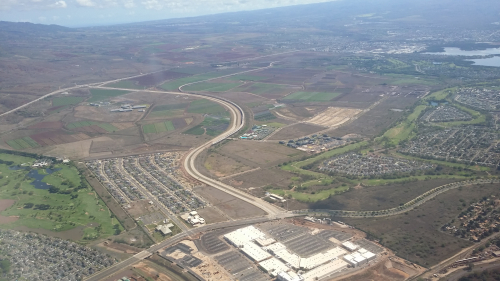
As we noted last week, the expanding costs of the Honolulu Rail project has forced Honolulu’s mayor to ask whether construction should be delayed or stopped entirely, short of its planned terminus at Ala Moana shopping center. “Middle Street” became the new rail watchword, even though stopping it there would omit — temporarily or permanently — the most densely populated, and therefore the most useful, portion of the route. 

Middle Street is somewhat of a nondescript, dare we say it, “blah” street; more of a demarcation between the airport area and the more industrialized Dillingham corridor. A place you generally go by on your way elsewhere, not consider a destination. Frankly, it doesn’t have much of a reputation for anything exciting. In our minds, it is most notable as the border between “town” and “country,” at least psychically. 

  • Civil Beat‘s Chad Blair, however, sees it differently. In a tongue-in-cheek


Continue Reading Rail: Building To The Nowhere Of Middle?