In In re: Condemnation by PPL Electric Utilities Corp., No. 1389 CD 2012 (Pa. Comm’w May 8, 2013), a Pennsylvania state appeals court held the condemnation of property by a utility for a right-of-way to reconstruct electric lines already existing on the land, needed the prior approval of the Public Utilities Commission. The utility had not sought the PUC’s approval because the the statute does not require approval when seeking to rebuild existing lines, and the utility asserted it only meant to do that (and not build new lines).

The declaration of taking, however, was worded much more broadly, and in addition to the rebuilding, also gave the utility the power to “‘construct, operate and maintain … additional Electric Facilities of any type,'” as “‘from time to time [may] be necessary for the convenient transaction of the business of [PPL],’  including the right to erect new facilities, including

Continue Reading Pa Appellate Ct: Declaration Controls In Eminent Domain, Not Professed Intent

We generally don’t cover unpublished decisions, but since we’re adding this case to our “to watch” list, we’re making an exception. In 62-64 Main Street, LLC v. Mayor and Council of the City of Hackensack, No. A-3257-11T4 (N.J. Super. May 3, 2013), the Appellate Division of the New Jersey Superior Court held that “the trial judge and the City misapplied our Supreme Court’s decision in Gallenthin Realty Development, Inc. v. Borough of Paulsboro, 191 N.J. 344 (2007),” when it concluded that the taking of property for redevelopment was supported by a blight finding. The appellate court concluded that the city had not made a factual showing that the properties it wishes to take are in an actual state of “deterioration or stagnation that negatively affects surrounding areas.”

Under the Gallenthin decision, New Jersey courts — unlike the courts in many other states — are not mere rubber

Continue Reading NJ App: No Blight Proven In Redevelopment Taking

Cle-logoFor those of you attending the Virginia Eminent Domain Conference, here’s the expanded papers on “Tough Takings Questions: Regulatory Takings, Zoning Issues and Judicial Takings” and Public Use issues.

Use the password provided at the conference to open the pdf’s. It’s the same p/w for both. If you forgot the password, email me.

For those who did not attend, sorry folks, there are some benefits to coming to a conference! Y’all are going to have to wait for a bit — after a decent interval to allow the attendees to get their money’s worth, we’ll remove the password.

For more about the cases and books we discussed yesterday during my presentation on “Virginia’s Place in National Eminent Domain Trends, check these out:

  • Lingle v. Chevron, U.S.A., Inc., 544 U.S. 528 (2005) (gas station rent control, and the demise of the “substantially advance” test as a takings test).

     
    Continue Reading Materials From Today’s Virginia Eminent Domain Conference

    When reading the Ninth Circuit’s latest foray into the regulatory takings doctrine which holds that a muncipal rent control ordinance did not qualify under Penn Central (MHC Financing Ltd P’ship v. City of San Rafael, No. 07-15983 (Apr. 17, 2013), we were reminded of the opening line in Andy Williams’ signature tune “Love Story” —

    Where do I begin …”

    But before we begin, two preliminary thoughts. First, the district court’s decision finding that San Rafael’s mobile home rent control ordinance worked a taking of the mobilehome park owner’s property because it reduced the value by more than 80% was not some one-off aberration by a conservative district judge out on a lark. No, the decision was by the now-retired Vaughn R. Walker, the same judge who invalidated California’s Proposition 8 in one of the same-sex marriage cases currently before the Supreme Court.

    Continue Reading The Ninth Circuit Botches Regulatory Takings Again

    When the cert petition was filed in Ilagan v. Ungacta, No. 12-723 (cert. petition filed Dec. 7, 2012), we wrote that the case seemed like a good vehicle for the U.S. Supreme Court to revisit the pretext-in-eminent-domain issue it teased us with in Kelo, especially the part about the taking being part of a “comprehensive” eminent domain plan.

    The facts of the case were egregious. The Guam Supreme Court’s opinion reversed the trial court’s conclusion that the taking was unconstitutional. The Guam Government refused to appeal, leaving only the benefitted private party arguing the taking was valid. The petition was well done and highlighted the lower court split in authority. When the respondent waived a reponse, the Court requested one. The petition was supported with an amici brief authored by lawprof Ilya Somin, a noted scholar on public use issues and joined by other legal

    Continue Reading Sorry, Property Owners. Supreme Court Just Not That Into You

    Film critic Roger Ebert, whose death was announced yesterday, was a huge fan of our favorite eminent domain movie, Australia’s The Castle. Not so much a fan in the four-star-auteur-director-Fellini-Malick-Herzog mode, but a fan in the sense that when it came time for programming for his personal film festival and others, he selected it more than once and dubbed it “the funniest film in the history of Ebertfest.”

    And so life spins along at 3 Highview Crescent in Melbourne, where the Kerrigan home sits surrounded by its built-on rooms, screened-in porch, greyhound kennel, big-dish satellite and carport. For Darryl, it is not so much a house as a shrine to one of the best darn families in the universe, and he proudly points out the plastic Victorian gingerbread trim and the fake chimney to an inspector–who is there, as it turns out, to condemn the property under

    Continue Reading Ebert On “The Castle”

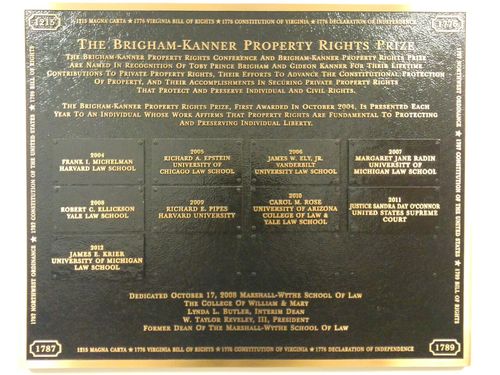
    IMG_20121012_135714

    William & Mary Law School, host of the annual Brigham-Kanner Property Rights Conference, has announced that Columbia Law School Professor Thomas W. Merrill will receive the 2013 B-K Prize at the conference (October 17-18, 2013, Williamsburg, Virginia). The photo above is of the plaque on the wall at the William & Mary Law School listing B-K Prize winners.

    The Conference agenda and speakers have yet to be finalized, but here’s the tentative list of topics:

    • The Impact of a Leading Property Scholar: Defining the Essence of Property
    • Promoting Government Forbearance
    • The Implications of the Court’s Recent Takings Cases
    • Property Rights in Times of Transition

    We spoke at the 2012 Conference in Williamsburg, and attended the 2011 Conference in Beijing. The 2013 lineup sounds pretty good, so mark your calendars. Continue Reading 2013 Brigham-Kanner Property Rights Prize: Professor Thomas Merrill

    Here’s what’s on our reading list today:

    • Here’s the latest chapter in the saga of one Fane Lozman, whose titling at windmills got some Supreme Court love recently when the Court held that his floating home was not a “vessel” under admiralty law, and a Florida city was wrong to seize it. My Damon Key colleague Mark Murakami reports on the 11th Circuit’s recent ruling in Lozman’s related federalcivil rights case. Houseboat Redux – Eleventh Circuit Reinstates Lawsuit (via Hawaiioceanlaw.com). 


    Continue Reading Wednesday Round-Up: Houseboat Redux, Backtracking Post-Kelo, Arkansas Game Remand, Big Gulps

    Here’s the Reply Brief in Ilagan v. Ungacta, No. 12-723 (cert. petition filed Dec. 7, 2012), the case in which the Court is considering whether to review the Guam Supreme Court’s opinion applying Kelo v. City of New London, 545 U.S. 469 (2005) to reverse a trial court decision invalidating a taking. 

    The reply brief responds to the Brief in Opposition‘s argument that the taking of the Ilagan property did not violate the Public Use Clause because it was accomplished under the auspices of the Agana Plan:

    Most notably, the Opposition does not dispute the evidence showing the private character of the transfer of the Petitioners’ (Ilagans) land to their neighbors, the Ungactas. To be precise, the Opposition does not deny: (1) that the taking of the Ilagans’ land was initiated and funded by the Ungactas; (2) that the Unguctas are politically connected, with Respondent Felix Ungacta

    Continue Reading Reply Brief In Eminent Domain Pretext Case: If The Government Won’t Even Defend The Taking … It Might Be A Private Condemnation

    Here’s the Brief in Opposition which responds to the cert petition in Ilagan v. Ungacta, No. 12-723 (cert. petition filed Dec. 7, 2012).

    In that case, an Agana, Guam property owner is alleging that a taking of his residential property so that his neighbor (the former mayor of Agana) could have a driveway for his lot, violated the Public Use Clause. Of course, the taking was not justified by private necessity but as part of the “Agana Plan,” an economic development plan adopted following World War II to reconfigure irregular lot lines in the city. The Guam trial court invalidated the taking, but the Guam Supreme Court unanimously reversed, holding that under Kelo v. City of New London, 545 U.S. 469 (2005), the taking was for a public use.

    Disclosure: we represent the Owners’ Counsel of America, which has joined an amici brief supporting the property owner/petitioner

    Continue Reading BIO In Eminent Domain Pretext Case: Redevelopment Plan Established “Order Out Of Chaos”