Update: More thoughts on the apology from Gideon Kanner , the Queens, NY-based property owners’ blog Willits Point United, and from eminent domain scholar lawprof Ilya Somin.

++++++++++++++++++++++++++++++++++++++++++++++++++++++++++++++++++

Comes word from Jeff Benedict, author of the Kelo book Little Pink House, via his blog and a story in the Hartford Courant, that one of the Connecticut Supreme Court justices who voted in favor of the government approached Mrs. Kelo last year at an event and apologized for ruling against her. 

After she told her story, he came up and said, “[h]ad I known all of what you just told us, I would have voted differently.”

Recall that the Connecticut Supreme Court ruled 5-4 that the “economic development” taking of the homes of Mrs. Kelo and her neighbors passed muster under the Connecticut and U.S. Constitutions, overturning the trial court’s post-trial judgment that the takings were invalid

Continue Reading Too Soon Old And Too Late Smart: A Jurist Offers His Kelo Mea Culpa

Not hardly. Just check out the amici supporting her (NAACP, Jane Jacobs, et al.).

To drive the point home that many of the property owners on the business end of eminent domain are those who lack political power and influence, check out this brief filed on behalf of New York state Senator Bill Perkins in the Columbia/Tuck-it-Away case, where he argues that “blight removal” and “economic development” takings “disproportionately impact already marginalized groups, including tenants, the elderly, persons of low-income, and racial and ethnic minorities.” Br. at 7.

A post on a blog at Forbes, Liberals Should Be Upset by the Kelo Case makes the point well.Continue Reading Is Kelo A “Conservative” Issue?

Thanks to the Rocky Mountain Appellate Blog for pointing out the Colorado Supreme Court’s recent opinion in The Glenelk Ass’n, Inc. v. Lewis, No. 10SC275 (Sep. 12, 2011), an important decision about the standard of proof in private-way-of-necessity condemnations. The court concluded that a property owner who claimed to be “landlocked” could not condemn a private access corridor over a neighbor’s land without proof of a “concrete development proposal” showing that the access corridor is necessary.

Lewis owned a 334 acre ag-zoned parcel, and had the right to build one dwelling per 10 acres. Other access options were apparently not feasible, so Lewis and his neighbor Glenelk negotiated for purchase of an easement but failed to reach an agreement. Under Colorado law (like the law of many other jurisdictions) one private landowner may institute a condemnation action against a neighbor if necessary to gain access to a landlocked parcel

Continue Reading Colorado: Private Condemnor Must Prove Present Necessity

Little-pink-house

As we noted earlier, Little Pink House, Jeff Benedict’s book about the Kelo v. City of New London case, looks like it is going to become a TV movie. Mr. Benedict writes:

On Monday my publisher will officially announce that Lifetime is making a movie based on Little Pink House, and Brooke Shields, who is currently on Broadway playing Morticia in The Adams Family, will star in the film as Susette Kelo.

Congratulations, Jeff … but come on Hollywood: even though you disregarded our choice for the lead role, there’s still time to cast the supporting players!

Discover more of the backstory on how he came to write the book, and how Ms. Kelo’s story will transition from the page to the screen here. Continue Reading The Kelo Story Coming Soon To The Screen

Worth reading: “Six Years of Separation: Life After Kelo” by Ethan Friedman, posted on Miller Starr’s web site. Mr. Friedman writes about the state of affairs in eminent domain at the macro level, noting the reactions in state legislatures and the US House of Representatives’ current consideration of the “Private Property Rights Protection Act of 2011.” (You might think that having express protection for private property rights in both the Fifth and Fourteenth Amendments might be sufficient, but apparently Congress thinks we need a statute.)

The article also references our pending cert petition in County of Hawaii v. C&J Coupe Family Ltd. P’ship, No. 11-75 (filed July 14, 2011):

However, the Supreme Court had a vastly different makeup in 2005 than it does today. The new Supreme Court, with Justices Alito, Roberts and Sotomayor, and without Justices Stevens, Breyer and O’Connor, was recently asked to consider a

Continue Reading “Life After Kelo” – A Summary Of the Current State Of Eminent Domain Policy

Thanks to the good folks at Volokh and Gideon’s Trumpet for alerting us to the Texas Supreme Court’s opinion in a case we’ve been following, but somehow slipped by, Texas Rice Land Partners, Ltd. v. Denbury Green Pipeline-Texas, LLC, No. 09-0901 (April 19, 2011).

Texas, like many other states, delegates the power of eminent domain to certain utlilities (Hawaii even delegates the power to “irrigation corporations”). Under a Texas statute, Tex. Nat. Res. Code § 111.002, a pipline company may take property to transport carbon dioxide “to or for the public for hire.” A dispute arose between a property owner and a pipeline company when the owner objected to the taking of its property for a pipeline, claiming that there was no evidence that the pipeline would be used by the public to transport CO2. The pipeline company asserted it met the definition of “common carrier”

Continue Reading Texas: “Common Carrier” Claim Subject To Actual Judicial Review

Today, we filed the Reply Brief (also available below) in the case that asks: after Kelo, when is eminent domain pretextual? 

Last month, we filed a cert petition asking the Supreme Court to review the Hawaii Supreme Court’s decision in County of Hawaii v. C&J Coupe Family Ltd. P’ship, 242 P.3d 1136 (Haw. 2010). In that case, the Hawaii court upheld the taking of land on the Big Island, holding that the asserted public use was not a pretext to the overwhelming private benefit to the developer of the luxury Hokulia project.

On August 17, 2011, the developer and the County filed their joint brief in opposition. Our brief responds:

After reviewing the Oceanside/County brief, it would be easy to forget why this case is here: they argue the Hawaii Supreme Court correctly applied the rational basis standard for pretext established in Kelo v. City of

Continue Reading Final Cert Brief In Eminent Domain Pretext Case

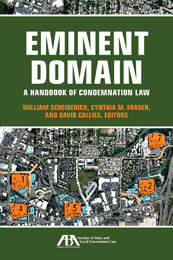
5330215_big The American Bar Association’s Section of State & Local Government Law has just published a new book on eminent domain fundamentals: Eminent Domain – A Handbook of Condemnation Law (available for preorder here).

I was privileged to author two chapters (Prelitigation Process and Flooding & Erosion), and my Damon Key colleagues Mark Murakami and Christi-Anne Kudo Chock co-authored the chapter Damages Resulting from a Taking: An Overview.   

The price is $89.95 with the price of $69.95 for members of the Section of State and Local Government Law (discounts on books and CLE: another good reason to join the Section). There are also discounts for purchase of multiple copies. More details here.

Here’s what the book offers, from the Introduction by my colleague Dan Dalton:

Eminent domain has a long and distinguished legal history, dating from the first limits on sovereign power in the Magna

Continue Reading New Book: Eminent Domain – A Handbook of Condemnation Law (ABA 2011)

Battle for Brooklyn film posterWe reviewed the docfilm Battle for Brooklyn after it made its public debut a few months ago (the filmmakers presented a rough cut preview at the annual ALI-ABA eminent domain program), and we recommended it. We even sat down for a few minutes with director Michael Galinsky for a short interview.

Battle For Brooklyn made its premiere in Brooklyn, naturally, and it has been playing in the New York area on an extended run. Unfortunately, there’s only one print of the final film because prints are very expensive, about $7,500 apiece, so it has not been more widely shown. But for the next week, the film will be in Southern California at the Laemelle Theatre in Beverly Hills.

Those of you in the area really should check it out. Our colleagues at the California Eminent Domain Report agree (“If you’re in the right of way industry, this is a

Continue Reading “Battle For Brooklyn” Comes West