A quick one from the Arizona Supreme Court that isn’t so much a true takings case, but more like “takings adjacent.” In our view, it well illustrates the way that takings arguments can shape how statutes are interpreted, even if there isn’t a taking.

The case — Cao v. PFP Dorsey Investments, LLC, No. CV-22-0228-PR (Mar. 22, 2024) — was shaping up to be more in our area of operations because the Arizona Supreme Court granted review to decide this question (and others):

Either on its face or as applied in this case, does A.R.S. § 33-1228 authorize the taking of private property for private use in violation of Article 2, § 17 of the Arizona Constitution?

Seemed promising. The statute says that when property organized as a condominium regime decides to wind up and abandon the condominium format, the condo association shall sell “all the common elements and

Continue Reading Condo Forced-Sale Statute Is Not A Taking Because It Does Not Allow Picking Off Individual Units, But Requires Sale Of Entire Condo

Here’s what we’re reading today:


Continue Reading Thursday Round Up: Pretextual Takings, Squatting, Unconstitutional Conditions

Under many (most?) state eminent domain schemes, if a property owner withdraws the condemnor’s deposit prior to the judgment of condemnation, the owner waives — or, more technically, forfeits — the ability to challenge public use and necessity. 

Vermont is no different, and under its statute, waiver is triggered by the owner’s “acceptance and use” of a payment:

Except in the case of agreed compensation, an owner’s acceptance and use of a payment under this section does not affect his or her right to contest or appeal damages under sections 511-513 of this chapter but shall bar the owner’s right to contest necessity and public purpose.

19 Vt. Stat. Ann. § 506(c).

The Vermont Agency of Transportation was doing one of those interstate interchange reconstruction projects, and needed some nearby property. After some procedural wrangling about which property owners need to be included in the case, it sent the

Continue Reading Vermont: It Doesn’t Matter If Property Owner Realizes That Cashing A Check For Estimated Compensation Waives Public Use Challenge

The New York Supreme Court Appellate Division’s opinion in HBC Victor LLC v. Town of Victor, No. 23-01347 (Mar. 22, 2024) marks the second time the issue of whether the Town can seize HBC’s property by eminent domain.

The first time out the court shot down the taking, concluding that it lacked a valid public use because the Town did not have a present plan for the property and the resolution of taking did not specify the present purpose other than “redevelopment.” And that isn’t enough.

As you know, that doesn’t mean the end of the line when it comes to eminent domain. As we often used to counsel clients when we did this stuff, beating back a taking on public use grounds just educates the condemnor about the shortcomings. Unlike other civil litigation, there’s no res judicata (sorry kids, that’s what we still call it) in eminent domain

Continue Reading NY App Div: Yes, We Previously Said This Taking Wasn’t For A Public Use, But Now The Condemnor Has A Plan

In Brinkmann v. Town of Southold, No. 22-2722 (Mar. 13, 2024), the U.S. Court of Appeals for the Second Circuit addressed a longstanding issue left unresolved by the Supreme Court in Kelo v. City of New London, 545 U.S. 469 (2005): is it enough that a condemnor’s professed use qualifies as a public use, or may a property owner nonetheless challenge a taking on the grounds that the real reason for the taking is not a public use?

Yes, the “pretext” issue is back!

The facts of the case are pretty straightforward. The Brinkmanns wanted to build a big box hardware store on a 1.7 acre vacant parcel. The usual objections from area residents and the Town itself appeared (you know the drill): a store like this would result in too much additional traffic (traffic study said no), special permits and impact studies are needed (the owners began

Continue Reading It’s OK To Do Good Things For Bad Reasons: CA2 On Spite Takings – As Long As Taking Is For A Public Use, The Real Reason Is Irrelevant

ALI-CLE brochure cover page

When it comes to the longstanding ALI-CLE American Law Institute-CLE Eminent Domain and Land Valuation Litigation Conferences, we’re always ready to go. You know that. But this year’s version — the 41st — was buzzing like no other in recent memory.

Maybe it was the New Orleans venue with its atmo, food, and music for our after-class activities, or even the timing (the second-to-last week on the Mardi Gras parade season, and our conference hotel was right on the routes). It might have been the nice weather (oh, it rained buckets one evening, but there wasn’t an ice storm like we experienced in Austin in 2023). Or maybe it was the capacity crowd, and new topics and speakers on the agenda. Or maybe it was just the prospect of seeing our friends and colleagues again after a year.

Here’s a photo essay of some of the Conference highlights.

And

Continue Reading Pass A Good Time: Our Report From The 41st ALI-CLE Eminent Domain & Land Valuation Litigation Conference, Feb 1-3, 2024, New Orleans

NCSCT
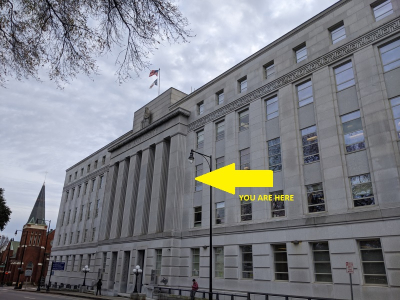
The historic Supreme Court of North Carolina.

Here’s the latest in a somewhat strange case we’ve been following about what happens after a court determines that a taking lacks a public use — but the condemnor goes ahead and just seizes the property anyway.

The Town of Apex, North Carolina, sought to take an easement across Rubin’s land. She objected, asserting the taking was not for a public use or purpose, but rather to benefit a private party: a developer who needed the easement to connect two of his non-contiguous parcels to the municipal sewer system, a precondition of the Town’s development approvals for his proposed residential subdivisions.

While Rubin’s public use objection was pending, the Town went ahead at installed the sewer line, purportedly under its quick-take power. That was not the best of moves, however, because the courts eventually agreed with Rubin that the taking violated the public

Continue Reading The Public Use Requirement Is Self-Executing: “In a free society, we should not expect that when a court tells the government that a taking is illegal and unconstitutional, that it would just go ahead and seize the property anyway.”

Don’t miss out!

We promise: this is the last time we’re going to try to entice you to the upcoming ALI-CLE Eminent Domain & Land Valuation Litigation Conference in New Orleans. We are getting close to capacity, but there is still room. In recent years, we have standing room only in the Conference halls, and have sold out the hotel block. After all, this is a pretty niche area of law. So what gives?

When we were in Austin last year, we thought it might be nice to try and answer that question. We asked Conference participants why they come, year-after-year (and in Austin, despite massive travel disruptions). Yes, it is the various venues (Nashville, Austin, Scottsdale, Palm Springs, to name a few recent locations), and yes, it is the excellent and useful programming.

But as we suspected it is more than that.

Continue Reading No FOMO: There’s Still Room For You To Join Us In New Orleans Feb 1-3, 2024 For The 41st ALI-CLE Eminent Domain & Land Valuation Litigation Conference

Here are the cases that Michael Berger and I discussed in today’s presentation to the ABA State and Local Government Law Section’s Land Use group. It was good seeing everyone, even virtually:


Continue Reading Cases And Links From Today’s ABA State & Local Govt Law Land Use Presentation

PXL_20231202_194330453.PORTRAIT

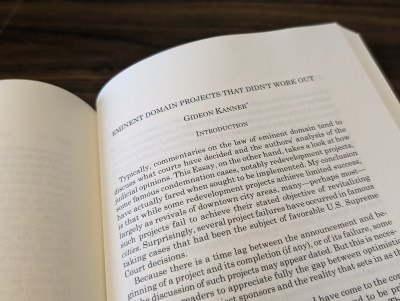
Here it is — Professor Gideon Kanner’s final law journal article, published shortly before his passing:

Gideon Kanner, Eminent Domain Projects That Didn’t Work Out, 12 Brigham-Kanner Prop. Rts. J. 171 (2023).

Appropriately, we think, published in William and Mary Law School’s Brigham-Kanner Property Rights Journal, named in part in Gideon’s honor.

This isn’t a typical law journal article, but an essay collecting Professor Kanner’s thoughts, comments, and (best of all) opinions on, well, eminent domain (and redevelopment) projects that didn’t work out.

In Gideon’s own words, from the Introduction:

But whether you favor widespread use of eminent domain or not, and whether the projects created by its use are sound or not, it is deplorable that the power of eminent domain has been often deployed to the detriment of racial and politically powerless minorities. Typically, redevelopment projects tend to displace middle class and poor people from

Continue Reading Professor Kanner’s Final Article: “Eminent Domain Projects That Didn’t Work Out,” 12 Brigham-Kanner Prop. Rts. J. 171 (2023)