


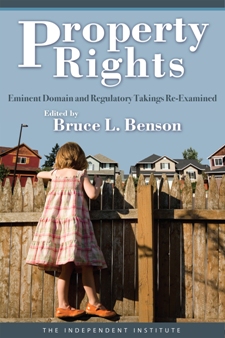
Property_1800 I recently picked up a copy of Property Rights – Eminent Domain and Regulatory Takings Re-Examined (Bruce L. Benson, ed., Independent Institute 2010), available on-line here.

At 299 pages and with 13 entries, I haven’t had a chance to read the whole thing yet. But after an initial skim, a few of the chapters stand out: Steven Eagle on Assembling Land for Urban Development – The Case for Owner Participation, Ilya Somin on The Limits of Backlash – Assessing the Political Response to Kelo, and Scott Bullock on The Inadequacy of the Planning Process for Protecting Property Owners From the Abuse of Eminent Domain for Private Development

We will post more as we get further into the book, but for now, here’s the publisher’s summary: 

The U.S. Supreme Court decision, Kelo v. New London, has become a dramatic focal point for the broad use of eminent

Continue Reading New Book: Property Rights – Eminent Domain and Regulatory Takings Re-Examined (2010)

We have no idea what these cases might be about, or whether there is any substance behind the property owners’ objections, but these are headlines no condemnor could possibly like:

  • Bedford County Widow Sued (via wjactv.com) – “A Bedford County widow is being sued for trying to keep Columbia Gas Transmission off her property. The Texas-based company is using eminent domain to gain access to 67-year-old Mary Ellen McConnell’s 125-acre farm.”
  • Granny Vows To Fight For House (via wyff4.com) – “On the other side of Stenhouse Rd, 85-year-old Juanita Sullivan worries about eminent domain.”

Might as well say they’re trying to take property from cute, fluffy kittens.


Continue Reading Headlines No Condemnor Likes To See

Two unreported opinions arising out of cases from New Jersey. We won’t be reviewing them  (they are not precedential after all), but you may want to check them out if you are interested in public use and redevelopment (case #1), or inverse condemnation by permit denial (case #2):

  • RLR Investments, LLC v. Town of Kearny, No 09-3100 (3d Cir., July 2, 2010) (“This appeal is centered on the “public use” requirement for the governmental taking of private property. The appeal presents a number of overlapping and interrelated claims set out in a ten count complaint. We conclude that the District Court’s judgment in favor of the governmental entry should be affirmed.”).


Continue Reading New Jersey Monday

Here are items we’re reading today, in no particular order:

  • Bill Ward’s thoughts on Klumpp v. City of Avalon, the recent New Jersey Supreme Court case about inverse condemnation and beach restoration. Our take here.


Continue Reading Wednesday Potpourri: Inverse Condemnation And Beaches, Rail Takings, And More “Adult-Oriented” Land Use

512n15x1gdl_ss500_

Here’s the latest development in the ongoing life imitating art saga of the the use of eminent domain to take property in St. Johannes Cemetery for the expansion of O’Hare airport.

Appellate court hears arguments in O’Hare cemetery case is a short news report about last week’s oral argument in the appeal by the “living relatives” from an Illinois state court’s judgment dismissing their claims.

Listen to the argument recording here (be warned if you aren’t streaming the file, it’s a massive 140mb mp3).

The issues, as framed by the living relatives, are two-fold: first, whether the religion-based claims were barred by res judicata, and second, whether the taking is for a public use. It’s often very difficult to discern the scope of the issues from oral argument, so we’re not sure what the specific questions presented are. Nonetheless, the argument is worth a listen. Continue Reading They Really Are Moving Father’s Grave To Build … An Airport

Today’s U.S. Supreme Court plurality opinion in the long-anticipated Second Amendment case, McDonald v. City of Chicago, No. 08-1521

In the late 19th century, the Court began to consider whether the Due Process Clause prohibits the States from infringing rights set out in the Bill of Rights. See Hurtado  v.  California, 110 U.S. 516 (1884) (due process does not require grand jury indictment);  Chicago, B. & Q. R. Co.  v.  Chicago, 166 U.S. 226 (1897) (due process prohibits States from taking of private property for public use without just compensation). Five features of the approach taken during the ensuing era should be noted. 

First, the Court viewed the due process question as entirely separate from the question whether a right was a privilege or immunity of national citizenship. See  Twining  v.  New Jersey  , 211 U. S. 78, 99 (1908) .

Second, the Court explained that the only

Continue Reading Takings, Guns, And Incorporation

Here’s a round-up of reports and analysis of yesterday’s opinion by the New York Court of Appeals in the “Columbia U. blight” case, Kaur v. New York State Urban Development Corp., No. 125:


Continue Reading Friday’s Columbia “Blight” Case (Kaur) Links

More on today’s opinion in the “Columbia U. blight” case, Kaur v. New York State Urban Development Corp., No. 125.

As we noted in our critique of the Atlantic Yards case (Goldstein), New York judges apparently are too “frightened and confused” by allegations that property is not truly “substandard or unsanitary,” so must defer to the agency’s finding:

The term “substandard or insanitary area” is defined as “a slum, blighted,  deteriorated or deteriorating area, or an area which has a blighting influence on  the surrounding area” (Uncons Laws § 6253 [12]). Here, the two reports prepared by ESDC consultants — consisting of a voluminous compilation of documents and photographs of property conditions — arrive at the conclusion that the area of the Project site is blighted. Just as in Matter of Goldstein, “all that is at issue is a reasonable difference of opinion as to whether

Continue Reading New York Still Has “Unfrozen Caveman Judges” Who Are “Frightened And Confused” By Eminent Domain Blight

The New York Court of Appeals today reversed the Columbia “blight” case, Kaur v. New York State Urban Development Corp., No. 125 (June 24, 2010). The unanimous opinion came swiftly (oral arguments were just under a month ago), suggesting it was not a close call for the court. Here’s the Appellate Division’s opinion.

We haven’t had time to digest it, and there certainly will be a round of analysis and opinion on the case, but here’s the introductory paragraph of the court’s opinion:

In this appeal, we are called upon to determine whether respondent’s exercise of its power of eminent domain to acquire petitioners’ property for the development of a new Columbia University campus was supported by a sufficient public use, benefit or purpose (see New York Const art I, § 7 [a]; Eminent Domain Procedure Law 207 [C] [4]). We answer this question in the affirmative

Continue Reading There Really Are No Limits To Eminent Domain In New York – Court Of Appeals Reverses The Columbia Case (Kaur)

The WMA Reporter, the monthly publication of the Western Manufactured Communities Housing Association has published A Regulatory Takings Glossary (or, How to Translate Property Rights Lawyerspeak), my short article that attempts to deconstruct some of the more common terms property lawyers toss about. Here’s the Introduction:

One of my law school professors once remarked (hopefully in jest) “if it ain’t Latin, it ain’t the law.” While thankfully we have moved away from the days when Latin and Norman French were the languages of the law, those of us who regularly represent property owners defending their rights sometimes toss about terms that, although they purport to be standard English, often make normal people look at us askance.

We may forget that not everyone might understand what we mean when we say, for example, “The court dismissed the regulatory takings claim on ripeness grounds under Williamson County because the

Continue Reading A Regulatory Takings Glossary (or, How to Translate Property Rights Lawyerspeak)