


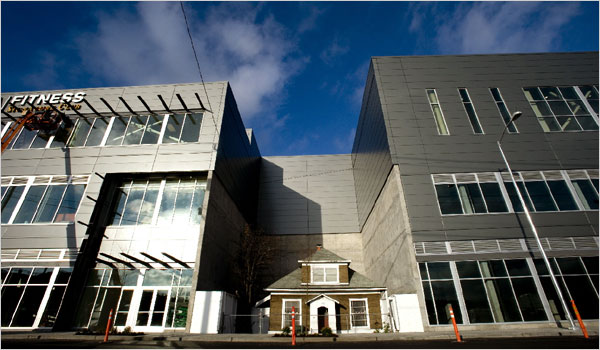
Holdout The New York Times posts a story, “House Stands as Legacy to Fight Against Developers,” about one woman’s refusal to sell her modest Seattle, Washington area home to a redeveloper, even when offered $1 million.  If a picture is worth a thousand words…

While the case is not like Kelo — or the fictional The Castle — in that the developers apparently did not attempt to get the government to take Edith Macefield’s property forcefully by eminent domain once she refused to sell, it does illustrate at least one of the reasons people may have for refusing, even where the offer is obviously well in excess of the home’s value:

Everybody that’s come in and tried to talk about this has tried tocreate that image of her,” said Mike Semandiris, whose family has owneda chili parlor around the corner for more than 70 years. “But shedidn’t give a

Continue Reading A Holdout

Given that Honolulu voters recently approved a $4B-plus rail system, an article from the San Francisco Chronicle about a new California law encouraging “local governments and builders to concentrate growth in urban areas orclose to public transportation hubs in an effort to reduceCalifornians’ use of cars and lower their greenhouse gas emissions” should be of some interest. In other words, development is “encouraged” in urban areas in “multifamily urban properties” (apartments).

One of the more interesting issues is whether people want to live in these areas, or whether — like so many other things such as mass transit — it is a case of “good for others, but not for me.” The article quotes the attorney for California Major Builders Council

“Our industry very much supports the goal of building morehigh-density projects in blighted areas, doing redevelopment andtransit-oriented developments,” he said. “There is a demand for thistype of development

Continue Reading New California Law: You Shall Live Near Transit

In reviewing some of the comments posted on the Honolulu Advertiser’s November 1 report  “Rail study doesn’t list all affected properties,” it seems several of the commenters have fairly severe misconceptions about how eminent domain law works in Hawaii. Let’s clear some up some myths.

  • Myth #1: The city will offer a “premium” to property owners whose homes, businesses and churches will need to be acquired, because the city will want their properties quickly. Wrong on two counts. First, the city does not need to offer a premium since Hawaii law has a procedure by which the city can take immediate possession of property it wants, “ex parte” (without notice to the landowner). Second, the city will only offer what it believes to be the amount legally required to be paid for “just compensation” and damage, not a penny more. Indeed, the citywill claim it is


Continue Reading Clearing Up Myths About Hawaii Eminent Domain Law and the Rail

On November 4, 2008, Honolulu voters are being asked to say yes or no to a proposed amendment to the Honolulu charter:

Shall the powers, duties, and functions of the city, through its director of transportation services, include establishment of a steel wheel on steel rail transit system?

A “yes” vote means that the proposed $4+ billion rail project is full steam ahead, while a “no” vote would, by all accounts, kill it. Resolution 08-166, CD1, which put the issue on the ballot, is available here.

If the voters approve of the project, it will be the largest public works development in Hawaii’s history, and will require the acquisition of private property, either by purchase or eminent domain. In this post, we discussed an earlier report in the Honolulu Advertiser, “189 Hawaii properties in transit’s path,” which detailed the proposed rail route and some of the

Continue Reading D-Day Draws Nigh For Honolulu Rail, Condemnations

Professor Kent Schooland has posted “Eminent Domain and the Eighth Commandment,” a piece with his thoughts about the morality of condemning property and the system of “just compensation.”

Given the realities of eminent domain, perhaps we should prepare our children with relevant civics lessons for the playground. Whena gang of kids wants to grab a pretty ring off the finger of a littlegirl, they can avoid annoying accusations of “theft” by following a fewsimple steps:

1) The gang must use the Latin words eminent domain, never “stealing.”

2) The gang must designate one of their members as leader—thus the “superior owner” of everything on the playground.

3)The gang leader must instruct his or her lieutenants to “tax” a fewcoins from other children on the playground in order to offer “justcompensation” to the girl when her ring is taken.

4)The gang leader must explain that his actions are for

Continue Reading The Fifth Amendment and the Eighth Commandment

In a story titled “Honolulu notifying landowners in way of planned rail route,” the Honolulu Advertiser reports “The city has started notifying residents living in the path of the planned $3.7 billion elevated commuter rail that all or part of their properties may be condemned.  The letters, which are being sent out in batches, don’t specify how much property may be needed along the 20-mile East Kapolei to Ala Moana route.” 

The proposed rail project, if it survives an initiative vote this November, is shaping up to the biggest public works and largest singular use of eminent domain in Hawaii’s history (I say “singlar,” since the Land Reform Act — the law challenged in Hawaii Hous. Auth. v. Midkiff, 467 U.S. 229 (1984) — might still be considered the largest use of eminent domain, but it was piecemeal).   I guess our December 2006 prediction of the “dear

Continue Reading Eminent Domain and the Holy Rail: “Dear Homeowner” Letters in the Mail?

Several items today with a common theme of eminent domain and public use –

  • PropertyProf Blog posts a link to Professor Richard Epstein’s latest article, “Public Use in a Post-Kelo World.”  I agree with Professor Barros’ recommendation: “Given the author, obviously a must-read for anyone interested in public use issues.”
  • The Honolulu Advertiser’s Sean Hao details the issues when takings for Honolulu’s proposed +$4B rail transit project runs into a unique “old Hawaii” neighborhood in “Pearl City’s Banana Patch at risk.”  A neighborhood without city water, street lights, or sidewalks (but a community nonetheless) is slated for removal for a “park and ride.”


Continue Reading Public Use/Kelo Round Up

right-of-way_land_condemnations

In “189 Hawaii properties in transit’s path,” the Honolulu Advertiser’s Sean Hao writes about the potential use of eminent domain to take private property along the path of Honolulu’s proposed $4B rail transit project:

Some landowners in the path of the new rail line, who may havelittle choice but to sell to the city, are not pleased with thepotential eviction and complain that the process so far has left themin the dark.

The city, which has budgeted $70 million to purchaseland needed to build the rail system, will offer property owners fairmarket value for their land based on an appraisal. That could provecontroversial as some owners challenge the appraised value.

The article notes that the City’s web site has listed these properties for more than a year, but the information is difficult to locate, so many of the owners were not aware their properties may be acquired.  The

Continue Reading Honolulu Rail Takings

Hawaii Public Radio has posted a five-part series ofreports on “Transit and Growth in Hawaii,” the third of which is themost interesting since it focuses on Honolulu’s proposed $4 billion+ railsystem.  Each of the segments, however, is worth a listen:

  • Part I – did 1970’s projections match up to reality?
  • Part II – gas prices and growth
  • Part III – the cost of rail, and who will pay
  • Part IV – the EIS
  • Part V – which technology will be employed?

In a similar vein, last year, UH Law professor David Callies, Honolulu attorney Vernon Woo, and I were guests on Jay Fidell’s KHPR program on the topic of Honolulu rail, and the development and land use issues sure to surround the project.  Audio of the show is available here.Continue Reading Hawaii Public Radio on Transit, Land Use, and Growth (mp3)