Our thanks to Clint Schumacher for having us on his program to talk about the upcoming Conference. We’re “remote” this year, but that means a different approach to our presentations (and a very modest tuition!).

We’re having programs with intriguing subjects such as “Planning to Win: Practical Strategies for a Successful Inverse Condemnation Case,” “How Do I Keep My Firm’s Doors Open When the Courthouse Doors Are Closed? Making Your Practice More Efficient When You Can’t Try Cases,” “Where Is the Supreme Court Headed on Takings Cases? Regulatory Takings Update and Cedar Point Preview,” “No Show and All Tell: Breaking News in Property Rights and Takings,” “More Than the Fifth Amendment: Other Tools for Upholding Property Rights,” “Evaluating Lockdown, Moratorium, and Emergency Claims,” and more (including Ethics for those of you in MCLE jurisdictions). We’ll have a post with more details. 

Register now!Continue Reading Eminent Domain Podcast’s Preview Of The Upcoming ALI-CLE Eminent Domain & Land Valuation Litigation Conference
A short (unpublished) one from the Federal Circuit, Albright v. United States, No. 19-2078 (Dec. 1, 2020).

This rails-to-trails takings case turned on the predicate question: do the plaintiffs own private property? That question turned on the lex loci, and whether, under Oregon law, the original right-of-way conveyance meant to grant to the railroad an easement or a fee simple interest. 

Thus, the opinion naturally relies solely on Oregon’s property law: if the grant was for a limited purpose (“right of way” or “railroad”), then it was an easement; if the grant did not specify the use or was otherwise unlimited, it was a conveyance of fee simple. That was enough for the federal court:

In addition, none of the deeds provide for a reverter or otherwise contain language limiting the use that the grantee could make of the land. To the contrary, each of the deeds purport

Continue Reading Fed Cir: No Taking, Because Oregon Property Law Is Clear (But Is It?)

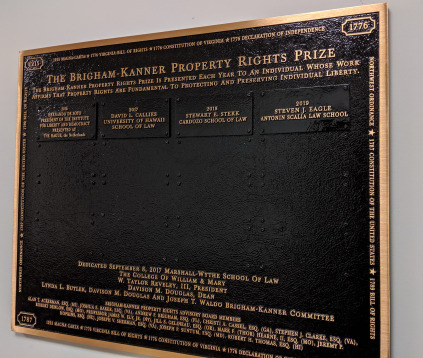
IMG_20190925_175845

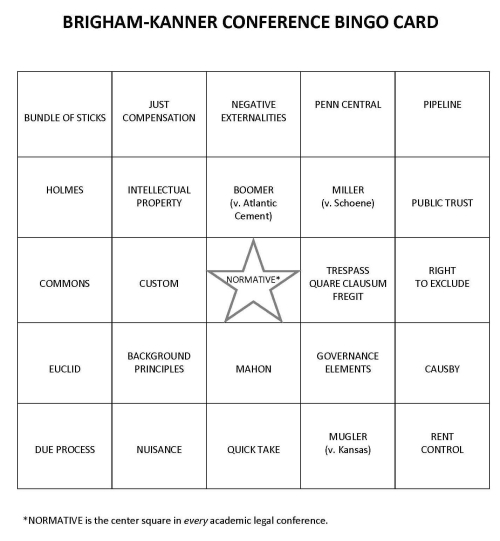
Although it is set to launch this Friday, October 2, 2020, there’s still more than enough time to register (and room at the inn) for you to join us for the 17th Annual Brigham-Kanner Property Rights Conference at the William and Mary Law School.

Like everything else this season, the Conference is online (register here), and although we would have preferred to gather in-person of course, the online format has some advantages: the number of attendees isn’t limited by the classroom size (this year’s registrations are at record levels), you don’t need to travel to Williamsburg, and the Conference is free if you don’t want Virginia CLE credit for attending. What a deal.

In our opinion, this is the best legal academy/practicing bar conference on property law. This year, the Conference honors the Brigham-Kanner Prizewinner, Harvard Law School Professor Henry Smith.

Here are the panel topics

Continue Reading There’s Still Room: Join Us For The 17th Annual Brigham-Kanner Property Rights Conference (Online, Free!)

It was mostly a win for the property owners in today’s Federal Circuit opinion in Hardy v. United States, No. 19-1793 (July 15, 2020).

The opinion isn’t heavy on the takings doctrine. It spent most of the time affirming the Court of Federal Claims’ conclusion that the plaintiff-owners owned property under Georgia law (their predecessors had conveyed easements, not fee simple interests, and thus maybe had their reversionary interests taken when, after the rails were abandoned, they were converted to trails use).

Check it out for the nuances of Georgia property law. Is this an easement, a fee, a right-of-way, or something else? Whatever the feds wanted them to be, the court agreed with the owners that Georgia said they were easements. And we know who defines property, mostly, for purposes of the takings clause in this case: Georgia.

The balance of the opinion was more of a draw

Continue Reading A Not Too “Takey” Takings Opinion From The Federal Circuit

Congratulations – if you understood this post’s headline, you are officially a rails-to-trails nerd. A super-nerd.

But even if not, you shouldn’t need a rails-to-trails nerd’s level of knowledge to understand and appreciate the Federal Circuit’s ruling in Caquelin v. United States, No. 19-1385 (May 29, 2020). It’s a case worth reading for all of us — nonnerds included — because it nicely gets into the weeds of takings doctrine. 

One observation before we begin. There are takings of a fee simple interest. Takings of less-than-a-fee interest, such as the taking of an easement. Partial takings where less than all of the owner’s property is taken, and there’s a remainder property. Temporal takings where the seizure is not forever (temporary takings vs permanent takings). Regulatory takings, inverse condemnations, per se (categorical) takings, physical takings and ad hoc (Penn Central) takings. And myriad combinations fo the

Continue Reading Federal Circuit: Arkansas Game Did Not Overrule Ladd (NITUs Are Categorical Takings)

ALICLE-tagline-250x90

There’s still time to join us tomorrow, Friday, April 24, 2020 at 2-3pm Eastern Time, they will be presenting “Strategies for Litigating Regulatory Taking Cases” in a webinar produced by ALI-CLE. Register here (multiple attendee discounts available). 

At the recent ALI-CLE Eminent Domain and Land Valuation Litigation Conference in Nashville, our colleagues, New York’s Jon Houghton and Hawaii’s Dave Day presented a very informative program on litigating regulatory takings cases. Jon is a property owner-side lawyer, while Dave is a Deputy Attorney General who represents the State of Hawaii in such cases. So it was a practical and balanced presentation. Jon and Dave are taking it to the next level. This isn’t simply a repeat of their Nashville program, but they will be exploring in more detail the practicalities of building and defending these difficult cases. 
Here’s the description of the program:

The U.S. Constitution provides that

Continue Reading Still Time To Join Us (Tomorrow): ALI-CLE Webinar – Strategies for Litigating Regulatory Taking Cases

Missed out on the 2021 ALI-CLE Eminent Domain and Land Valuation Litigation Conference swag?
Well fear not: here’s your chance to get your high-class reminder — a kit of road warrior essentials — to save the Conference date on your calendar. We’re already underway with planning the agenda and faculty, so it’s never too soon to block it off (January 28-30, 2021, at the 4-Diamond DoubleTree Resort, Scottsdale, Arizona). 

If you were not able to get your swag in Nashville, send us a note (rht@hawaiilawyer.com) and we shall gladly drop one or two in the mail to you.

While supplies last!  Continue Reading Unboxing The 2021 (Scottsdale) ALI-CLE Eminent Domain Conference Swag: Get Yours Today!

They’re coming so fast, we can hardly keep up.

Today, in Castillo v. United States, No. 19-1158 (Feb. 20, 2020), the U.S. Court of Appeals for the Federal Circuit resolved a common issue in rails-to-trails takings cases: when a property owner holds title and her deed describes the land as bordering on a railroad line or other easement (or the property is described as a lot in a plat that shows the lot’s “property line” as adjoining a road or railroad easement), does the owner of the adjoining fee estate own the fee interest up to the “centerline” of the right of way?

Applying Florida property law, the court held yes, there is a presumption that the owner’s title goes up to the “centerline.” The court reversed the Court of Federal Claims’s conclusion that the presumption did not apply, and that deeds describing the property as a “less

Continue Reading Federal Circuit: When Road Is The Property Boundary, Owner’s Fee Goes Up To The “Centerline”