LgoIt’s time for the annual ALI-CLE (fka ALI-ABA) eminent domain conferences, to be held January 24-26, 2013 in Miami Beach, Florida.

In the “advanced” course, Eminent Domain and Land Valuation Litigation, we’ll be covering topics such as “Condemning Underwater Mortgages,” “An Engineer’s Role in Damage,” “How To Develop and Implement a Business Plan for an Eminent Domain Practice,” and “Condemnor Beware: What Activities Will Make You Liable for Pre-Condemnation Damages.” Along with Pacific Legal Foundation’s Jim Burling and Cornell lawprof Robert Hockett, I’ll be speaking on the panel about underwater mortgages. More details on the agenda and the faculty here.

The companion course, Condemnation 101: How to Prepare an Eminent Domain Case, covers the basics of eminent domain law, and although designed as an overview of condemnation law for the beginner or general practitioner, it’s a great refresher course for the seasoned eminent domain lawyer. More

Continue Reading Upcoming ALI-CLE Eminent Domain Conferences

13.LULHIIt’s back! Time once again for the bi-annual Hawaii Land Use Law Conference, to be held January 17 and 18, 2013 (Thursday and Friday) at the Downtown YWCA (a very convenient venue).

Planning co-chairs Professor David Callies and Ben Kudo have once again assembled a stellar faculty and put together an agenda that covers most topics of interest.

We’ll be moderating a panel on “Development Through Exemptions – The Evolution of Reclassifications, Permitting, Land Use &Development in Hawaii: The Unintended Consequences ofan Increasingly Complex System of Regulations,” featuring panelists Linda L.W. Chow (Deputy Attorney General State of Hawaii), Oswald K. Stender (Office of Hawaiian Affairs), and Kali Watson (Hawaiian Community Development).

Two highlights of the conference:

First, Mike Berger will give the keynote presentation on our favorite topic, regulatory takings: “Taking a Critical Look at 30 Years of the Supreme Court’s Taking Jurisprudence.” Mike has taken the lead in

Continue Reading Mark Your Calendars: 10th Hawaii Land Use Law Conference (Jan. 17-18, 2013)

In the op-ed piece “Eminently reasonable,” Brooklyn lawprof David Reiss writes that “using the power of eminent domain to restructure underwater mortgages is constitutional, beneficial and administratively feasible.”

Local governments across the country are considering an innovative use of eminent domain. They propose to condemn underwater mortgages (those that exceed the fair-market value of the home) in their communities and restructure them so that home­owners can afford their payments and so that the new mortgage is for less than the fair market value of the property. If this proposal is implemented, the local government will pay the owner of mortgages of “underwater” homes the fair market value for the mortgages. The local government will then restructure each mortgage by reducing the principal amount owed to be in line with a mortgage that would be appropriate for the fair market value of the home. This will result in lower

Continue Reading “Eminently Reasonable,” Or Desperate Times Breed Desperate Measures?

Today’s American Banker has a story on the latest development in the let’s-use-eminent-domain-to-take-underwater-mortgages scheme: the Federal Housing Finance Agency has sent a strong shot across the bow of local governments contemplating such a move (e.g., San Bernadino, Chicago, even Berkeley):

Uh, don’t.

Full statement here, or below. The American Banker story is unfortunately behind a paywall, so we can’t bring it to you here, but we do have the highlights from a trio of Owners’ Counsel of America commentators who are quoted, us included:

“San Bernardino County cannot condemn federal property,” said Gideon Kanner, professor of law emeritus at Loyola Law School in Los Angeles and a longtime eminent domain expert. The FHFA is “a federal agency and the Feds can take the property of a state or city but the state or a local entity cannot take federal property.”

Robert Thomas, an attorney at the

Continue Reading “Hey Look, Free Money!” Fed Agency Has Problems With The Plan To Take Underwater Mortgages

20120803_134704
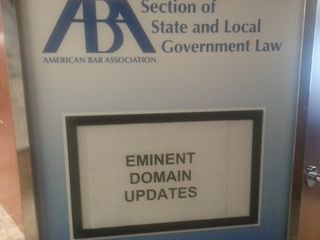
Here are the cases and links that I discussed at today’s ABA session on eminent domain:

  • Kelo – Remember the holding of the case: the Court majority rejected the petitioners’ call to adopt a blanket rule that all takings supported only by claims of economic development violate the Public Use Clause of the Fifth Amendment. In declining to adopt the rule, the Court left open challenges based on lack of a comprehensive plan, claims that the advanced public use is a pretext to hide a predominant private purpose, and the old “A-to-B” private taking.
  • City of Stockton v. Marina Towers LLC (Cal. Ct. App. 2009) – The case in which the court held that the city’s resolution of necessity was so “nondescript [and] amorphous,” and “so vague, uncertain and sweeping in scope that it failed to specific the ‘public use’ for City sought acquisition of the property.”


Continue Reading Resources From Today’s ABA Eminent Domain Session

Thanks to the Land Use Prof Blog for getting the word out about the most recent documentary from filmmaker Gary Hustwit, “Urbanized,” which will have its Hawaii premier this weekend as part of Interisland Terminal‘s “Manufacturing Reality” film series.

The film examines how cities are designed — whether on purpose or though usage — and what works and what doesn’t. It covers a range of issues: zoning, architecture, mass-transit, sewage, redevelopment, sprawl, smart growth, and economic inequality. Urbanized features planners, architects, artists, and lawyers (including colleague Grady Gammage, Jr., with a different perspective on “sprawl” in Arizona), discussing their visions of urban design.

From the film’s description page:

Urbanized is a feature-length documentary about the design of cities, which looks at the issues and strategies behind urban design and features some of the world’s foremost architects, planners, policymakers, builders, and thinkers. Over half the world’s population

Continue Reading Honolulu Premiere: “Urbanized” – Designing Cities, Working Cities

We couldn’t post much last week due to a pressing engagement on Friday before a three-judge federal district court (the case challenging Hawaii’s latest state reapportionment plan on Equal Protection grounds in which we represent the plaintiffs — more here). But the court took the matter under submission, so while we are awaiting a ruling we can clear off some of the backlog of items.

First, you will recall R&J Holding Co. v. Redevelopment Authority of Montgomery County, 670 F.3d 420 (3d Cir. Dec. 9, 2011), a case we detailed here, in which the Third Circuit held that a property owner did not actually or impliedly litigate its federal takings claims in an earlier state court case, and thus actually allowed a property owner to raise its federal constitutional claims in federal court.

Apparently, a property owner even having a chance of vindicating its federal constitutional rights

Continue Reading Amicus Brief: Federal Takings Claims And State Law Claims … Ehh, What’s The Difference?

There is still time to register for the Eminent Domain & Land Use in Hawaii seminar, to be held this Thursday, May 12, 2012, in downtown Honolulu. Along with James Mee, I am leading the session “Eminent Domain Update” in which we will talk about the latest in public use issues from the U.S. and Hawaii Supreme Courts, and other recent developments in condemnation law.

The Chair of the program is my Damon Key partner Mark M. Murakami. Also on the agenda is a session on potential burials issues in the rail project with another Damon Key partner, Greg Kugle, and a session on rail bid protests with Anna H. Oshiro. The final session of the day will be devoted to ethics, so you can get your MCLE credit requirement at least partially fulfilled for this year.

The complete faculty list and agenda is available here

Continue Reading Honolulu Eminent Domain Seminar – May 12, 2012

Here’s one for your California readers. You know Proposition 13, the provision in the California Constitution that limits property tax increases, and allows reassessment of value only upon a change of ownership, and you either love it or hate it: to some it insulates property owners from being forced out of their homes by uncontrolled property taxes, to others it is responsible for the downfall of California as the Golden State.

A property owner’s acquisition of replacement property for property taken in “eminent domain proceedings” in which the taken property is acquired by a “public entity,” is not a “change of ownership.” But what about when new property is purchased to replace property sold under threat of condemnation to a private developer who is teamed up with a government redevelopment agency — is that a “change of ownership” such that the property is assessed at current market rates?

In

Continue Reading Cal App: Sale To Private Redeveloper Under Threat Of Condemnation Is A “Change Of Ownership” Under Prop 13