


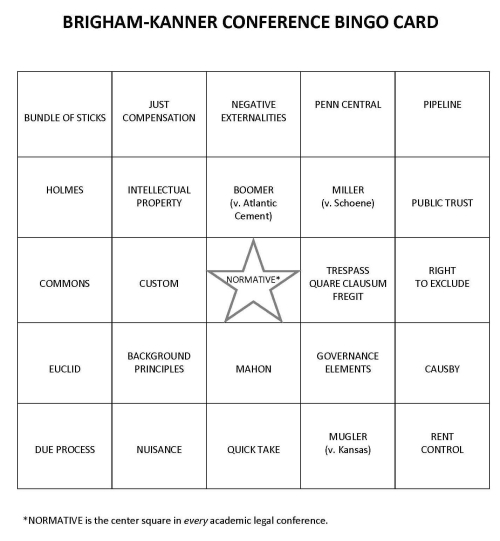
 Continue Reading Your 2020 Brigham-Kanner Property Rights Conference Bingo Card
There’s Still Room: Join Us For The 17th Annual Brigham-Kanner Property Rights Conference (Online, Free!)
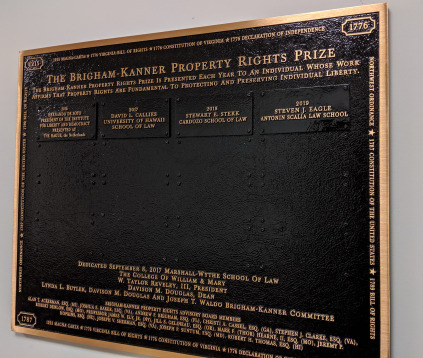
Although it is set to launch this Friday, October 2, 2020, there’s still more than enough time to register (and room at the inn) for you to join us for the 17th Annual Brigham-Kanner Property Rights Conference at the William and Mary Law School.
Like everything else this season, the Conference is online (register here), and although we would have preferred to gather in-person of course, the online format has some advantages: the number of attendees isn’t limited by the classroom size (this year’s registrations are at record levels), you don’t need to travel to Williamsburg, and the Conference is free if you don’t want Virginia CLE credit for attending. What a deal.
In our opinion, this is the best legal academy/practicing bar conference on property law. This year, the Conference honors the Brigham-Kanner Prizewinner, Harvard Law School Professor Henry Smith.
Here are the panel topics
Available Now: 2020 Zoning and Planning Law Handbook (Green Book)
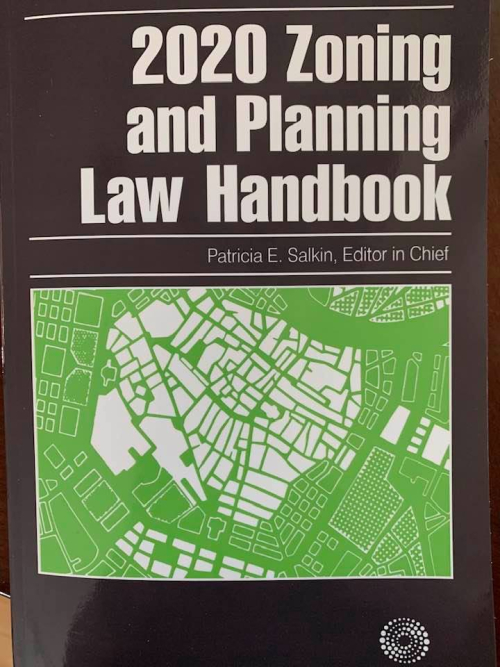
Just published: the 2020 Zoning and Planning Law Handbook (Green Book). The first section of the Summary of Contents is about Takings, and includes as the lead piece Professor Gideon Kanner and Michael Berger’s tour-de-force article, “The Nasty, Brutish, and Short Life of Agins v. City of Tiburon.” It also includes my articles on Murr, “Restatement (SCOTUS) of Property: What Happened to Use in Murr v. Wisconsin?”
Check it out. The Green Book is a one-stop shop for the best articles on land use in a given year, and this edition includes chapters on housing, agriculture, cell tower placement, RLUIPA, and (of course) zoning.
Our thanks to Dean Patty Salkin who edited the volume for including us.
Summary of Contents, 2020 Zoning and Planing Law Handbook (Green Book)
Continue Reading Available Now: 2020 Zoning and Planning Law Handbook (Green Book)
Illinois App: We Haven’t Changed Our Mind – Chicago’s Sketchy Redevelopment Taking Is Still For Public Use
In City of Chicago v. Eychaner, No. 1-19-1053 (May 11, 2020), the Illinois court of appeals revisited a case that it ruled on once before.
Five years ago, in City of Chicago v. Eychaner, 26 N.E.3d 501 (Ill. Ct. App. 2015), the same court held that a redevelopment taking of Eychaner’s property qualified as a public use. We won’t go into the details of facts or that opinion’s reasoning. Instead, we’ll refer you to our summary, analysis (and criticism) of the opinion here (“The Chicago Way: City Taking Non-Blighted Property For Economic Development Was Not Pretextual Because … Studies“). After approving the taking, the court remanded the case for a determination of the compensation owed.
Flash forward. On remand, the jury determined just compensation was $7.1 million. Also while the case was remanded, the City changed its redevelopment plans. You know, the basis for the court
Join Us This Week: May 12-14, 2020 For (Virtual) Land Use Institute Webinar Series
Join us starting tomorrow, Tuesday, May 12, 2020 for the 34th Land Use Institute. Originally scheduled for April in Tampa, we obviously couldn’t do tha, so we did the next best thing — moved this venerable course online. The Planning Chairs (Frank Schnidman and Dean Patricia Salkin) have assembled the usual hot topics session and a lineup of expert faculty (we’re speaking at the 2:45 ET session on Federal Laws (in our case, NEPA, Water, and Wetlands (including the Maui case from SCOTUS)).
The program takes place over three days Tuesday, Wednesday, and Thursday, and you can either register for the sessions or all three days, with various discounts if you are a member of the American Bar Association, and even more if you are a member of the Section of State and Local Government Law.
Here’s the three-day agenda. There is a lot here to like, and we
Continue Reading Join Us This Week: May 12-14, 2020 For (Virtual) Land Use Institute Webinar Series
Amicus Brief: Invocation Of “Police Power” Is Not Dispositive In Takings

Today, along with our colleague Bill DeVinney, we filed this amicus brief in support of the property owners’ cert petition in a case we’ve been following for a while.
Yes, this is the case where the Village police pretty much destroyed a family home in the course of their efforts to dislodge a shoplifter who had taken refuge there while fleeing. Homeowner sought compensation for a taking. The Tenth Circuit, however, concluded “no taking” because the police were exercising the police power. And you can’t have a taking where the government is exercising the police power.
Instead of summarizing our brief, how about we just post the Summary of Argument:
This Court should review the Tenth Circuit’s holding that action taken by the government under its police power—as opposed to an exercise of eminent domain—can never trigger a taking under the Fifth Amendment’s Just Compensation Clause. This brief makes two main
Continue Reading Amicus Brief: Invocation Of “Police Power” Is Not Dispositive In Takings
Latest Readings: On Emergency Takings, Compensation For Commandeered Property
It’s tough with all that’s swirling around all of us to keep focused on non-virus related things. But because we think that’s one way to keep calm and carry on, we shall continue to endeavor to do so. But come on, being takings and dirt lawyers we also can’t help viewing current events through that lens, no? Consequently, we shall also continue from time-to-time to post about issues that have cropped up in practice that are related to the thing that is on everyone’s mind these days.
In that vein, here’s the latest on-topic things we’ve been reading:
- History: Fire and Blood(worth) – Steve Silva, Taking Nevada blog (“Many argue, with great merit, that when a person’s property is sacrificed to preserve the public health, that the person is entitled to compensation. But the law has not yet reached that conclusion, … [and] there is no legal mandate
Continue Reading Latest Readings: On Emergency Takings, Compensation For Commandeered Property
The Royal Origins Of “Police Power” Hawaii-Style: The King v. Tong Lee (1880)
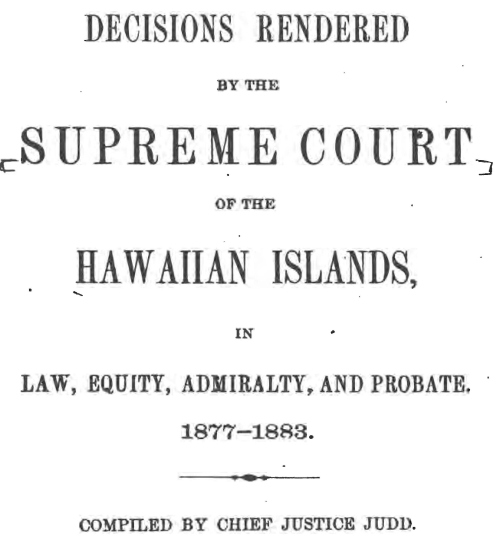
Here’s one for our Hawaii folks, in case you all are curious about the origins of the analytical framework which courts use to review the legality of measures taken by the authorities in the name of “public health” that have an impact on the uses of private property.
As far as we can tell, The King v Tong Lee, 4 Haw. 335 (Kingdom 1880) (in banco), is the first Hawaii case which uses the term “police power,” and which upheld the broad – and nearly unreviewable – authority of the government to limit the uses of property, as long as there’s a colorable argument that the property’s use is contrary to the public health.
There, the Kingdom’s legislature (one of the joys of practicing law in Hawaii is that you get to deal with cases involving the Kingdom; things like Privy Council, the royal prerogative, and the like) prohibited
Continue Reading The Royal Origins Of “Police Power” Hawaii-Style: The King v. Tong Lee (1880)
Unboxing The 2021 (Scottsdale) ALI-CLE Eminent Domain Conference Swag: Get Yours Today!
Missed out on the 2021 ALI-CLE Eminent Domain and Land Valuation Litigation Conference swag?
Well fear not: here’s your chance to get your high-class reminder — a kit of road warrior essentials — to save the Conference date on your calendar. We’re already underway with planning the agenda and faculty, so it’s never too soon to block it off (January 28-30, 2021, at the 4-Diamond DoubleTree Resort, Scottsdale, Arizona).
If you were not able to get your swag in Nashville, send us a note (rht@hawaiilawyer.com) and we shall gladly drop one or two in the mail to you.
While supplies last! Continue Reading Unboxing The 2021 (Scottsdale) ALI-CLE Eminent Domain Conference Swag: Get Yours Today!
Carousing at Carousel Farms: Final SCOTUS Cert-Stage Briefs In Colorado Eminent Domain Abuse Case
The last two cert-stage briefs have been filed in a case we’ve been following for a while (since it was decided by the Colorado Court of Appeals).
In Carousel Farms Metro. Dist. v. Woodcrest Homes, Inc., 444 P.3d 802 (Colo. App. 2017), the appeals court invalidated an attempt to exercise eminent domain to take property which the owner had refused to sell to developer Carousel Farms. Although the Carousel Farms Metropolitan District couldn’t point to a present public use or benefit from the taking, it asserted that in the future the public would benefit from the condemnation because if Carousel Farms were allowed to develop its property in accordance with its agreement with the town, the public would receive new infrastructure such as roads and sewers. The trial court upheld the taking, but the court of appeals reversed. The real purpose of the taking was to facilitate the developer’s