


ALI-CLE-2016-masthead

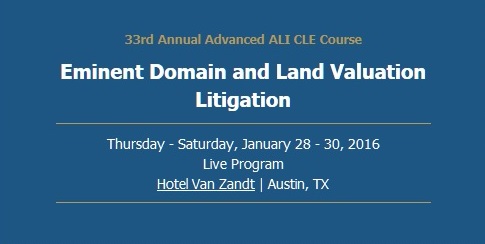
We’re now only a bit more than two weeks away from the 2016 Eminent Domain and Land Valuation LitigationCondemnation 101 Conference, which runs from January 28-30, 2016, in Austin, Texas. 

As we’ve noted here earlier, we think that this is going to be a fantastic conference that will cover a lot of ground, and the hot topics of the day. Here’s the full agenda for the program. If you are not familiar with the conference or have not attended recently, we’ve undergone some formatting changes lately, but are still bringing the best faculty and topics to bear. Here’s a summary of last year’s San Francisco conference, to give you an idea of how we’ve updated the programs, while keeping the best elements and traditions unchanged.  

This is the first time the conference has been held in Austin, and thus far, the registration figures are doing exceedingly

Continue Reading ALI-CLE Eminent Domain Conference, Austin, TX – Nearly Here, But There’s Still Time To Register

We’ve been tied up with other things the past few days, so haven’t had a chance to do much posting, but here’s something to tide you over, a piece from Florida colleague Jacob Cremer, “Why Exactions Law Should Bring Property Rights Advocates Cheer in the New Year.” 

Land use and takings mavens, rejoice. 

Continue Reading Exactions, Again

Here’s a good one from the Ohio Court of Appeals to start off your 2016.

In State ex rel Greenacres Foundation v. City of Cincinnati, No. C-150038 (Dec. 30, 2015), the court agreed that the City’s failure to issue a demolition permit for the “Gamble House,” which the City claimed was a property worthy of historic preservation but had not yet so designated, was a taking. 

The Gamble House was built by the “Gamble” in Proctor & Gamble, the guy who invented Ivory Soap. But over the years, the house “had been uninhabited since 1961, had suffered extensive water and termite damage, and was infested by mice, birds, raccoons, squirrels, and bats.” So the current owners asked the city for a demolition permit so they could redevelop the property. 

The city said no, and ran the owners through a maze, with several appeals through the usual administrative procedures.

Continue Reading City’s Prohibiting Demolition Of Uninhabitable House So City Could Designate It As Historic, Is A Taking

One more in our year-end opinion rush, a short one from the U.S. Court of Appeals of the Eighth Circuit. Here’s what you need to know about Tubbs v. Surface Trans. Bd., No. 14-3898 (8th Cir. Dec. 28, 2015):

Finally, the Tubbses argue that the Board has prevented them from bringing a claim for just compensation under the Fifth and Fourteenth Amendments. In short, the Tubbses claim that the Board has foreclosed their ability to bring a claim based on the Takings Clause of the Constitution and thus affected a taking. We are not persuaded. The loss of a cause of action, which is not a vested interest until it is reduced to a final judgment, is too speculative to constitute a taking. See Jones Truck Lines, Inc. v. Whittier Wood Products Co. (In re Jones Truck Lines, Inc.), 57 F.3d 642, 651 (8th

Continue Reading Eighth Circuit: Wiping Out Unrealized Rails-to-Trails Takings Claim Is Not A Taking

ALI-CLE-2016-masthead

Here’s our second day of highlights from the upcoming American Law Institute-CLE Eminent Domain and Land Valuation Litigation / Condemnation 101 Conference, which will be held in Austin, Texas, from January 28-30, 2016.  

This is the first time the conference has been to Austin, and we’re hoping for a good turnout. Here’s the full agenda for the program. 

  • We especially focused on the ethics component this year, and are looking forward to the session on “Ethics: Tips and Traps for the Eminent Domain Practitioner” at the first plenary session on the second day, taught by Jamila A. Johnson (Schwabe, Williamson & Wyatt, Seattle), Robert B. Neblett, (Jackson Walker L.L.P., Austin). and Joseph V. Sherman (Waldo & Lyle, P.C., Norfolk, Virginia). 
  • Pipeline takings are a huge issue, and we’ve got the lawyers on the very tip of the spear on these cases. “Pipelines and Energy


Continue Reading More On The Upcoming ALI-CLE Eminent Domain Conference (Austin, Jan 28-30, 2016)

Here’s one from the Federal Circuit that doesn’t break new ground, but is founded on an arcane point of Florida law. 

Rogers v. United States, No. 13-5098 (Dec. 28, 2015) is a rails-to-trails case, so the background is pretty standard: old railroad right-of-way, abandoned, followed by a NITU (Notice of Interim Trail Use), which ripened takings claims for the reversionary interest. Followed by standard government tactic: avoid the takings by showing that the reversionary interest isn’t property.

And that’s where Florida law comes in, the question being whether the deeds which originally conveyed the land to the railroads conveyed a fee simple interest or something like an easement. The Court of Federal Claims concluded the deeds conveyed a fee simple interest (the deeds used the words “fee simple,” after all), but on appeal, the Federal Circuit was not as sure because there was no “controlling” state law authority. So

Continue Reading Fed Cir: No Property, No Taking

ALI-CLE-2016-masthead

We’re exactly one month away from the 2016 Eminent Domain and Land Valuation Litigation / Condemnation 101 Conference, which runs from January 28-30, 2016, in Austin, Texas. 

Together with our friends and colleagues Joe Waldo, Jack Sperber, and Andrew Brigham, we think we’re put together a pretty good program that covers a lot of ground. This is the first time the conference has been to Austin, and we’re hoping for a good turnout. 

Here’s the full agenda for the program. 

If you have not already signed up, there is more than enough room, and there’s still time.

If you haven’t yet pulled the trigger, we’d like to convince you to come. So over the next few days, we’re going to be posting highlights from the agenda, featuring our stellar faculty.

  • We’ll start off with a talk welcoming us to the city by Austin Mayor Steve Adler


Continue Reading Counting Down To The ALI-CLE Eminent Domain Conference (Austin, Jan 28-30, 2016)

When we hear the word “trona,” we think of Trona, California, a hardscrabble San Bernardino County town near Death Valley.

We just thought we’d get that out of the way, because today’s case from the Federal Circuit, Barlow & Haun, Inc. v. United States, No. 15-5028 (Oct. 9, 2015), doesn’t involve the town, but it does involve trona mining (in Wyoming). 

It seems that the federal government preferred trona mining to oil and gas development. The Bureau of Land Management “indefinitely suspended” oil and gas leases on federal public lands in one part of Wyoming, because oil and gas development posed risks to trona mining. Barlow had 26 oil and gas leases with BLM, and it sued for a taking, and for breach of the leases. 

After trial, the Court of Federal Claims concluded that the breach of contract claim failed on the merits, and that

Continue Reading Fed Cir: Claim That BLM Suspension Of Oil And Gas Leases Was A Taking Isn’t Ripe Because BLM Didn’t Really Suspend The Leases

One for all you Court of Federal Claims mavens: a new cert petition, filed On Wednesday, that once again puts front and center 28 U.S.C. § 1500the statute which bars the CFC from hearing claims that are “pending in any other court” against the United States.  

The statute was last interpreted by the Supreme Court in United States v. Tohono O’Odham Nation, 563 U.S. 307 (2011), a case in which the Nation alleged in a District Court lawsuit that the federal government had breached trust duties it owed. Almost immediately thereafter, the Nation filed a claim in the CFC for money damages based on the same theory. The CFC’s limited jurisdiction does not allow it to hear claims for declaratory relief, and District Courts are without power to make the federal government pay significant money damages. Meaning that claims like the Nation’s (and takings claims

Continue Reading New Cert Petition: Federal Circuit Expanded § 1500’s Jurisdictional Bar

We always enjoy reading the briefs filed by the Center for Constitutional Jurisprudence because they reference “first principles” and are usually heavy on the history. We like history. 

This amicus brief, filed by CCJ today in support of the cert petition in Arrigoni Ent., LLC v. Town of Durham, No. 15-631 (cert. petition filed Nov. 10, 2015), is no different. It argues that the “state procedures” prong of Williamson County should be overruled, or at least confirmed as a prudential (and not jurisdictional) requirement:

Apart from the procedural trap that Williamson County creates, Amicus Curiae urges this Court to reexamine the state litigation rule because the requirement is not firmly established in the text of the Takings Clause and it represents a significant departure from the original understanding of the right at issue. Stated succinctly, the Fifth Amendment requires that compensation be paid when the government takes property

Continue Reading Amicus Brief: Williamson County’s State Procedures Requirement Is Ahistorical