If you need CLE credits, you are in luck. There’s a plethora of upcoming programs that may be of interest to readers. 

First, the ones we’re involved with:

  • The Takings Issue – August 10, 2015, 1 – 2pm ET (webinar) – from the International Municipal Lawyers Association. We’re joining Professors Dan Mandelker and John Echeverria, and land use lawyer Michael Giairno, to talk takings. “Two titans of takings, who just happen to have profoundly opposing views of the world, have graciously agreed to discuss the latest developments and spar. This will be the Great Debate of 2015.” Sounds like fun, no? Registration free for IMLA members, $99 for everyone else. More information, including registration, here
  • Is Sharing Really Caring? The Law of Transportation Sharing: Uber, Lyft, and the Sharing Economy – July 30, 2015, 2:15-3:45pm CT (in-person) –  at the ABA Annual Meeting in Chicago. We’re moderating a session

Continue Reading Mark Your Calendars For Upcoming Events: Takings, Sharing Economy, Fair Housing, etc.

20150422_112618
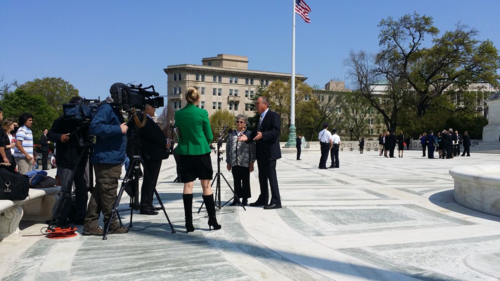
The Hornes outside the Supreme Court

“Separate educational facilities are inherently unequal.”
Chief Justice Earl Warren,
Brown v. Board of Education

“The Fourteenth Amendment does not enact
Mr. Herbert Spencer’s Social Statics.”
Justice Oliver Wendell Holmes,
dissenting in Lochner v. New York

“…prejudice against discrete and insular minorities…”
Justice Harlan Fiske Stone, in footnote 4,
United States v. Carolene Products Co.

“Raisins … are a healthy snack.”
Chief Justice John G. Roberts,
Horne v. Dep’t of Agriculture

A Supreme Court win is a win, particularly by a margin of 8-1, so we’re not going to complain too much about the Court’s opinion in Horne v. Department of Agriculture, No. 14-275 (U.S. June 22, 2015), holding that the USDA’s requirement that raisin producers physically turn over a percentage of their yearly crops to the government without being provided compensation is a taking in violation of the Fifth Amendment.

I

Continue Reading Horne v. USDA: Way More Than Silly Raisin Jokes

There’s nothing new in the California Court of Appeal’s opinion in Rancho de Calistoga v. City of Calistoga, No. A138301 (July 7, 2015), which is probably why the court didn’t designate it for publication. 

But read it anyway, since there’s some interesting bits. Nothing in the details, mind you, but in the overall vibe of the opinion. 

It’s a mobile home rent control case, so you shouldn’t expect much from a California court, and this decision certainly meets those low expectations: it goes through the usual analysis dealing with the park owner’s argument that the city — at the northern end of the Napa Valley — didn’t agree to increase the rent to $625 per month from the $471 average which tenants were paying. The city permitted an increase of only $60, so the owner sued, asserting among other things that the failure to increase the rent to $625 was

Continue Reading Cal App: No Takings Claim, Because Property Owner Makes “Enough”

There’s apparently a huge backlog in California of liens which workers’ comp medical providers file to seek payment for services they’ve provided to injured workers.

These are liens possessed by service providers for workers whose employers declined to provide treatment on the ground it is not work related. In those cases, the worker may seek treatment on her own, and if the injury is later determined to be covered by workers’ comp, the employer is liable for payment. The service provider cannot seek payment from the injured employee, and is limited to filing a lien on the workers’ comp case. The lien filing gives the provider standing in the workers’ comp case to protect its interests. The rights of a lien holder are contingent on the worker prevailing on her claim that the injury is work-related.  

In response to the huge backlog in processing such liens, the legislature adopted

Continue Reading 9th Circuit: Fee To “Activate” Workers’ Comp Lien Not A Taking – The Liens Are Not Property

Remember the Roca Solida case? That’s the follow up to the Supreme Court’s recent decision in United States v. Tohono O’odham Nation, 131 S. Ct. 1723 (2011), highlighting the jurisdictional problem in takings cases which that case left open. We labeled it a “jurisdictional ambush” that awaits any property owner who has a takings claim against the federal government.   

The question presented by the cert petition in Roca Solida is whether 28 U.S.C. § 1500, the statute which deprives the Court of Federal Claims of jurisdiction over a case if a related case is pending in another court at the time the CFC complaint is filed, applies to takings claims. In Tohono O’odham, which was not a takings case, the Court held that the statute prohibited the CFC from taking jurisdiction over the Nation’s monetary claim against the United States, when its related claims against the federal

Continue Reading Amici Brief In § 1500 Case: Congress Cannot Limit Property Owners’ Rights To Just Compensation By Narrowing CFC Jurisdiction, Especially With An Absurd Statute

LUI header

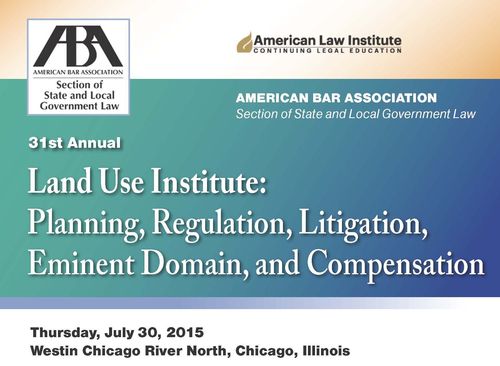
The Land Use Institute, a program that for many years has been planned by co-chairs Frank Schnidman and Gideon Kanner, has found a new home with the American Bar Association’s Section of State and Local Government Law as the main sponsor. It also has a new Planning co-chair, Dean Patty Salkin of Touro Law School, who has stepped in for Professor Kanner.

This program is designed for attorneys, professional planners, and government officials involved in land use planning, zoning, permitting, property development, conservation and environmental protection, and related litigation. It not only addresses and analyzes the state-of-the-art efforts by government to manage land use and development, but also presents the key issues faced by property owners and developers in obtaining necessary governmental approvals.

This year, the one-day program is being held in conjunction with the ABA Annual Meeting in Chicago. It will be held on Thursday, July 30, 2015

Continue Reading Land Use Institute: Planning, Regulation, Litigation, Eminent Domain, and Compensation – 31st Annual Conference, Chicago, July 30, 2015

2012-02-06_11-19-51_574

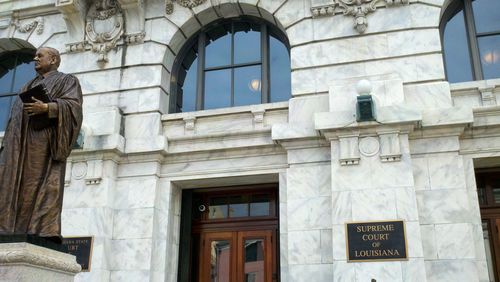
Here’s a case in which the court ruled there wasn’t a taking, but it could be argued that the property owners won. How so? Because this case pitted the property rights of railroads against the property rights of the owners over whose land the rail lines run.

The U.S. Court of Appeals asked the Louisiana Supreme Court to answer this certified question:

Whether the application of LA. REV. STAT. § 48:394 to any of the properties in this case amounts to an unconstitutional taking of private property without a public purpose, in violation of Article I, Section 4 of the Louisiana Constitution.

In Faulk v. Union Pacific Railroad Co., No. 2014-CQ-1598 (June 30, 2015), the Supreme Court answered no.  

The case arose in 2007 after the railroad planned to close 100-year old private crossings over its tracks, which the property owners asserted disrupted their farming operations and their

Continue Reading Takings Claim Rejected, But Property Owners Win In Louisiana: Statute Limiting Closing Of Private Railroad Crossing Isn’t A Taking Under State Constitution

In State ex rel. Dep’t of Transportation v. Eighth Judicial Circuit, No. 15-19376 (June 25, 2015), the Nevada Supreme Court covered territory addressed by other courts recently (see here by North Carolina, Florida, and here by California) — whether there’s a taking when an agency with the power of eminent domain takes steps to condemn property, but hasn’t actually done so yet.

Here, the Nevada court concluded that there wasn’t a taking, because even though the DOT announced “Project Neon,” a “six-phase, 20- to 25- year highway improvement for the Interstate Highway 15 (I-15) corridor between Sahara Avenue and the U.S. Route 95/I-15 interchange in Las Vegas” which included plaintiff’s property, it did not result in a “de facto moratorium” on development as the property owner characterized it.

Rather, the court viewed the DOT’s actions as preliminary because the plaintiff’s property “is not anticipated to be

Continue Reading Nevada: No Regulatory Taking When DOT Announced Future Plans To Condemn

Apa_2015_planning_law_review

On Wednesday, July 1, 2015, the American Planning Association is putting on the 2015 Planning Law Review, a program highlighting the most important and topical cases decided by the courts recently. Here’s the program description:

Planning feels the impact of decisions from the U.S. Supreme Court, federal district courts, and state courts. How will their rulings affect you? Get a briefing on the year’s legal developments, from First Amendment issues to environmental actions, housing, and equal access. Presenters also will discuss major legislative initiatives and APA’s amicus filings. Join in a lively, informative program you and your staff, colleagues, and officials won’t want to miss. This program is also suitable for planning commissioners.

Joining me on the faculty are Jason Jordan, Director, Policy and Communications, American Planning Association (Moderator); Nancy Ellen Stroud, Lewis, Stroud & Deutsch; John M. Baker, Greene Espel; and John Echeverria, Professor of

Continue Reading Upcoming APA Webinar: 2015 Planning Law Review

We are distracted today so haven’t had the time to write up our initial thoughts about Horne v. Dep’t of Agriculture, No. 14-275 (June 22, 2015), the California raisins takings case which the Supreme Court decided yesterday.

So instead we did this video, a take off on those goofy tech “unboxing” videos.

We’ll have more in the traditional format once we have a chance to write something down.  Continue Reading Unboxing Video: Horne v. Dep’t of Agriculture