


Here’s the amici brief of the National Association of Home Builders, the National Association of Realtors, the National Association of Independent Business Small Business Legal Center, and others in the case we’ve been following out of the federal courts in Florida about a county’s “right of way preservation” ordinance (which is somewhat similar, but perhaps worse in some ways than North Carolina’s Map Act).

As you might recall, the federal district court held that the ordinance — which allows the county to land bank for future road corridors by means of an exaction is “both coercive and confiscatory in nature and constitutionally offensive in both content and operation” — violated Hillcrest’s due process rights. Yes, the Takings Clause was part of the mix in that it was Hillcrest’s right to just compensation that the county wrongfully interfered with (see Nollan, Dolan, and Koontz), but this was
Continue Reading Amici Brief: Didn’t Lingle Tell Us That Due Process And Takings Are Distinct Claims?

A short one from the Florida District Court of Appeals, Florida Dep’t of Transportation v. Mallards Cove, LLP, No. 2D13-181 (Mar. 6, 2015), a regulatory takings case that followed on the heels of a straight condemnation.

The DOT condemned property belonging to Mallards Cove via Florida’s quick take procedure, by which certain agencies may obtain immediate possession and title, provided they deposit a good faith estimate of the land’s value with the clerk of the court. Under Florida law, the property owner’s right to just compensation is then vested, and two weeks later, the property owner withdrew the $2 million deposit. While the funds were on deposit, he clerk invested it, and under a Florida statute, 90% of the interest went to the DOT. The eminent domain case wrapped up, with the owner agreeing that the final judgment represented full compensation for the property taken.

But the owner wasn’t

Continue Reading Fla App: Quick Take Deposit Only Vests Owner’s Right To Compensation, Not To Specific Funds

This one from the Federal Circuit is a must read, particularly for those interested in takings claims where the federal government is involved. But even if that doesn’t describe you, we think you should review Ministero Roca Solida v. United States, No. 14-5058 (Feb. 26, 2015), because the issues raised — especially in Judge Taranto’s concurring opinion — could have impact far beyond the narrow confines of the case.

The core issue is one we’ve dealt with extensively before, and which the Supreme Court addressed in United States v. Tohono O’odham Nation, 131 S. Ct. 1723 (2011), the effect of 28 U.S.C. § 1500 when the federal government is sued both in the Court of Federal Claims and in a District Court. That statute deprives the CFC of subject matter jurisdiction when there is a case pending in “any other court” against the United States which involves “any claim for or

Continue Reading Tohono’s “Jurisdictional Ambush” And The Tucker Act Shuffle In The Federal Circuit

Worth reading: “Legislative Exactions after Koontz v. St. Johns River Management District,” an article by colleagues Luke Wake and Jarod Bona, recently posted to SSRN. Here’s the abstract:

Decided in June, 2013, Koontz v. St. Johns River Management District settled a long-running debate among scholars as to whether the nexus test — first pronounced in Nollan v. California Coastal Commission — applies in review of monetary exactions. In the preceding years, the lower courts had largely resolved this question in the government’s favor — limiting Nollan to its facts, and holding the nexus test inapplicable if a challenged permit requires the applicant to pay or expend money as a condition of permit approval. Further, the trend among the lower courts held the nexus test inapplicable in review of legislatively imposed exactions, regardless of whether the contested condition requires a dedication of real property or money.

Without question

Continue Reading New Article: “Legislative Exactions after Koontz v. St. Johns River Management District”

Here’s one that we’ve had in our “to read” stack for a while, but put off since it didn’t look all that interesting. But after finally reading it recently, there’s a line in the opinion that jumped out at us. Read on. 

Araya v. JPMorgan Chase Bank, N.A., No. 13-7036 (Dec. 30, 2014) is a pro se case in which, after foreclosure and sale of rental property to a third person, a property owner sued in D.C. Superior Court claiming the defendants (Fannie Mae, the bank, a law firm, and the person who purchased the property at the auction) had not provided him proper notice or an opportunity to cure the default. The plaintiff also asserted that the defendants took his property without just compensation under the Fifth Amendment. The defendants removed the case to federal court and sought dismissal and summary judgment. In response, the plaintiff asked to

Continue Reading DC Circuit: No Supplemental Federal Jurisdiction Because “Elvis Had Left The Building” Upon Failure Of Takings Claim

Here’s the latest in an issue we’ve been following out of North Carolina.

In Kirby v North Carolina Dep’t of Transportation, No. COA14-184 (Feb. 17, 2015), the N.C. Court of Appeals not only held that the property owners’ claims were ripe, but that the Map Act — which gives the DOT the ability to designate property for future highway use and prevent its development in the meantime — effected a taking. The court reversed the trial court’s dismissal and sent the case back down for a calculation of the compensation owed to each property owner. A big win for the property owners.  

We’ve set out the background here and here, but the short story is that the N.C. legislature adopted a statute which allows the DOT to designate future highway corridors, but doesn’t require it to actually acquire the property. Once the DOT files a map showing

Continue Reading NC App: “Map Act,” Which Land Banks Property For Future Highways, Is A Taking

Yesterday, we were able to attend the Ninth Circuit oral arguments in a case which we posted on last month, Rancho de Calistoga v. City of Calistoga, No. 12-17749.

In that case, the U.S. District Court for the Northern District of California dismissed the complaint filed by the owner of a wine country mobile home park subject to a municipal rent control ordinance which alleged that the city’s hearing officer did not allow a fair return. The court concluded that the complaint did not adequately plead the claims for relief under a regulatory takings, private takings, due process, or equal protection theory.  

We filed an amicus brief in the case on behalf of the Western Manufactured Housing Communities Association

Much of the panel’s time was spent questioning the park owner’s counsel about whether the case was even ripe under Williamson County. Counsel responded that it

Continue Reading 9th Circuit Oral Arguments: Reg Takings, Private Takings, Due Process … And Williamson County

Owners of taxi medallions in Boston thought that they had some kind of special relationship with the city, perhaps understandably so. After all, taxi medallions are tough to get, are expensive, require the owner to comply with stringent regulations, and are the only commercial vehicles which can pick up passengers on the street (in other words, be “hailed”). 

But apparently, this relationship wasn’t special enough to cover the so-called “sharing economy,” because the city, according to the Boston Taxi Owners Association, wasn’t doing much of anything to crack down on ridesharing services like Uber, Lyft, and Sidecar. While their models differ somewhat, at their core these services allow owners of private vehicles to give rides to passengers that might otherwise be using taxis. And this means trouble for the owners of taxi medallions because it is lower-cost competition which hurts their bottom line.

So they

Continue Reading Fed Ct: Taxis Not Likely To Win On “Sharing Economy” Takings Claim

20150204_161439 (1)

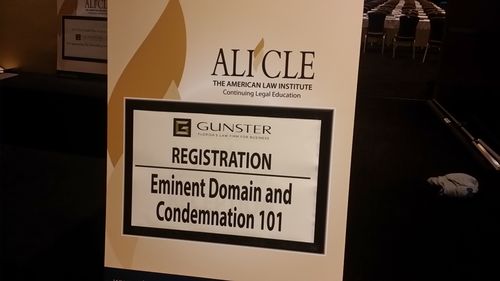
Here are the cases which I spoke about this morning at the 2015 ALI-CLE Eminent Domain and Land Valuation Litigation conference:

Here is our annual “proof of life” photo, the view from the dais. Proof

Continue Reading ALI-CLE 2015 Eminent Domain Conference: Links From Today’s Presentation

The Nevada Supreme Court’s opinion in Buzz Stew, LLC v. City of North Las Vegas, No. 15-03100 (Jan. 29, 2015) was the second time the court had issued a published ruling in the case, the first being Buzz Stew, LLC v. City of North Las Vegas, 181 P.3d 670 (Nev. 2008), in which it held that “the just compensation provision requires compensating a landowner for a lesser invasion of his property rights when a would-be condemnor acts improperly following its announcement of intent to condemn, such as by unreasonably delaying condemnation of the property.” The court remanded the case for a jury determination of whether the city unreasonably delayed condemnation.  

The jury didn’t think so, which resulted in this second appeal and the second opinion. Unfortunately, this round didn’t turn out as well for the property owner as the first, and the Supreme Court affirmed the jury’s

Continue Reading Nevada: That Contract For Future Condemnation Proceeds Isn’t Property