


Here’s the third and final amicus brief supporting the petitioner in Marvin M. Brandt Revocable Trust v. United States, No. 12-1173 (cert. petition filed Mar. 22, 2013). The Pacific Legal Foundation brief argues:

This case raises important questions regarding the common law of property ownership and the certainty of titles in property.

. . . .

As fully set out in the Petition, the Tenth Circuit’s rule directly conflicts with decisions of this Court as well as decisions from the Federal Circuit, the Court of Federal Claims, and the Seventh Circuit. Pet. at 17-34. The split of authority regarding ownership of abandoned railroad rights-of-way has been growing for years, and is well-documented. See, e.g., Pet. Cert. App. at 5-6, 22-24 (discussing split of authority); Hash v. United States, 403 F.3d 1308, 1318 (Fed. Cir. 2005) (same); 11 Powell on Real Property § 78A (referring to the

Continue Reading One More Amicus Brief In Railbanking Case: Growing And Well-Documented Circuit Split

Here’s the amici brief of the Cato Institute and the National Association of Reversionary Property Owners supporting the petitioners in Marvin M. Brandt Revocable Trust v. United States, No. 12-1173 (cert. petition filed Mar. 22, 2013).

In that case, the Tenth Circuit’s opinion held that the term railroad “right of way” as used in an 1875 federal statute was a grant of land to railroads in fee simple with an “implied reversionary interest” to the United States, and not merely an easement. The difference is that easements may be extinguished, while reversionary interests are not. In this case, the railway abandoned its use, after which the federal government instituted a quiet title action in federal court claiming it and and not Brandt owned the right of way.

The amici brief argues:

This case is important to the Association because the Tenth Circuit’s decision unsettles long-established property interests and clouds

Continue Reading Amicus Brief In Railbanking Case: Circuit Split May Upset Title To Millions Of Acres

Cle-logoFor those of you attending the Virginia Eminent Domain Conference, here’s the expanded papers on “Tough Takings Questions: Regulatory Takings, Zoning Issues and Judicial Takings” and Public Use issues.

Use the password provided at the conference to open the pdf’s. It’s the same p/w for both. If you forgot the password, email me.

For those who did not attend, sorry folks, there are some benefits to coming to a conference! Y’all are going to have to wait for a bit — after a decent interval to allow the attendees to get their money’s worth, we’ll remove the password.

For more about the cases and books we discussed yesterday during my presentation on “Virginia’s Place in National Eminent Domain Trends, check these out:

  • Lingle v. Chevron, U.S.A., Inc., 544 U.S. 528 (2005) (gas station rent control, and the demise of the “substantially advance” test as a takings test).

     
    Continue Reading Materials From Today’s Virginia Eminent Domain Conference

    Here’s the amicus brief we filed today on behalf of our colleagues at Owners’ Counsel of America, urging the U.S. Supreme Court to grant cert in Marvin M. Brandt Revocable Trust v. United States, No. 12-1173 (cert. petition filed Mar. 22, 2013).

    That petition asks the Court to review a Tenth Circuit decision that continued a lower court split about the meaning of the term railroad “right of way” as used in an 1875 federal statute and federal land patents subject to the 1875 Act. The issue is whether the federal government retained an “implied reversionary interest” when it issued these patents, or whether these grants were subject only to a railroad easement. The difference is that easements may be extinguished, while reversionary interests cannot. In this case, the railway abandoned its use, after which the federal government instituted a quiet title action in federal court asserting

    Continue Reading Amicus Brief In Rails-to-Trails Case: Switching Tracks To Undermine Takings Claims

    When reading the Ninth Circuit’s latest foray into the regulatory takings doctrine which holds that a muncipal rent control ordinance did not qualify under Penn Central (MHC Financing Ltd P’ship v. City of San Rafael, No. 07-15983 (Apr. 17, 2013), we were reminded of the opening line in Andy Williams’ signature tune “Love Story” —

    Where do I begin …”

    But before we begin, two preliminary thoughts. First, the district court’s decision finding that San Rafael’s mobile home rent control ordinance worked a taking of the mobilehome park owner’s property because it reduced the value by more than 80% was not some one-off aberration by a conservative district judge out on a lark. No, the decision was by the now-retired Vaughn R. Walker, the same judge who invalidated California’s Proposition 8 in one of the same-sex marriage cases currently before the Supreme Court.

    Continue Reading The Ninth Circuit Botches Regulatory Takings Again

    This just in: the Ninth Circuit has issued an opinion in MHC Financing Ltd P’ship v. City of San Rafael, No. 07-15983 (Apr. 17, 2013), reversing the District Court’s decision that the city’s mobilehome rent control ordinance was a taking under Penn Central.

    More, after a chance to review the opinion.

    MHC Financing Ltd. P’ship v. City of San Rafael, No. 07-15982 (9th Cir. Apr. 17, 2013)


    Continue Reading Ninth Circuit: No Penn Central Taking In Rent Control Ordinance

    Here’s one to brighten your day, courtesy of the the U.S. District Court for the Middle District of Flordia (that’s Tampa, to all you non-Floridians). In Hillcrest Property, LLP v. Pasco County, No. 8:10-cv-819-T-23TBM (Apr. 12, 2013), the court held the county’s “Right of Way Preservation Ordinance” that allows it to land bank for a future road corridors by means of an exaction (more details on the ordinance below), is “both coercive and confiscatory in nature and constitutionally offensive in both content and operation.” Slip op. at 4.

    We’ve seen this situation before — the government wants to build roads, but it either doesn’t have the money to buy or condemn the necessary property to do so, or it simply figures it can get it another way. The county had such plans, and designated future transportation corridors on its comprehensive plans. In 2005, the county adopted the

    Continue Reading Fla Fed Ct: Exaction Scheme Is “Constitutional Mischief” To Avoid “Nettlesome Payment of ‘Just Compensation’”

    You’d think the proposition in the title of this post, upheld today by the U.S. Court of Appeals for the Federal Circuit in Ladd v. United States, No. 2012-5086 (Apr. 9, 2013), would seem kind of obvious. That a landowner could not be charged with notice that a government act is a taking if the government admits to not even knowing about the event? But it wasn’t, and required a court of appeals’ opinion to lock it down. 

    This case is the latest from our colleague Thor Hearne. Readers know Thor as our semi-regular updater of the latest from the Court of Federal Claims in “rails-to-trails” takings cases, and this appeal is from a Court of Federal Claims case on that subject.

    The Federal Circuit has a “bright-line rule” that the six year statute of limitations begins to run on a physical takings claim in a rail-to-trail case

    Continue Reading Federal Circuit: Statute Of Limitations In Tucker Act Doesn’t Start Running Until Govt Provides Notice Of The Taking

    IMG_20121012_135714

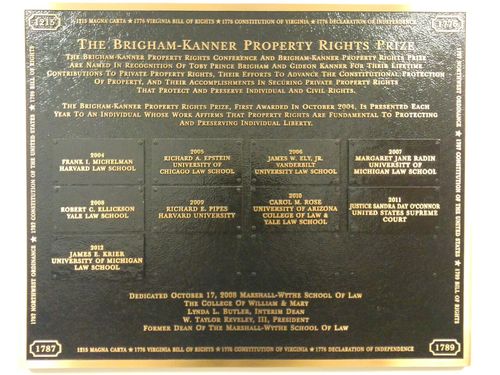
    William & Mary Law School, host of the annual Brigham-Kanner Property Rights Conference, has announced that Columbia Law School Professor Thomas W. Merrill will receive the 2013 B-K Prize at the conference (October 17-18, 2013, Williamsburg, Virginia). The photo above is of the plaque on the wall at the William & Mary Law School listing B-K Prize winners.

    The Conference agenda and speakers have yet to be finalized, but here’s the tentative list of topics:

    • The Impact of a Leading Property Scholar: Defining the Essence of Property
    • Promoting Government Forbearance
    • The Implications of the Court’s Recent Takings Cases
    • Property Rights in Times of Transition

    We spoke at the 2012 Conference in Williamsburg, and attended the 2011 Conference in Beijing. The 2013 lineup sounds pretty good, so mark your calendars. Continue Reading 2013 Brigham-Kanner Property Rights Prize: Professor Thomas Merrill

    Here’s what’s on our reading list today:

    • Here’s the latest chapter in the saga of one Fane Lozman, whose titling at windmills got some Supreme Court love recently when the Court held that his floating home was not a “vessel” under admiralty law, and a Florida city was wrong to seize it. My Damon Key colleague Mark Murakami reports on the 11th Circuit’s recent ruling in Lozman’s related federalcivil rights case. Houseboat Redux – Eleventh Circuit Reinstates Lawsuit (via Hawaiioceanlaw.com). 


    Continue Reading Wednesday Round-Up: Houseboat Redux, Backtracking Post-Kelo, Arkansas Game Remand, Big Gulps