It looks like our crystal balls are working.

Wait, that didn’t come out the way we quite intended, so let’s rephrase. Recently, we and others suggested paying attention to the property rights cases on the Supreme Court’s cert docket, paying particular attention to a case out of the Ninth Circuit, Horne v. United States Dep’t of Agriculture, 673 F.3d 1071 (9th Cir. 2011).

In Horne, the Ninth Circuit concluded that the defensive takings claim raised by raisin farmers who qualified as “raisin handlers” under federal regulations and thus were required to “reserve” (donate) 47% of their crop to the government, was not ripe because the farmers could seek just compensation in a Tucker Act claim in the Court of Federal Claims. The court dismissed the case for lack of jurisdiction. That opinion replaced an earlier opinion holding that the reserve requirement was not a taking because the

Continue Reading SCOTUS Grants Cert In California Raisins Takings Case

Believing that discretion was the better part of valor, we didn’t think there would be a challenge to the Hawaii Intermediate Court of Appeals’ opinion in Leone v. County of Maui, No 29692 (June 22, 2012). But we were wrong, and the County of Maui is going all in. 

Update Dec. 12, 2012: cert rejected.

The County has filed a cert application (remember, under Hawaii appellate procedure we don’t “petition” for cert, we “apply”) arguing that a property owner faced with the County’s refusal to even process its request for a use permitted by zoning has an obligation to appeal that refusal up the County’s administrative chain. The reason for the refusal to even consider the request was that the proposed use, while permissible as of right under applicable zoning, was inconsistent with the Community Plan designation (the same as General Plans in most other places), so the

Continue Reading New HAWSCT Cert App: Williamson County Ripeness Requires Property Owner Change The Law

13.LULHIIt’s back! Time once again for the bi-annual Hawaii Land Use Law Conference, to be held January 17 and 18, 2013 (Thursday and Friday) at the Downtown YWCA (a very convenient venue).

Planning co-chairs Professor David Callies and Ben Kudo have once again assembled a stellar faculty and put together an agenda that covers most topics of interest.

We’ll be moderating a panel on “Development Through Exemptions – The Evolution of Reclassifications, Permitting, Land Use &Development in Hawaii: The Unintended Consequences ofan Increasingly Complex System of Regulations,” featuring panelists Linda L.W. Chow (Deputy Attorney General State of Hawaii), Oswald K. Stender (Office of Hawaiian Affairs), and Kali Watson (Hawaiian Community Development).

Two highlights of the conference:

First, Mike Berger will give the keynote presentation on our favorite topic, regulatory takings: “Taking a Critical Look at 30 Years of the Supreme Court’s Taking Jurisprudence.” Mike has taken the lead in

Continue Reading Mark Your Calendars: 10th Hawaii Land Use Law Conference (Jan. 17-18, 2013)

Check out “Property rights take center stage in disputes over wetlands, flooding,” by Greenwire‘s Lawrence Hurley, asking whether the U.S. Supreme Court’s recent “flurry of activity” in property cases augurs a renewed interest in these issues by the Court, or is, as lawprof John Echeverria is quoted as suggesting, “serendipity.”

So far this Term, the Court has agreed to review two major property rights cases, Arkansas Game & Fish Comm’n (is government-caused flooding a taking) and Koontz (do the Nollan/Dolan limitations for land exactions apply to government demands for cash), and could grant cert in others. Lawprof Jonathan Adler suggesting this might not be a new trend, but simply “a return to the norm.”

One of the views noted in the article is ours:

In analyzing why property rights is making a comeback at the high court, some court-watchers point to an active and ideologically driven

Continue Reading Supreme Court Again Focused On Property Cases?

The three-part Penn Central test for an ad hoc regulatory taking tasks courts with evaluation of the economic impact of the regulation on the property’s use, the property owner’s distinct investment-backed expectations, and the character of the government action. Throw all of these “factors” into a pot, stir, and voila, the answer of whether the regulation goes “too far” is supposed to emerge. But try as they might, many courts don’t really have a good idea of how to apply this test, even though in Lingle, the Supreme Court affirmed that it remains the “default” analysis to evaluate most takings claims.

The latest regulatory takings opinion from the Ninth Circuit, Laurel Park Community, LLC v. City of Tumwater, No. 11-35466 (Oct. 29, 2012) is another example of a court applying the test, in this case to evaluate property owners’ claims that the enactment of a new zoning

Continue Reading 9th Cir: No Facial Penn Central Taking In Ordinance Creating Mobile Home Zoning

You can take the Justice out of the Court, but you apparently can’t take the Court out of the Justice. Retired Justice John Paul Stevens has added the “ninth vote” (his words, not ours) in Stop the Beach Renourishment, Inc. v. Florida Dep’t of Environmental Protection, No. 08-11 (June 17, 2010), the case is which the other eight Justices all agreed that the Florida Supreme Court had not changed the law, so there had been no “judicial taking.” Four Justices, however, opined that if a court declares that what was once an established right of private property no longer exists, it has taken that property in violation of the Takings Clause.

Justice Stevens sat that one out, recusing himself because news stories had noted his wife owned a beachfront condo in Ft. Lauderdale. But the lure of adding his reaction to Justice Scalia’s opinion has proven too much to

Continue Reading Justice Stevens, Recused In The “Stop The Beach Renourishment” Case, Weighs In On The “Stop The Beach Renourishment” Case

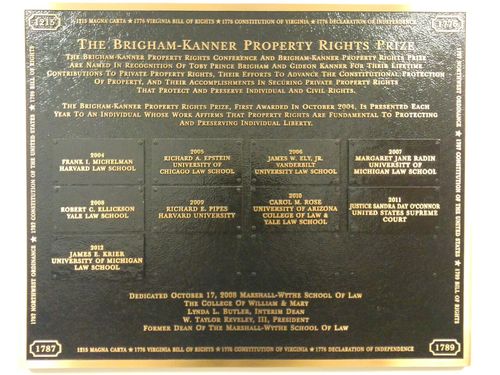
Here are my remarks from last week’s Brigham-Kanner Property Rights Conference at the William & Mary Law School in Williamsburg, Virginia. Our panel spoke on “Property Rights in Times of Economic Crisis,” and included lawprofs James W. Ely (Vanderbilt), William Fischel, (Dartmouth), and Eric Kades (William & Mary). See the complete faculty list and agenda here.

+++++++++++++++++++++++++++++++++++++++

Aloha, I bring you greetings from the land of Midkiff, the land of Lingle.

I practice in the jurisdiction that believed it would cure our economic ills to use eminent domain to bust up the legacy land trusts, and make sure that everyone who owns a home could also own the fee simple interest.

Which they may now do, provided they can afford our median price for a single-family residence, $637,000.

I practice in the jurisdiction that believed that it would be a good idea to try and bring

Continue Reading Professor Ely, You Magnificent Bastard, I Read Your Book!

In July, we posted the opening brief in Ladd v. United States, the case in which the Court of Federal claims dismissed the property owners’ Fifth Amendment takings claim stemming from a rail conversion. The CFC held that the claim was filed past the six-year Tucker Act statute of limitations even though the government did not provide the owners notice of the action that they assert was a taking.

The appeal, now pending in the Federal Circuit, asks whether the federal government can take an owner’s property without providing any notice to the landowner, and avoid its constitutional obligation to pay compensation because the statute of limitations began to run when the government issued the order, not when the landowner had notice of the government’s order taking their property? Our colleague Thor Hearne has sent along the recently-filed Reply Brief. which argues:

The government defends the CFC’s dismissal

Continue Reading Reply Brief In Fed Cir Rails-to-Trails Appeal: Statute Of Limitations Doesn’t Start To Run Until Gov’t Gives Notice Of The Taking