


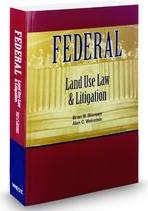
P13513986-160025L I’ve just received my copy of the 2010 revision of Federal Land Use Law & Litigation by Brian W. Blaesser and Alan C. Weinstein (West, $225).

Here’s the description of the book from West’s site:

Examines all federal, constitutional, and statutory limitations on local land use controls, discussing cases, regulations, liability, defense strategies, doctrines, and antitrust restrictions. Comprehensively reviews Supreme Court and lower federal court decisions that consider the constitutionality of land use regulations. Discusses complicated free speech issues affected by federal land use law, and municipalities exercising home rule powers. Examines issues such as: constitutional and statutory limits, First Amendment limitations on land use controls, federal remedies and attorney’s fees, liability and immunity issues, litigation guidelines, zoning, subdivision controls, growth management, model complaints, and selected constitutional and statutory decisions.

Federal Land Use Law & Litigation is an eminently useful single-volume research and reference guide. It’s well-organized, and although it

Continue Reading Book Review: Federal Land Use Law and Litigation, 2010 edition

The State of Hawaii has filed a brief responding to the amicus brief we filed in June in In re Trustees Under the Will of the Estate of James Campbell, No. 30006, an appeal now under review by the Hawaii Intermediate Court of Appeals. The issues in the case include the nature of “Torrens” title and the scope of the “public trust” in water resources.

Hawaii is one of the few remaining states retaining its Torrens system of title registration (two others are Massachusetts and Minnesota). We call it “Land Court,” a system in which the State guarantees indefeasible title to the rights and interests reflected in the title register. In Campbell, the State of Hawaii claims that title to property on Oahu’s north shore which was registered and confirmed to the Campbell Estate by the Land Court in 1938, is subject to the State’s ownership of “all

Continue Reading Final Brief In Torrens Title And Public Trust Appeal

Here are items we’re reading today, in no particular order:

  • Bill Ward’s thoughts on Klumpp v. City of Avalon, the recent New Jersey Supreme Court case about inverse condemnation and beach restoration. Our take here.


Continue Reading Wednesday Potpourri: Inverse Condemnation And Beaches, Rail Takings, And More “Adult-Oriented” Land Use

Today, we bring you guest commentary on Stop the Beach Renourishment, Inc. v. Florida Dep’t of Environmental Protection, No. 08-1151 (June 17, 2010), last week’s Supreme Court decision on judicial takings and ownership of replenished beaches. 

++++++++++++++++++++++++++++++++++++++++++++++++++++++++++++++++

Beach Decision Draws No New Line in Sand

But high court launches debate about topic of judicial takings

By DWIGHT MERRIAM

On June 17, the U.S. Supreme Court handed down its decision in Stop the Beach Renourishment, its first property rights case since Kelo, Lingle and San Remo five years ago. The pundits pounced. Even the New York Times jumped on the dog pile with an editorial decrying Scalia’s promotion of judicial takings as “harebrained.”

The reaction is mostly overblown. This is a case the Court should not have taken. The Florida Supreme Court correctly decided the takings claim with a well-reasoned, rational analysis consistent with Florida precedent.

Coastal property

Continue Reading Guest Post: Beach Decision Draws No New Line In Sand

Today’s U.S. Supreme Court plurality opinion in the long-anticipated Second Amendment case, McDonald v. City of Chicago, No. 08-1521

In the late 19th century, the Court began to consider whether the Due Process Clause prohibits the States from infringing rights set out in the Bill of Rights. See Hurtado  v.  California, 110 U.S. 516 (1884) (due process does not require grand jury indictment);  Chicago, B. & Q. R. Co.  v.  Chicago, 166 U.S. 226 (1897) (due process prohibits States from taking of private property for public use without just compensation). Five features of the approach taken during the ensuing era should be noted. 

First, the Court viewed the due process question as entirely separate from the question whether a right was a privilege or immunity of national citizenship. See  Twining  v.  New Jersey  , 211 U. S. 78, 99 (1908) .

Second, the Court explained that the only

Continue Reading Takings, Guns, And Incorporation

In Muscarello v. Ogle County Board of Commissioners, No. 08-2464 (June 24, 2010), the U.S. Court of Appeals dismissed as unripe a claim the county’s grant of a special use permit to a neighboring property owner allowing it to construct windmills on its land was a taking. 

Ogle County granted Baileyville Wind Farms a special use permit to allow the construction of 40 windmills on its property. Muscarello owns the adjoining property and brought suit in federal court for a variety of federal and state law claims. See pages 4-5 of the slip opinion for the details of the “laundry list” (in the court’s words) of allegations of harm (“We glean from all this, taking it in the light most favorable to Muscarello, that she believes that the preconstruction of windmills will have uncompensated adverse consequences for her and her fellow nonresidential property owners. Muscarello sued to stop the

Continue Reading Seventh Circuit: Claim A Wind Farm Is A Taking Is Tilting At Windmills

We rarely post developments from trial courts, but every now and then a trial court order is so interesting that we deviate from our usual rule. Here’s one that’s worth sharing.

In Sterling v. California Coastal Comm’n, No. CIV. 482448 (Cal. Super. June 18, 2010), the San Mateo County Superior Court (the county immediately south of San Francisco) invalidated a permit condition imposed by the California Coastal Commission that would have required the property owners maintain their property “in active agricultural use,” meaning that they “either personally conduct agriculture on all their land or enter into a lease with a third party willing to engage in agricultural use on the land.” In other words, forced farming.

You read that right. Did we mention that the family seeking the permit are not farmers or ranchers, that the vast majority of the 143-acre parcel is not prime ag soil, that the

Continue Reading Permit Condition Requiring “Active” Farming Struck Down Under Nollan/Dolan

Yesterday, we attended and posted a long summary of the en banc oral arguments in Guggenheim v. City of Goleta, the case challenging the city’s mobile home rent control ordinance as a regulatory taking, now pending in the Ninth Circuit.

Today, the court posted the sound recording of the argument.

Download it here (caution, it is a 23 MB wma file, meaning you’d best have a broadband connection and a Windows Media Player).

The argument was also broadcast from the Pasadena courthouse to the San Francisco, Portland, and Seattle courthouses, so we’re hoping that the video is eventually posted. The issues in the case aside, it was a very good example of high-level appellate advocacy.Continue Reading Oral Argument Recording In Ninth Circuit Rent Control Taking Case (Guggenheim)

Continued from Part II

The court was not much easier on the City’s attorney, even though one might think that the hard time they gave the property owners’ counsel indicated they were more sympathetic to the City’s arguments.

Right off the bat, Judge Callahan asked Schwartz whether he “conceded” [appellate advocate alarm bells going off] that there can be a facial Penn Central taking. This seemed to be a response to Judge Rymer’s questions to the property owners’ lawyers of whether “there is such an animal.” If Schwartz were to concede it, issue gone. He did concede it, but only barely. “Yes,” he answered, there can be such a thing, but it is difficult to imagine it, since the Penn Central test is “an ad hoc, factual inquiry.” Judge Callahan asked whether the Penn Central factors “bleed over to the merits” of a facial challenge, and whether the court

Continue Reading Ninth Circuit Rent Control Taking Case (Guggenheim) En Banc Oral Argument Report pt. III

Continued from Part I

Coldron seemed to sense that the court was in danger of veering off track and buying into the argument in the amicus brief filed by the League of California Cities and California State Association of Counties in support of the city about the claim being time-barred. Judge Clifton returned to his initial barrage of questions and asked whether the ordinance was the same after the City incorporated, and whether the park owners were seeking a “windfall” from that event. Recall that Goleta was originally not an incorporated city, so these parks were subject to the County’s mobile home rent control ordinance. When the City incorporated, the County ordinances continued in effect for a time, and after a gap (another issue in contention), the new City of Goleta adopted its own mobile home rent control ordinance.

Coldron responded to Judge Clifton’s question by noting that “there is

Continue Reading Ninth Circuit Rent Control Taking Case (Guggenheim) En Banc Oral Argument Report pt. II