SCOTUSblog posts the brief for the landowner in Wilkie v. Robbins, a land use case to be heard by the US Supreme Court on March 19.  The appeal arose after federal officials used their regulatory power to coerce a Wyoming rancher to give the government an easement without just compensation.  Among other claims, the rancher sued the government officials in their individual capacities for extortion under “RICO” laws.

The Court accepted review of these questions (from the cert petition):

1. Whether government officials acting pursuant to their regulatory authority can be guilty under the Racketeer Influenced and Corrupt Organizations Act (RICO), 18 U.S.C. 1961 et seq., of the predicate act of extortion under color of official right for attempting to obtain property for the sole benefit of the government and, if so, whether that statutory prohibition was clearly established.

2. Whether respondent’s Bivens claim based on the exercise of

Continue Reading ▪ Property Owner Brief in Land Use Extortion Case
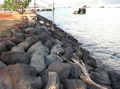
Seawall_1 No easy answers on seawalls, a column in today’s Advertiser, poses an interesting question.  Is it legal to walk on seawalls where there is no beach makai (seaward) of the wall:

Q. In Kane’ohe Bay on O’ahu, there are numerous stretches of the coastline that do not have a beach but rather, the ‘aina ends abruptly with a seawall that is about 2 to 5 feet high. Walking along the makai side of the seawall is not possible due to the depth of the ocean, so is it OK to walk on top of the seawall?  Would this be considered the high water mark?

A. There’s no easy answer, and this might be something for the Legislature to address.

The article then goes on to discuss the possibilities: the legislature can address the issue, or perhaps such seawalls are already subject to public use.  Let me add my

Continue Reading ▪ Trespassing on Shoreline Private Property

VeglineOne of 2006’s bigger cases was Diamond v. Bd. of Land and Nat. Res., 112 Haw. 161, 145 P.3d 704 (Oct. 24, 2006), involving the location of the “shoreline” for purposes of determining the buildable area on an oceanfront parcel. 

There was news coverage a-plenty, and I posted more than a few comments on the case and on the coverage.  Start here, then read this, this, this, then this post.

I’d bet this case will have lasting impact, even though it was not about the public-private boundary, and only analyzed the location of the “shoreline” under Hawaii’s Coastal Zone Management Act.Continue Reading ▪ 2006 Land Use in Review: Shoreline Tales

Professor Ilya Somin has posted a summary of the Kelo-fueled voter measures:

Why are the anti-Kelo referendum initiatives so much more effective than most of their legislative cousins? I suspect because the former are usually drafted by property rights activists rather than by state legislators. As I discuss in more detail in the posts linked above, politicians often have incentives to give voters the impression that they are “reforming” eminent domain without actually doing so. Activist groups have few if any such incentives and the reforms they draft are therefore likely to have fewer loopholes and be more effective in eliminating economic development takings.

Despite not getting enough votes to pass in California and Idaho, overall, it looks like the property rights issue received a big stamp of approval from the public. 

How about Hawaii?  Last session, the legislature did not pass any of the four eminent domain reform measures proposed after Kelo, and Hawaii law does not permit statewide initiative or referendum.  The only way to get a measure on a statewide ballot is a constitutional amendment, most of which originate in the Legislature. 

     Continue Reading ▪ Eminent Domain Reform a Big Winner

This post continues the prior, discussing the legal problems with the County of Maui’s proposed “affordable housing” impact fee ordinance.  The details of the proposed ordinance are reported here.

The blanket requirement that a property owner who wishes to make reasonable use of his or her property first donate some portion of it to the pool of affordable housing, or instead pay a cash fee, would be subject to challenge under both Hawaii Const. art. 1 § 20, and the Fifth Amendment to the U.S. Constitution.  The courts have established two requirements before an exaction may be imposed as a mandatory condition of development, “nexus” and “rough proportionality.”

First, there must be a close connection (also known as a “nexus”) between the condition imposed on the use of land and the social evil that would otherwise be caused by the unregulated use of the owner’s property.  See Nollan v. California Coastal Comm’n, 483 U.S. 825 (1987). 

Absent a nexus, a permit condition is “not a valid regulation of land use but ‘an out-and-out plan of extortion.’ ”  Id. (citations omitted).  In other words, the courts are worried that impact fees, in-lieu fees, and development exactions would become a form of “pay to play” where local governments are tempted to take advantage of the fact that a property owner seeks permits, and treat it as an opportunity to leverage land, other property, or cash in order to address other impacts not caused by the property owner. 

The constitutional protections are designed to keep property owners from being forced to shoulder a disproportionate share of public burdens, if it cannot be shown individually that they caused the problem.  The protections are “designed to bar Government from forcing some people alone to bear public burdens which, in all fairness and justice, should be borne by the public as a whole.”  Armstrong v. United States, 364 U.S. 40 (1960). 

In other words, if there is a shortage of affordable housing on Maui, the proposed bill’s requirements must be related to some condition the developer created.  The proposed bill makes no attempt to establish this factual nexus.  There are many factors that have resulted in the issue the Council seeks to address, not just developers. 

The second requirement is that there must be a close “fit” between the development exaction and the burdens created by a proposed development plan.  See Dolan v. City of Tigard, 512 U.S. 374 (1994).  As the Supreme Court held, if there is a “nexus” as required by Nollan, there must also be a “degree of connection between the exactions and the projected impact of the proposed development.”  Id. at 386.  In other words, there must be “rough proportionality” — “some sort of individualized determination that the required dedication is related both in nature and extent to the impact of the proposed development.”  Id. at 391.

Under this second requirement, it is difficult to imagine how the proposed bill would pass judicial scrutiny.  It proposes blanket rules and percentages, not “individualized determination[s] that the required dedication is related both in nature and extent to the impact of the proposed development.”  The law requires an examination of whether this development is causing a particular problem, and then only allows the government to address the problem in a proportional manner by imposing mitigation measures on a developer.

     Continue Reading ▪ Big Problems With Maui’s Proposed “Affordable Housing” Exaction Ordinance (pt II)

As reported here, the County of Maui is attempting to address a shortage of “affordable housing” by considering a new ordinance requiring property owners who wish to develop their land to first commit a percentage of it to “affordable housing” or pay a cash “in-lieu” fee.

There are two major legal infirmities with the proposal, which is, in essence, an impact fee:  First, Hawaii’s counties have no power to enact an “affordable housing” impact fee, or require affordable housing exactions.  Second, the bill does not conform to constitutional requirements of close tailoring to mitigate any impacts on the stock of affordable housing that particular developments may cause. 

This post deals with the first issue, the power of the counties.  The constitutional issue is examined in a separate post.

REASONABLE USE OF PROPERTY IS A FUNDAMENTAL RIGHT

All questions regarding regulation of property should start at the same point: that the right to own and make beneficial use of property is a fundamental constitutional right

The framers of the U.S. Constitution and the Hawaii Constitution both recognized that the ability to use property is the building block to all other freedoms, and the government may not place unreasonable conditions on that right.  As noted by the U.S. Supreme Court:

The right to build on one’s own property – even though its exercise can be subjected to legitimate permitting requirements – cannot remotely be described as a “governmental benefit.”

Nollan v. California Coastal Comm’n, 483 U.S. 825 (1987).  An “exaction” (a forced donation of land) or “impact” or “in-lieu” fees (cash payments instead of land exactions), may not impermissibly burden the right to build on one’s own property. 

HAWAII COUNTIES ONLY HAVE AUTHORITY TO ENACT IMPACT FEES WITHIN THE LIMITATIONS OF HRS § 46-142

Counties have been delegated a limited power to enact impact fees, but have no power to enact impact fees regarding “affordable housing.” 

An “impact fee” is defined by state law as:

[t]he charges imposed upon a developer by a county or board to fund all or a portion of the public facility capital improvement costs required by the development from which it is collected, or to recoup the cost of existing public facility capital improvements made in anticipation of the needs of a development.

Haw. Rev. Stat. § 46-141 (Supp. 2005).  The power of the counties to enact impact fee requirements is narrow, and must be exercised within the scope of the statutory authority.  Section 46-142 is the critical guideline for what the counties may and may not do:

(a) Impact fees may be assessed, imposed, levied, and collected by:

(1) Any county for any development, or portion thereof, not involving water supply or service; or

(2) Any board for any development, or portion thereof, involving water supply or service;

provided that the county enacts appropriate impact fee ordinances or the board adopts rules to effectuate the imposition and collection of the fees within their respective jurisdictions.

(b) Except for any ordinance governing impact fees enacted before July 1, 1993, impact fees may be imposed only for those types of public facility capital improvements specifically identified in a county comprehensive plan or a facility need assessment study.  The plan or study shall specify the service standards for each type of facility subject to an impact fee; provided that the standards shall apply equally to existing and new public facilities.

Haw. Rev. Stat. § 46-142 (1993 & Supp. 2005).

HRS SECTION 46-142(B)

Analysis of the statutory authority in a four-step process demonstrates that the proposed affordable housing bill falls outside the permissible scope of the County’s authority to enact impact fee laws.

Subsection (a) provides that impact fees “may be assessed” by the counties for development.  Thus, we start with a presumption that counties generally have the power to enact impact fee requirements, provided they do so by ordinance or agency rule.

However, the authority delegated to the counties by the statute is not unlimited or lacking specific guidelines.  Ultimate sovereignty, of course, rests with the people of Hawaii.  Haw. Const. art. I, § 1.  The people have delegated their power via the Hawaii Constitution to the state Legislature, which in turn has the power to establish counties.  See Haw. Const. art. VIII, § 1. 

Thus, a county is not a sovereign entity, but rather a political subdivision that must remain within the confines of whatever authority is delegated to it by the Legislature, no matter how narrow.

With respect to impact fees, those limitations are contained in Haw. Rev. Stat. § 46-142(b), so the second step in determining the scope of the County’s impact fee authority is focused on this critical language: “impact fees may be imposed only for those types of public facility capital improvements specifically identified in a county comprehensive plan or a facility needs assessment study.” 

Thus, if an impact fee purports to be for a “public facility capital improvement” — however that is defined — the County has no power to enact it.

A County has no power to enact affordable housing impact fees because the term “public facility capital improvement” is defined in section 46-141 to expressly exclude affordable housing:

“Public facility capital improvement costs” means costs of land acquisition, construction, planning and engineering, administration, and legal and financial consulting fees associated with construction, expansion, or improvement of a public facility.  Public facility capital improvement costs do not include expenditures for required affordable housing, routine or periodic maintenance, personnel, training, or other operating costs.

Haw. Rev. Stat. § 46-141 (1993 & Supp. 2005). 

Thus, a County’s general power to enact impact fees in subsection (a) of section 46-142 is expressly curtailed in subsection (b). 

Other sections of chapter 46 – the state law that establishes the limited powers of the counties – similarly do not provide any authority to assess impact fees, in-lieu fees, or exactions for affordable housing.  These provisions permit impact fees or exactions for other subjects, or limit the powers of the counties to address affordable housing issues by tools other than impact fees. 

Section 46-6 permits the counties to impose exactions, but only for “parks and playgrounds.”  Affordable housing exactions are not permitted.  Haw. Rev. Stat. § 46-6 (1993). 

Similarly, subdivision approval may be conditioned on a property owner’s agreement to provide access to beaches.  Haw. Rev. Stat. § 46-6.5 (1993).  There is no authority for affordable housing impact fees or exactions. 

Other portions of chapter 46 permit the counties to address affordable housing issues, but do not permit them to do so by enacting impact fee or exaction requirements.  For example, sections 46-15.1 and 15.2 permit the counties to develop and fund affordable housing projects either as public projects or in public-private partnerships with developers.  Counties may also issue bonds.  There is no authority in these sections, however, permitting counties to use impact fees or exactions to accomplish these goals.

The Development Agreement statute, Haw. Rev. Stat. § 46-121 et seq., permits the counties to enact development agreement ordinances providing a process for a county to enter into a voluntary agreement with a developer which may include affordable housing.

There is no authority in those sections allowing counties to impose mandatory requirements.

The constitutional problems with the bill are detailed in a separate post

    Continue Reading ▪ Big Problems With Maui’s Proposed “Affordable Housing” Exaction Ordinance (pt I)

The US Supreme Court today denied review to an appeal seeking to overturn Olympia, Washington’s requirement that a developer pay a “traffic impact fee” as a condition of developing a four-story office building.  In Drebick v. City of Olympia, the city demanded the developer pay the traffic impact fee even though the proposed office building was on the edge of town, and would not affect traffic. 

Exactions are land use law’s version of “pay to play.”  Local governments often condition development permits on a property owner’s agreement to “donate” land (exactions) or cash in-lieu fees (aka “impact fees”).  These demands only pass muster under the Fifth Amendment when they meet two requirements:

1.  They must have a logical connection (nexus) to the proposed development, and

2.  They must be be roughly proportional to the impact anticipated to be created by the proposed use. 

These requirements were first enunciated by the Court in Nollan v. California Coastal Comm’n and Dolan v. City of Tigard, respectively. 

They are designed to limit the obvious potential for abuse: if the government has unfettered ability to condition use permits on the owner’s concession to turn over property or money, the result, as the Court pointed out in Nollan, would be an “out-and-out plan of extortion,” and an impermissible burden on an owner’s right to make reasonable use of his or her own property. 

An example from my own experience: in a case involving an owner’s request to develop its own property, the head of the planning department testified that permission would not be forthcoming unless and until the owner agreed to give up “the goodies” (his word, not mine) for a public park, which just happened to be the most valuable portion of the parcel.  This illustration highlights another rationale for the exaction limitations — the legitimate concern that exactions would substitute as a compensation-and-due-process-free shortcut to an exercise of eminent domain power.  If the city needed a public park, it should have condemned and paid for it, not exacted it from the owner as a condition of use.  The Nollan/Dolan rules were meant to curb just this sort of demand.

The Drebick petition presented two questions: whether cash in-lieu fees are exempt from Nollan/Dolan, and whether exactions imposed by a legislature are similarly immune(disclosure: Pacific Legal Foundation filed the Drebick petition).

Denials of cert do not establish precedent, so today’s action has no effect on the law in other cases.   

Sidebar: commenting on the decision, PropertyProf Blog cheekily suggests the Court not grant review to another takings case for a few years to permit the lower courts to flush out doctrine, and to allow legal scholars to focus on other interests for a while.  Not to worry: the Kelo-Lingle-San Remo triad may have dampened whatever mojo the federal courts had for eminent domain and regulatory takings cases, even though there remain many issues, like those in the Drebeck petition, deserving of resolution.  In-lieu fees are a favorite of local governments (especially in Hawaii), even though they are of questionable constitutionality.

     Continue Reading ▪ Cert Denied in Exaction Appeal

According to this story, the County of Maui is in the process of revising its shoreline setback rules.

The county’s shoreline setback rules determine where beachfront landowners can build on their property. The current formula to determine a setback is 20 feet, plus 50 times the annual erosion rate of the property. The minimum setback is 25 feet, while the maximum is 150 feet.

The proposed amendments include increasing the base used in the setback formula from 20 to 25 feet.

Abbott said the change was needed because some landowners whose properties had zero erosion have argued they should have a 20-foot setback based on the formula.  He said the change would make the formula consistent with the minimum setback.

As I recently posted here, shoreline legal issues are a touchy subject, but in the rush to “protect” beaches, you cannot just blow by the property rights of owners.  Government escapes liability for regulations imposing “no build” easements (setbacks being a classic example) only to the extent that the regulation is closely tailored.  The reason advanced for Maui’s variable setback rules is the supposed history of beachfront erosion at particular locations, with a fixed “buffer zone” plus historical erosion rates added together to calculate the “no build zone” on a specific parcel.  The major justification for setbacks is protecting the homeowner from building on property that may eventually be eroded.

If so, it seems odd that if a shoreline parcel has had “zero erosion” that the owner should be subject to a setback at all.  What harm is caused by building where there has been no erosion, and what danger is being prevented?

    Continue Reading ▪ Review of Maui Shoreline Setback Rules Underway

Shoreline and beach issues in Hawaii are a sensitive and often heated topic.  It is natural that in an island state with 1,052 miles of coastline, people get passionate about beaches, especially when the economy relies in large part on images of sandy shores and beautiful ocean. 

But the very things that make Hawaii beautiful, just as naturally, also attract people who want to live near those beaches and ocean.  A recent story in the Honolulu Advertiser, Erosion hasn’t slowed shoreline construction, highlights many of the competing concerns when the desire to protect the shoreline runs into people’s homes: on one hand, the public is concerned about the perceived “loss” of sandy beaches, while on the other, the existing homes of shoreline property owners may be in danger, while other owners may be prevented by restrictive regulations from building upon their undeveloped property. 

That is not a recipe for compromise, or even reasoned discourse.  What I said in the July 2006 ABA Journal — in a story about seawalls and property rights in Florida — is just as true in Hawaii:

“It’s hard to find a middle ground on this,” . . . “Every time someone sneezes on the shoreline, it’s front-page news.”

In Hawaii, all beaches are public up to the “high wash of the waves,” as usually evidenced by the vegetation line.  This differs dramatically from the rule in other states, where the public beach ends at the mean high water mark. 

Several years ago, the Hawaii Supreme Court revisited the long-standing rule and “reinterpreted” a phrase (“ma ke kai“) to mean upper reaches of the wash of the waves, not mean high water mark.  The public-private boundary In Hawaii can therefore be much further mauka (inland) than in other states.  And as shorelines erode, this public-private boundary can move and encroach further on private property. Note: as shorelines accrete, the public-private boundary should, conversely, move further makai (seaward).  However, in 2003 the Hawaii Legislature enacted Act 73, which altered these age-old rules.  For a related post on a circuit court’s striking down of Act 73, go here.

Shoreline legal issues, like the shorelines themselves, are in flux.  The State Board of Land and Natural Resources recently revised its administrative rules regarding the definition of shoreline for certification and setback purposes to conform more closely to the common law definitions established by the courts.  These rules and other proposed regulations have not yet been challenged in the courts. 

My Damon Key colleague Sat Freedman has posted a very good primer on the subject of Shorelines, Setbacks, & Seawalls, detailing the different definitions of “shoreline” (setback vs public-private boundary), how Hawaii’s counties handle the administration of setbacks, and how seawall construction and other property protection measures may be impacted by restrictive regulation. 

In the back-and-forth on the issue, the question of the property rights of the owners of shoreline property should not get pushed aside.  The Fifth Amendment to the U.S. Constitution and article I, section 20 of Hawaii’s Constitution provide that private property may not be taken for public use without just compensation.  Property may be taken by overbearing regulation as well as outright confiscation (also known as a “regulatory taking” or “inverse condemnation” — so yes, you have reached the right blog), and the issue of whether the government has gone too far and crossed the line between permissible regulation and confiscation is sure to arise again.  The public often clamors for expansion of the public beach, with little to no concern shown for the property owners who are called upon to sacrifice their property upon the altar of the “public good” usually with no compensation. 

Those fortunate enough to own beachfront property — whether they are recent purchasers or long-time local residents (the law makes no distinction) — must vigorously protect their rights to insure they alone are not forced to bear the cost of a desired public benefit.Continue Reading ▪ Protecting Property Rights in Beachfront Land