Here’s the latest in an issue we’ve been following.

In Fletcher Properties, Inc. v. City of Minneapolis, No. A23-0191 (July 30, 2025), the Minnesota Supreme Court held that the city barring owners from refusing to rent residential properties to a prospective tenant because the applicant is on public assistance is not a taking. 

What is colloquially known as “Section 8” is a federal program “that provides rent subsides to eligible families … to help them pay for housing in the private market.” Slip op. at 2. This is a voluntary program, both for the tenant receiving the assistance as well as the lessor who enters the program by contracting with the public housing authority.

The City of Minneapolis added discrimination based on a tenant’s receipt of Section 8 assistance to the list of forbidden reasons for refusing to rent to a prospective tenants such as “race, creed, religion, ancestry
Continue Reading Minnesota: Requiring Landlords To Rent To Tenants On Public Assistance Is Not A Taking

PXL_20250624_180653444.MP

The room where it happened.

We’re not going to say much about the California Court of Appeal’s recent decision in Sheetz v. County of El Dorado, No. C093682 (July 29, 2025), which is back in the California court system after remand from the U.S. Supreme Court, because it is one of ours.  

Here’s the bottom line:

Upon further analysis as directed by the Supreme Court, we now conclude that the challenged permit condition (TIM fee) does not constitute an unlawful monetary exaction under the Nollan/Dolan test. The legislatively formulated generally applicable impact fee is not an unconstitutional condition imposed on land use in violation of the Fifth Amendment’s takings clause. Accordingly, we again affirm the judgment.

Slip op. at 5.

We don’t necessarily agree 100% with our colleague Ben Rubin’s assessment, but do urge you to read his piece, “California Court of Appeal Confirms Legislatively Enacted

Continue Reading Sheetz On Remand: “The legislatively formulated generally applicable impact fee is not an unconstitutional condition imposed on land use in violation of the Fifth Amendment’s takings clause.”

It appears that the U.S. Court of Appeals for the Eleventh Circuit has addressed the issue the U.S. Supreme Court sidestepped recently in DeVillier v. Texas, 601 U.S. 285 (2024): do you need Congress’s ok to sue for just compensation for a taking?  

In Fulton v. Fulton County Bd of Commissioners, No. 22012041 (July 31, 2025), a 2-1 panel of the court held that the Just Compensation Clause is indeed “self-executing,” meaning that even in the absence of a legislative recognition of a cause of action, an owner whose private property has (allegedly) been taken by government action may sue for compensation. 

The opinion starts off dramatically, with this:

In Greek mythology, the Greek gods condemned Tantalus to eternal hunger and thirst, all while forcing him to forever stand in a shallow pool of water under a tree with low-hanging fruit. Though the remedy for Tantalus’s hunger and

Continue Reading CA11: Congress Doesn’t Need To Legislate A Cause Of Action For Just Compensation

Here’s the latest in an issue we’ve been following for a long time.

In Jackson v. Southfield Neighborhood Revitalization Initiative, No. 166320 (July 16, 2025), the Michigan Supreme Court re-confirmed its ruling in Rafaeli v. Oakland County, that the government “keeping the change” after liquidating property to satisfy a delinquent tax debt is a taking, rejecting the claim that transferring the property to a non-governmental organization does not relieve the government of its obligation to provide compensation. 

There’s a lot going on here, and we’re not wading into too much detail both because it is one of ours, but also because this one is Michigan-specific. But we will say that this case is a good example of a court viewing things pragmatically, and calling out government action that seeks to work around a constitutional ruling. 

Here’s the heart of the court’s holding:

In this case, the operative

Continue Reading Michigan: Gov’t Can’t Avoid A Rafaeli Taking Just By Having A Proxy Do It

Here’s the latest in a case we’ve been following.

In Englewood Hospital & Medical Center v. State, No A-16-24 (July 16, 2025), the New Jersey Supreme Court rejected physical and regulatory takings claims made by hospitals which are required to treat nonpaying patients even though the Medicare reimbursements available will not cover the hospitals’ costs. 

Here’s the bottom line:  

Under the facts as presented in this case, we hold that charity care is not an unconstitutional “per se” physical taking of private property without just compensation. It does not grant an affirmative right of access to occupy hospitals; it does not give away or physically set aside hospital property for the government or a third party; and it does not deprive hospitals of all economically beneficial use of their property. We also hold that charity care is not an unconstitutional “regulatory” taking of private property without just compensation.

Continue Reading NJ: Forcing Hospitals To Lose Money To Treat Nonpaying Patients Isn’t A Taking

JLEPcover

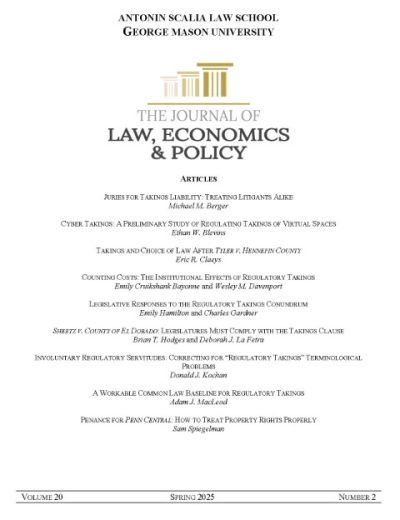
Last year, we attended a conference devoted to the future of regulatory takings, hosted by the Antonin Scalia School of Law (George Mason U), and Pacific Legal Foundation.

The publisher, the Journal of Law, Economics, and Policy has released the articles and essays from that conference, and made them available here

Here’s the list of articles:

  • Michael M. Berger, Juries for Takings Liability: Treating Litigants Alike
  • Ethan W. Blevins, Cyber Takings: A Preliminary Study of Regulating Takings of Virtual Spaces
  • Eric R. Claeys, Takings and Choice of Law After Tyler v. Hennepin County
  • Emily Cruikshank Bayonne and Wesley M. Davenport, Counting Costs: the Institutional Effects of Regulatory Takings
  • Emily Hamilton and Charles Gardner, Legislative Responses to the Regulatory Takings Conundrum
  • Brian T. Hodges and Deborah J. La Fetra, Sheetz v. County of El Dorado: Legislatures Must Comply With the Takings Clause
  • Donald J. Kochan, Involuntary Regulatory Servitudes:


Continue Reading New Property Rights Symposium Published – “Too Far: Imagining the Future of Regulatory Takings”

What’s going on in the Sixth Circuit? First, there was this opinion in Howard v. Macomb County, which in our view really missed the Knick vibe and resurrected the overruled Williamson County “state procedures” requirement.

Now there’s a doubling down, OPV  Partners, LLC v. City of Lansing, No. 24-2035 (July 9, 2025). Unpublished, most likely because it doesn’t add anything new to an existing existing circuit split, and relies on Howard. Neither OPV nor Howard uses the word “exhaustion” or even mentions Williamson County or worse yet, Knick. Nor do they mention administrative remedies. But that’s sure what it looks like to us.

The issue in OPV was whether the city is liable for, inter alia, taking OPV’s private property by denying a certificate of occupancy for residential units that OPV rented. The city had flagged these units for maintenance problems and hit them with “pink”

Continue Reading CA6 Adds To Williamson County Resurrection: You “Forfeit” Your Takings Claim When You Don’t Exhaust Administrative Procedures To Ask For Compensation

The latest episode of the Is That Even Legal?” podcast features a familiar voice, that of former Eminent Domain Podcast host, Clint Schumacher who joins host Bob Sewell as a guest to discuss takings by eminent domain, and by overregulation. 

Clint joins the ITEL Podcast to discuss a situation that has been in the news lately, the possible taking of American-born Pope Leo XIV’s childhood home in Illinois to preserve it. What was just an old house yesterday is today history worth preserving, apparently!

Here’s a description of the episode:

What happens when the government decides it needs your land? Does the Constitution really allow officials to seize your family home, farm, or business property against your will? The answer might disturb you.

Attorney Clint Schumacher, a leading eminent domain expert, joins us to unravel the complex world where constitutional rights, property ownership, and government power collide. Schumacher

Continue Reading New “Is That Even Legal” Pocast Ep: “This Land Is Your Land…Till It’s Not” (Clint Schumacher)

Righttoretrievecover

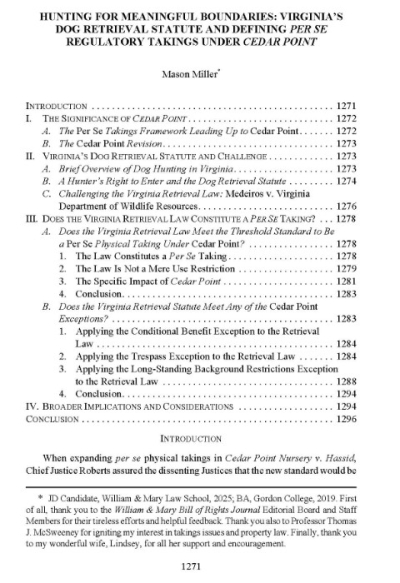
Be sure to read this recently-published piece in the William and Mary Bill of Rights Journal, Mason Miller, “Hunting for Meaningful Boundaries: Virginia’s Dog Retrieval Statute and Defining Per Se Regulatory Takings Under Cedar Point,” 33 Wm. & Mary Bill of Rights J. 1271 (2025). 

The article focuses on Virginia’s so-called “right to retrieve” law, Va. Code § 18.2-136 (“Fox hunters and coon hunters, when the chase begins on other lands, may follow their dogs on prohibited lands, and hunters of all other game, when the chase begins on other lands, may go upon prohibited lands to retrieve their dogs, falcons, hawks, or owls but may not carry firearms or bows and arrows on their persons or hunt any game while thereon.“).

Disclosure: our firm represented property owners in an earlier case challenging this statute, which is discussed in the piece. 

Here’s the Introduction

Continue Reading New Article: “Hunting for Meaningful Boundaries: Virginia’s Dog Retrieval Statute and Defining Per Se Regulatory Takings Under Cedar Point“

Screenshot 2025-06-30 201407

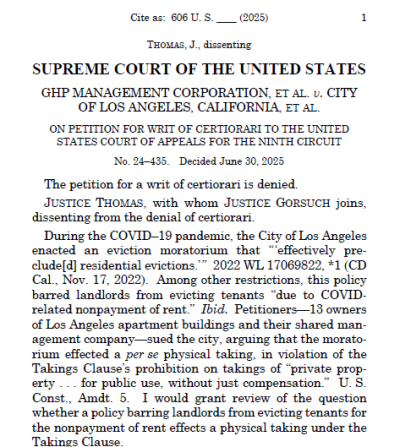
Yesterday, in this Order in a case we’ve been following, the U.S. Supreme Court declined to consider whether a municipal ordinance which allowed non-paying tenants to remain in the lessor’s property after the agreed-upon termination of a lease (nonpayment of rent) is a physical taking, or merely the regulation of the lessor/lessee relationship under the Yee theory.

You remember that theory? It goes like this: once an owner voluntarily rents property to a tenant, the government then allowing that tenant to remain rent-free when, under the rental agreement, the right to occupancy would otherwise be terminated (for failure to timely pay rent, for example) isn’t the government facilitating an unauthorized physical occupation (see, e.g., Kaiser Aetna), but rather is merely a regulation of the existing lessor/lessee relationship. The Ninth Circuit in this case, and other courts around the country have viewed Yee as compelling

Continue Reading The Other Shoe Drops: SCOTUS Declines Review Despite Acknowledged Split – Is Barring Owners From Evicting Nonpaying Tenants A Physical Taking?