According to that trustworthy source Wikipedia, in drama, the term deus ex machina (“God from the machine”) “is a plot device whereby a seemingly unsolvable problem in a story is suddenly and abruptly resolved by an unexpected and unlikely occurrence. Its function is generally to resolve an otherwise irresolvable plot situation, to surprise the audience, to bring the tale to a happy ending, or act as a comedic device.” It is mostly considered a “lazy or cheap” trope.

And that takes us to the various federal, state, and local eviction moratoria that are (or were) in effect at various points in the covid epidemic. To us, those have mostly seemed like cases of kicking the can down the road (to use another overworn trope) because although couched as merely temporary withholding of the usual eviction remedy for nonpayment of rent, in a great number of cases the practical effect
Continue Reading What The Deus Ex Machina? – Federal Court Complaint: California’s Eviction Moratorium Is A Taking

You just have to love any case that starts with the sentence, “Dried mangoes form the core of this commercial dispute, which involves a Fifth Amendment challenge…” Shades of Horne!

Well, you can add mangoes to your “healthy snack” list (hat tip CJ Roberts) and include the Supreme Court of Guam’s opinion in Western Sales Trading Co. v. Genpro Int’l, Inc. (Guam), No. CVA19-023 (July 28, 2021), in your oeuvre of fruit/takings cases, because the court held that a territorial statute permitting a judgment creditor to take property from a third party (who obtained it from the judgment debtor) violates the Takings Clause. The court concluded that Guam Code Ann. §§ 23401-23406 (the “turnover statute”) works an unconstitutional taking in violation of the Fifth Amendment and the Guam Organic Act. Follow along.

The statute allows a judgment creditor to apply to the Guam courts for an

Continue Reading Inorganic Fruit: Statute That Allows Creditor To Seize Property From Third Party Rec’d From The Debtor Is A Taking

Programming note: as we noted here, we’ve recently moved our email subscribers to a new service. If you are already subscribed to our email updates you should not need to do anything, except look for the emails coming from Feedblitz, not Feedburner. If you want to sign up for email updates anew, go here. If you experience technical issues, or receive duplicate email notifications, please let me know.

Now back to your regularly scheduled programming…

20151205_150106

Check out this Complaint, filed last week which asks the U.S. Court of Federal Claims to award property owners an unspecified amount (noted as $26 billion in the cover sheet) in just compensation for the taking of the plaintiffs’ property by the Center for Disease Control’s order temporarily halting residential evictions.

The Complaint alleges a physical invasion taking because it precludes “property owners from excluding [tenants] and leasing

Continue Reading New Takings Complaint: $26 Billion For CDC’s Eviction Moratorium

All the topics you want to know about, presented by top-notch faculty from across the nation. Sessions include:

  • Property Rights as Civil Rights
  • Eminent Domain National Update
  • Just Relocation: Understanding the Law and Regulations to Ensure Fairness
  • Challenging Public Use: Lessons From a 67-Day Trial
  • COVID Takings
  • Federal Court and the Daubert Challenge: How to Prepare
  • Did the Supreme Court Signal a New Direction in Property Rights in Cedar Point Nursery?
  • How to Position Your Client for the Fallout When Projects Don’t Get Built
  • Rural Broadband and the Emerging Constitutional Challenges
  • Are Precondemnation Entry Statutes Still Valid After Cedar Point Nursery?
  • How Condemnor and Property Owners’ Counsel Prepare the Battlefield
  • How Will the Trillion Dollar Infrastructure Bill Impact Your Practice?
  • Ethics
  • …and more, including a full slate of networking and social events!

We’ve sold out the last few years, so don’t miss out. Room block now taking reservations. Continue Reading Join Us For The 39th Annual ALI-CLE Eminent Domain & Land Valuation Litigation Conference, Jan 26-29, 2022 (Scottsdale, AZ)

Iin North Mill Street, LLC v. City of Aspen, No. 20-1130 (July 27, 2021), the U.S. Court of Appeals for the Tenth Circuit held that a claim that the city’s denial of a rezoning application to allow residential development effected a taking was not ripe because the city’s process also allows a property owner to ask the city to allow site-specific development even if not in conformity with the current zoning, and the plaintiff had not availed itself of this process. Thus, the takings claim was not ready for judicial review under “final decision” Williamson County ripeness.

But the really interesting part of the opinion is a footnote. See slip op. at 15 n.9. There, the court noted that it is joining the majority of other courts in holding that “final decision” ripeness is not a matter of a lack of Article III jurisdiction. Rather, it is merely a

Continue Reading CA10 Deepens The Split: Williamson County’s “Final Decision” Requirement Is Prudential, Not Jurisdictional


Talk amongst yourselves.

We’ve had our say, so in this post — the sixth and final post in a series of deeper dives about June’s U.S. Supreme Court opinion in Cedar Point Nursery v. Hassid , No. 20-107 (June 23, 2021) — we’re linking to what others are saying about the case.

Here are all of the posts in our Cedar Point series:

And in case you missed the live webcast on Friday, July 16, 2021 that featured expert analysis of the case, please don’t miss listening to the recording of ALI-CLE’s “Takings and Eminent Domain After Cedar Point: What Practitioners

Continue Reading Cedar Point Part VI: What Others Are Saying

In this post — the fifth and penultimate post in a series of deeper dives that we’re posting about June’s U.S. Supreme Court opinion in Cedar Point Nursery v. Hassid, No. 20-107 (June 23, 2021) — we’ll be trying to take some educated guesses about what the decision means for the future.

Here are all of the posts in our Cedar Point series:

And in case you missed the live webcast on Friday, July 16, 2021 that featured expert analysis of the case, please don’t miss listening to the recording of ALI-CLE’s “Takings and Eminent Domain After Cedar Point: What

Continue Reading Cedar Point Part V: Help Us Help You

IMG_20170323_142808

Here’s one we’re now following, thanks to a heads-up from a northern colleague.

The Supreme Court of Canada has granted leave to appeal in a case involving what Canadian law calls “de facto expropriation” (what we’d call “regulatory takings”).

Before you review the Application for Leave to Appeal by the property owner, and the responsive memorandum for the government, recall that even though Canada’s approach to “takings” is not a constitutional question, but nonetheless like the southern version of the doctrine, focuses on whether some government act has the effect of acquiring from the owner a beneficial interest, or removed all reasonable uses. See Canadian Pacific Railway v. Vancouver (City), 1 S.C.R. 227, 2006 SCC 5 (2006).

In Annapolis Group Inc v. Halifax Regional Municipality, the Supreme Court will consider whether Halifax’s refusal to approve Annapolis’ development applications (consistent with its residential zoning, more specifically “future serviced

Continue Reading Canada Supreme Court To Review De Facto Expropriation (aka Regulatory Takings) Case

Floodsfiresarticle

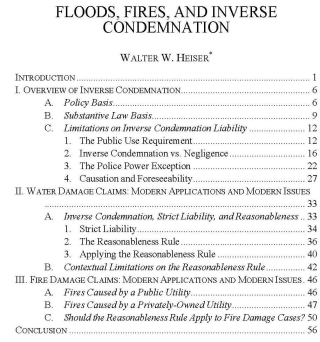
Here’s what we’re reading today (inter alia): Walter W. Heiser, Floods, Fires, and Inverse Condemnation, 29 N.Y.U. Envtl. L. J. 1 (2021).

From the Introduction:

This Article examines the proper application of the doctrine of inverse condemnation in two important areas: flood damage to private property caused by a public improvement (e.g., a flood control, storm drain, or sewer project), and wildfire damage to private property caused by a project (e.g., electricity or telephone lines) undertaken by either a public or privately-owned utility. Under the doctrine of inverse condemnation, a plaintiff may recover for a physical injury to private property caused by a public improvement as deliberately designed, constructed, or maintained.

….

How courts define the standard of liability in inverse condemnation cases will become increasingly important in both the flooding and wildfire contexts. The continuing nature of climate States and more wildfires in others. This Article examines

Continue Reading New L Rev Article: “Floods, Fires, and Inverse Condemnation”

Permanentortemporary

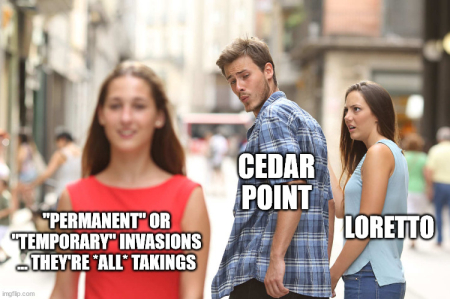
In this post — the fourth in a series of deeper dives that we’re posting about June’s U.S. Supreme Court opinion in Cedar Point Nursery v. Hassid, No. 20-107 (June 23, 2021) — we’ll be discussing the two separate opinions, Justice Kavanaugh’s concurrence, and the Justice Breyer-authored dissent.

Here are all of the posts in our Cedar Point series:

And in case you missed the live webcast on Friday, July 16, 2021 that featured expert analysis of the case, please don’t miss listening to the recording of ALI-CLE’s “Takings and Eminent Domain After Cedar Point: What Practitioners Need to Know

Continue Reading Cedar Point Part IV: The Other Opinions