Although the U.S. Court of Appeals for the Eleventh Circuit’s opinion in Warner v. City of Marathon, No. 2024-10901 (May 27, 2025) is unpublished, we’re posting it here because, as the title notes, this one might be the last victim of Williamson County‘s “state procedures” requirement.

As frequent flyers know, between 1985 and 2019 a property owner who claimed that a local government action resulted in a de facto taking of property under the Fifth Amendment could only raise that claim in a state court. The theory being that there had not been a taking without just compensation unless and until the state courts had told a claimant no compensation. And thus, the federal takings claim (and along with it, federal court jurisdiction) was not ripe until a property owner lost a state claim in state court.

Once that occurred it was theoretically possible, now having ripened a
Continue Reading The Final Victim Of Williamson County?

In this order, the U.S. District Court for the Northern District of Illinois temporarily enjoined enforcement of Chicago suburb Glen Ellyn‘s prohibition on renting property for less than 30 days.

Blakelick owns a five-bedroom single family home that when purchased was not located in Glen Ellyn. Since 2022, it has been offering the home for short-term rental on platforms like Airbnb. But in 2024, the property was annexed by the Village of Glen Ellyn. Blakelick continued to rent the property for less than 30 days. 

The dispute apparently began six months earlier when a neighbor began complaining about noise, culminating in the threat to “do everything in [his] capability to see to it that such use of property is banned in this area.” Slip op. at 2. Apparently he was successful, because in 2025, the Village, now having jurisdiction over the property, adopted an ordinance prohibiting owners from

Continue Reading Property Owner Likely To Succeed On Claim That Prohibition Of Short-Term Rentals Is A Penn Central Taking

We’re back to bump stocks. Indeed, we have covered cases raising similar issues so we’re not going into too much detail on the U.S. Court of Federal Claims’ recent decision in The Modern Sportsman, LLC v. United States, No. 19-449 (May 8, 2025), and we’ll just assume you, like us, have been following along with this issue.

Suffice it to say that the federal government adopted regulations defining these devices as prohibited machine guns and gave those in possession 90 days to either turn them over to the government, or to destroy them. The plaintiffs destroyed their bump stocks and then sued the federal government for a taking.

The CFC dismissed the complaint under the government’s “police power” authority to prohibit contraband and noxious items. As we noted in this post, the line between uncompensated destruction and compensated takings was not as clear at the CFC saw it (the Armstrong rationale cannot be ignored, even where a taking may be for a very good public reason), and thus the Federal Circuit affirmed, but shifted the rationale from police power to a lack of a private property interest. After the Supreme Court denied cert, “that was that.” Slip op. at 2.

Meanwhile, other bump stock owners challenged the validity of the administrative rule declaring these things machine guns. And there, the owners found more success, with the Supreme Court eventually concluding that the agency lacked the authority to adopt the bump stock rule. The owners here “then asked this Court to revive this lawsuit, which the Court did … [t]he next day, plaintiffs amended their pleadings to add an illegal exaction claim in addition to their takings claim.” Slip op. at 3. 

The government sought dismissal, arguing that the bump stock owners alleged a physical taking but the government hadn’t physically seized anything. It merely required the owners to destroy the bump stocks: as the CFC put it, the government “acknowledges that plaintiffs alleged that ‘the Rule required bump stock owners to destroy or surrender the devices to ATF.’ Reply 2. That does not pass muster for the government, however, because the government ‘did not seize any devices or otherwise physically invade plaintiffs’ property.’ Id. at 3.” Slip op. at 4. In short, we didn’t actually seize anything of yours, plaintiffs; we merely required you to destroy your property. Really. 

The CFC wasn’t having any of that, and rejected this too-clever-by-half argument:

The Court cannot agree. Let us be clear that the government need not literally force private persons to turn over their property for a taking to occur; a legal requirement is sufficient. For example, in Horne, the Supreme Court held that an administrative order requiring raisin croppers to “give a percentage of their crop to the Government, free of charge” effected a compensable appropriation. 576 U.S. at 355. The government did not literally oust the farmers from possession of the raisins, yet a taking occurred because the order made a “formal demand” backed by fines and penalties. Id. at 362, 367–68. It is the same here. The Rule plainly states: “This final rule requires the destruction of existing bump-stock-type devices.” 83 Fed. Reg. at 66,549. It then instructs: “Individuals who have purchased bump-stock-type devices prior to the implementation of this rule must destroy the devices themselves prior to the effective date of the rule or abandon them at their local ATF office.” Id. Finally, it makes clear that “individuals are subject to criminal liability . . . for possessing bump-stock- type devices after the effective date of regulation.” Id. at 66,525. These statements undoubtedly constitute a formal demand to destroy or transfer possession of bump stocks, satisfying the standard under Horne.

Slip op. at 4-5.

If this argument strikes you as nonsense, welcome to our world, where arguments like this are put forth with a straight face on a regular basis. 

And if that wasn’t enough, the government next argued that the regulations didn’t actually require the owners to destroy their bump stocks, “but ‘merely clarified’ the ‘longstanding statutory law’ banning machineguns.” Slip op. at 5. “Put plainly, the government essentially argues that the Rule is an informational document apprising the public of pre-existing legal obligations.” Id. The CFC held “[t]hat too is incorrect.” Id. That seems to be putting it mildly. What do you think would have happened to bump stock owners who didn’t comply with this “informational” rule and held on to their bump stocks?

Short story: the complaint alleged a physical taking.

Next, however, the CFC rejected the exaction claim, based on the remedy sought. As we know, the CFC is limited to awarding monetary damages in these kind of cases. The CFC held that an “exaction” generally “involves money that was ‘improperly paid, exacted, or taken from the claimant.'” Slip op. at 7 (quotations omitted). Here, the CFC held, no money changed hands and there’s no statute otherwise authorizing a claim for money damages:

In sum, plaintiffs cannot be said to have paid money, directly or “in effect,” for a very straightforward reason: They lost personal property, not money. Indeed, plaintiffs have not alleged that they spent any money for any purpose; or paid any money to any In sum, plaintiffs cannot be said to have paid money, directly or “in effect,” for a very straightforward reason: They lost personal property, not money. Indeed, plaintiffs have not alleged that they spent any money for any purpose; or paid any money to any

Slip op. at 8-9.

The CFC wrapped up by — get this — calling out the property owners’ lawyers for failing to expressly clarify that one of the cases they cited and relied on didn’t actually hold that an exaction could be a demand for “money or property,” only money. Slip op. at 9. The court acknowledged that the citation didn’t actually misquote the case, but that the lawyers should have been more candid that they were arguing for an extension of the law, and that the case limited exactions to money.

We’re fine with that (especially in the AI era), and requiring advocates to be candid. 

But where’s the call-out of the government’s horse hockey arguments, noted above? Dead silence, of course. In our view, the borderline frivolous, time-and-expense wasting, divorced-from-reality arguments the government made are equally if not more deserving of censure. 

Call us if that ever happens. We’ll wait.

The Modern Sportsman, LLC v. United States, No. 19-449 (Fed. Cl. May 8, 2025)

Continue Reading CFC: Allegation That Gov’t Ordered Destruction Of Bump Stocks Pleaded Physical Takings Claim

In Brady v. City of Myrtle Beach, No. 23-1847 (May 16, 2025), the U.S. Court of Appeals for the Fourth Circuit made short work of the takings claims brought by several business owners who claimed the city directly or indirectly shut them down because their businesses contributed to a rise in crime in the area.

Myrtle Beach’s “Superblock,” was one of those problem areas. As the Fourth Circuit put it:

In 2015 and 2016 alone, eleven people were shot in the Superblock. Dozens more were sexually assaulted, battered, or robbed. Because most of these crimes occurred in or around a small cluster of bars, the City increased its police presence in the area and began closely investigating the establishments for compliance with state and local safety regulations. Despite these measures, crime continued unabated.

Slip op. at 2.

Some of the details of those incidents:

The crime in

Continue Reading CA4: No Property Right To Conduct A Business, So No Taking For Police Response To Area Crime Surge

Florida, like a lot of other jurisdictions, has an unclaimed property program whereby if an owner is deemed to have abandoned property (remember that old bank account you had in college years ago with a $2.50 balance?), the holder of that property may transfer it to the State, which keeps it until you come get it. In the meantime, however, under Florida’s scheme if that property is money (or is reduced to money), any interest which accrues is used by the State to pay for public schools. (That may not be constitutional, but at least funding schools with someone else’s money seems a better use of the interest than funding the State Fair.)

Florida had some of Maron’s money in its unclaimed property fund, a whopping $26.24. State law allowed her to get that money back, but as noted above, also prohibited her from getting the interest, so she

Continue Reading CA11: State Can Be Ordered To Stop Withholding Just Compensation

Daunting

You know the claim: even after the federal courts opened back up to regulatory takings claims, winning a case is still pretty difficult. 

Yes, that may be by design: maybe it’s not supposed to be easy to get in the way of the regulatory state and prevail on a claim that a government action has “gone too far” by having similar effects on the owner’s property rights as an exercise of eminent domain. Or maybe it is. But either way, those of you who have been at this long enough can sense that something isn’t quite right. That our property owners are not getting a fair shake from the courts. That there’s an imbalance in The Force. 

Whether it is surviving a motion to dismiss where the court applies stricter pleadings standards than in other civil cases, or getting to the merits by escaping summary judgment, or even having

Continue Reading New Article: “Daunting Odds: Regulatory Takings Claims in The United States Circuit Courts of Appeals,” 94 Miss. L. J. 637 (2025)

In 1996 (you remember 1996, don’t you?), Corey purchased a vacant parcel, adjacent to a busy crossroads, and thus an ideal location for a truck stop. Problem was that the zoning was C-2, which didn’t permit truck stops (although it did allow gas stations and convenience stores).

So began a 25+ year odyssey, which in Corey v. Rockdale County, No. 23-13097 (May 7, 2025), the U.S. Court of Appeals held that Corey’s takings claim was not ripe because the County amended the challenged zoning ordinance around his earlier claim, and he had not received the County’s confirmation under the most recent version of its zoning that the truck stop Corey had been trying to build was a definite no-go. 

Let’s start at the beginning. To us, it seems like the takings claim was ripe back in 1999:

In 1999, Corey asked the County if its zoning regulations

Continue Reading CA11: 25-Year-Old Takings Case Isn’t Ripe

A brief, but important, decision from the U.S. Court of Appeals for the Second Circuit.

In Sikorsky v. City of Newbergh, No. 23-1171 (May 2, 2025), the court held that the plaintiff adequately pleaded a regulatory takings claim which was based on Tyler v. Hennepin County, where the U.S. Supreme Court held that a government violates the Fifth Amendment if it seizes and liquidates property in order to satisfy the owner’s tax debt, but “keeps the change” and retains any proceeds in excess of the tax debt.

Here, Sikorsky purchased a home but failed to pay $92,786 in taxes, and the city eventually foreclosed. The city sold the home for $250,000 more than Sikorsky owed in taxes, “but refuses to give him the surplus.” Slip op. at 3. He sued, and the district court dismissed:

Two months after Tyler was decided—and seemingly without reference to it—the District Court

Continue Reading CA2: The Harm In Home Equity Theft Takings Is Government’s Retention Of Surplus Equity

Here’s the latest in a case we’ve been following.

This is Fane Lozman. You know his name. Yes, the guy who has taken on the City of Riviera Beach, Florida twice at the Supreme Court, and is now coming back for a third shot on goal. Houseboat guy. Public hearing gadfly guy. And now, maybe the ripeness guy.

Lozman has filed a cert petition asking the Court to review the Eleventh Circuit’s opinion which dismissed his regulatory takings claim as unripe.

Here’s the Questions Presented:

Fane Lozman has a contentious relationship with the City of Riviera Beach, Florida. The City’s mistreatment of Mr. Lozman has twice required this Court’s intervention. See Lozman v. City of Riviera Beach, 568 U.S. 115 (2013); Lozman v. City of Riviera Beach, 585 U.S. 87 (2018).

In this third chapter, Mr. Lozman was forced to sue the City

Continue Reading SCOTUS Hat Trick? Houseboat Guy Returns For Shot At Lucas Ripeness

Chart

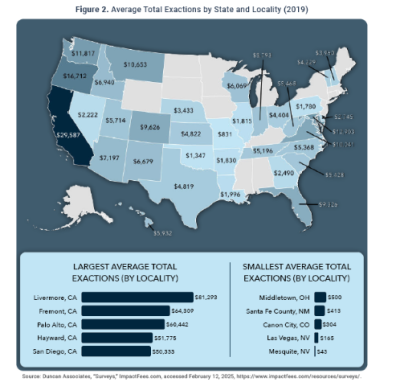
Check out the new report by our Pacific Legal Foundation colleagues Kyle Sweetland and Brian Hodges, “How to Protect Property Rights from Improperly Assessed Exactions” (Apr. 2025).

This research in brief shows how exactions grew and increased home construction costs over a 16-year period. It provides a history of exactions, showing how they have frequently moved away from their original impact-mitigation purpose and how that shift in purpose risks violating the Constitution. It illustrates an improperly assessed exaction and provides examples of how exactions have hampered construction during the present housing crisis. It concludes by examining how state legislatures can help set boundaries on local exactions and protect property rights.

It’s short, its sweet, it’s straightforward and understandable. What more could you want? Oh yeah, unlike exactions … it’s free. No strings attached. Check it out.

Sweetland & Hodges, How to Protect Property Rights from Improperly Assessed Continue Reading New Report: “How to Protect Property Rights from Improperly Assessed Exactions” (Sweetland & Hodges)