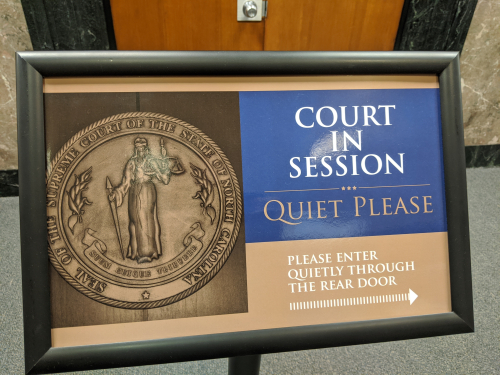
IMG_20191209_125404 (1)

Back in December — only a few months ago, yet it seems like another world away — we attended oral arguments in Raleigh in a case we’ve been following for a long time, about North Carolina’s “Map Act.”

This case is the follow up (after remand) of the N.C. Supreme Court’s landmark decision in Kirby v. North Carolina Dep’t of Transportation, No 56PA14-2 (June 10, 2016), in which the court held that the “Map Act,” a statute by which DOT designated vast swaths of property for future highway acquisition, was a taking because the Act prohibited development and use of designated properties in the interim. The court concluded “[t]hese restraints, coupled with their indefinite nature, constitute a taking of plaintiffs’ elemental property rights by eminent domain.” The court remanded the case for a parcel-by-parcel determination of just compensation. Shortly after the decision in Kirby, the North Carolina Legislature

Continue Reading NC: There Isn’t Just One Way To Value An “Indefinite Negative Easement”
Two more complaints challenging covid shutdown orders as takings (inter alia). Add to the growing list. See here, here, here and here, for other similar complaints.

The first is from California. It asserts that ordering “nonessential” businesses to shut down is a taking. The complaint alleges that unless the shut down is for “(1) destroying a building in front of a fire so as to create a fire break, (2) destroying a diseased animal, (3) rotten fruit or (4) infected trees,” it is a taking. 

The second is from New Jersey. So rather than get into the details, we’re going to send you over to our NJ colleague Tony Della Pelle, who has some thoughts here (“NJ Shutdown Challenge – I Can’t Rent My Beach House!“). 

Will there be more of these? As we have said before, for sure. Fasten your

Continue Reading Two More Takings Complaints Challenging Shut-Down Orders

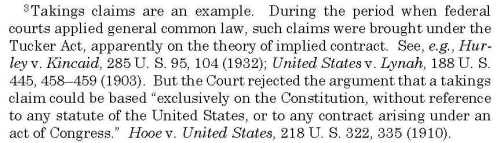
AIito-takings excerpt

(Spoiler alert: we think the answer is “yes” — see below)

Delving into the latest Supreme Court opinion related to the Affordable Care Act, lawprof Josh Blackman (who recently wrote about bump stock takings), now asks a broader question: Is there an express cause of action under the Takings Clause? More pointedly he writes about a question that takings mavens often think about (but on which there are few guideposts):

[I]s it possible to sue the federal government for an unconstitutional taking, without relying on the Tucker Act? That is, does the Takings Clause itself create an express cause of action.

What would have happened if the Congress never enacted the Tucker Act in 1887? Could the federal government take property without paying “just compensation”?

He points out that the majority opinion in the recent ACA case said no (see here, note 12 on page 25)

Continue Reading Lawprof Josh Blackman Asks: “Is there an express cause of action under the Takings Clause?”

What do you think of when you think of south Florida? Beaches? Jai Alai? Cuba Libre? Crockett and Tubbs and a career in southern law enforcement

Well, it better not be dog racing. Because by an amendment to the Florida Constitution (Amendment 13), the people of Florida banned it. Well, wagering on dog racing, technically. You can, apparently, still race dogs just for dog s**t and giggles.

Well, after the ban, the inevitable takings claim arrived, like the tail wagging the dog. In this Order, the U.S. District Court for the Northern District of Florida, dismissed the complaint for failure to state a claim. The court held the plaintiffs had standing, and the case was ripe and wasn’t barred by the 11th Amendment for some of the defendants. 

But naturally, we focused on the takings analysis. First, the court agreed with the

Continue Reading A Little Preview Of How Courts Are Going To Misapply Takings Analysis In Shutdown Cases – Federal Court: No Taking For Outlawing Dog Racing

That was fast: the very first (as far as we can tell) case challenging the various coronavirus shutdown orders has reached the Supreme Court. See here, here, here and here, for other cases. 

This is the Pennsylvania case we wrote about a couple of weeks ago. The one where where “Friends of Danny Devito” (no, not that Danny Devito) sued the Pennsylvania governor challenging shut down orders under a variety of theories. Including a takings claim, of course. The court rejected the takings claim, mostly relying on Tahoe-Sierra.  

The losing plaintiffs have now asked SCOTUS to stay enforcement while they prepare and file a cert petition. 

Here are the key parts, previewing the takings argument on the merits:

14. A Concurring and Dissenting Opinion written by the Chief Justice of the Supreme Court of Pennsylvania and signed by two other justices expressed

Continue Reading Tahoe-Sierra “Temporary” Moratoria Takings Front-and-Center Of First Shutdown Case To Reach SCOTUS

The town grabs, then sells property for failure to pay property taxes. The sales price is more than the tax lien. Does the town have an obligation to give the owner the difference, or can it keep it unless the owner sues?

Thanks to a colleague who sent us the case, we know that was the issue facing the New Hampshire Supreme Court in Polonsky v. Town of Bedford, No. 2019-0339 (Apr. 24, 2020). Short story: yes, the town needs to affirmatively give the extra money back, and no, the town can’t keep it unless and until the owner sues to get it. To read the statutory scheme otherwise would result in an unconstitutional taking.

Check it out (quick read, only 13 pages). 

A couple of notes:

  • The owner asserted his rights under part I, article 12 of the New Hampshire Constitution (“no part of a man’s property shall


Continue Reading NH: Govt Keeping Excess Proceeds Of Tax Sale Is A Taking

On one hand, there’s a lot going on in the Maryland Court of Appeal’s opinion in Maryland Reclamation Assoc, Inc. v. Harford County, No. 52 (Apr. 24, 2020), a case we’ve been following. The opinion is a whopping 81 pages, and details facts that go back decades. On the other hand, the opinion doesn’t actually say a lot. 

But what it does say is a doozy.

Here’s your BLUF (Bottom Line(s) Up Front):

  • Maryland agencies have jurisdiction to consider and rule on state constitutional issues including takings. Apparently, this is not something the court adopted in this case, but is a long-standing practice in Maryland. Count us as very surprised that agencies have the power to adjudicate constitutional rights. Very, very surprised.  
  • A property owner must raise their Maryland Constitution takings claim and present it for adjudication to very agency accused of taking property without compensation. 
  • The property


Continue Reading Maryland Resurrects California’s Agins Rule: Owner Must Seek Agency Variance, Which If Granted, Means “owner no longer has a takings claim and the right to alternative relief in the form of just compensation”

6a00d83451707369e201b8d25028d2970c-800wi

CHALLENGE: find the “damage” on the Loretto building

Here’s the amicus brief filed today by Pacific Legal Foundation that urges the Supreme Court to grant our cert petition in a case that asks:

To constitute a taking under the Fifth and Fourteenth Amendments, must a physical invasion also destroy or substantially impair an owner’s economically beneficial uses of property?

Yes, takings mavens, we’re talking Loretto and related. (If you want to see the truly “de minimis” invasion — and no damage — that resulted in Justice Marshall in that case concluding that the Takings Clause imposes a “categorical duty” to provide compensation for physical invasions, check out some recent photos of the Loretto building on Manhattan’s Upper West Side.)

Here’s the amicus brief’s Summary of Argument:

The Fritzes’ petition for a writ of certiorari raises an important question concerning the protections provided by the Takings Clause of the Fifth Amendment

Continue Reading New SCOTUS Amicus Brief Highlights Govt’s “Categorical Duty” To Compensate, Even Without Substantial Damage To Remainder

ALICLE-tagline-250x90

There’s still time to join us tomorrow, Friday, April 24, 2020 at 2-3pm Eastern Time, they will be presenting “Strategies for Litigating Regulatory Taking Cases” in a webinar produced by ALI-CLE. Register here (multiple attendee discounts available). 

At the recent ALI-CLE Eminent Domain and Land Valuation Litigation Conference in Nashville, our colleagues, New York’s Jon Houghton and Hawaii’s Dave Day presented a very informative program on litigating regulatory takings cases. Jon is a property owner-side lawyer, while Dave is a Deputy Attorney General who represents the State of Hawaii in such cases. So it was a practical and balanced presentation. Jon and Dave are taking it to the next level. This isn’t simply a repeat of their Nashville program, but they will be exploring in more detail the practicalities of building and defending these difficult cases. 

Here’s the description of the program:

The U.S. Constitution provides that

Continue Reading Still Time To Join Us (Tomorrow): ALI-CLE Webinar – Strategies for Litigating Regulatory Taking Cases

FULJ_logo_2-5-300x66@2x

Lacking things to read during your shut-down? Well, we have the solution: the Fordham Urban Law Journal has devoted an entire issue to Knick and takings ripeness (“Taking Account: Procedure, Substance, and Stare Decisis in the Post-Knick World“). 

Our article “Sublimating Municipal Home Rule and Separation of Powers in Knick v. Township of Scott,” 47 Fordham Urb. L.J. 509  (2020), leads the way (thank you, editors).

Other articles:


Continue Reading Takings Nerd Christmas: Fordham Urban Law Journal’s Knick Symposium (feat. “Sublimating Municipal Home Rules and Separation of Power in Knick v. Township of Scott”)