0116190650b_HDR

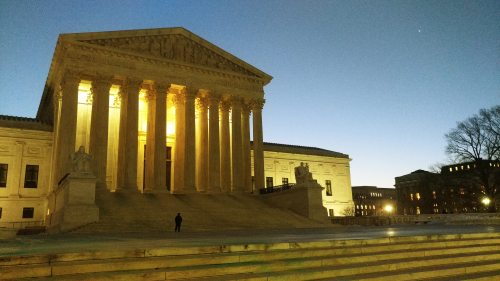
As Professor Gideon Kanner likes to remind us, eminent domain has been characterized as “the dark corner of the law.” We thought back to that phrase when we joined the queue outside of the Supreme Court this very dark (and very cold) morning, for the rehearing in the Knick v. Township of Scott case, this time with a full Court (Justice RBG was not present in the courtroom today, but will take part in the case).  

We soon got in the building, got warm, and got seated along with fellow takings geeks and the general public. 

We’ll have a detailed write-up once the written transcript is released, but for now, here are our initial thoughts. 

  • It was pretty clear right from the outset that the months intervening between October’s argument and now — and the various supplemental briefs and replies that have been filed — have not cleared things


Continue Reading Knick Argument Redux: Dark Corners, And A Lack Of Clear Consensus (Chief Justice Remains The Lynchpin)

It wasn’t going to be too hard to figure out what the U.S. Court of Appeals for the Sixth Circuit was going to do in Lumbard v. City of Ann Arbor, No. 18-1258 (Jan. 10, 2018). After all, the case involved a federal takings claim in federal court, which the district court dismissed because the plaintiff had already litigated her state takings claims in state court.

Yes, the plaintiff tried to make an England reservation in the earlier state court litigation to inform everyone that she was expressly not also litigating her federal takings claim. But ever since San Remo, you know what that means: diddly squat. Later, when the plaintiff came to federal court and asserted her federal takings claim, that court concluded full faith and credit, blah blah blah. 

The Sixth Circuit in just a few more words, affirmed. A short opinion (7 pages) with nothing

Continue Reading SCOTUS Shortlister Judge Kethledge Has Read The Knick Briefs: “[T]he Takings Clause does not say that private property shall not ‘be taken for public use, without just compensation, and without a remedy in state court.’”

Our final 2018 post focused on what we thought was the biggest case of that year, and which, we’re predicting, will be the biggest case of 2019: Knick v. Township of Scott, No. 17-647, that’s the one in which the Supreme Court is considering whether federal takings claims can be brought in federal court, and whether to revisit the 30-year old Williamson County “state procedures” requirement. 

So we’re kicking off 2019 with our thoughts on that case, coming up for reargument next week

Before we get to our prognostication (yes, we’re going to go there, however futile doing so might be), we wanted to lay out our thinking on the issues so you can see how we got there. The wildly divergent positions taken by the three main players — Ms. Knick, the Township, and the United States — illustrate well how mucked up and opaque regulatory takings

Continue Reading Stop Making Sense: Knick, Williamson County, And Lessons For Takings From The Dusky Gopher Frog Decision – Are “Takings” Federally Justiciable?

We’re going to end 2018 with the latest in what we think was the most important issue of the past year (and which, we predict, will be the most important case in takings law for at least a decade when it likely gets decided in 2019), Knick v. Township of Scott, No. 17-647.

That case, as you well know, asks whether a property owner who alleges that a local government action has taken property but hasn’t paid the required just compensation is entitled to bring a lawsuit seeking just compensation under the Fifth and Fourteenth Amendments in a federal court.

Thirty years ago, in Williamson County, the Supreme Court said no. Or at least not until the owner has first pursued compensation via a state’s available procedures to recover compensation, assuming such procedures exist. Add to the mix the rules of preclusion and full faith and credit —

Continue Reading Wrapping Up 2018, And Previewing 2019’s Most Important Case: Final Briefs In Knick v. Township Of Scott

1126181629e_HDR

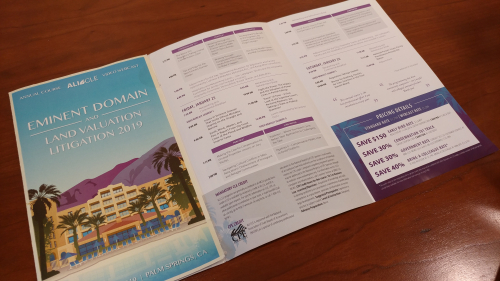
We’re almost there, but we still have room remaining. At the 2018 Conference in Charleston, we both sold out the registrations and the conference hotel, so we planned ahead for the upcoming 2019 Conference in Palm Springs at the Renaissance Palm Springs Resort

Register here. You will also be able to download the print brochure (above), or find out more details about the agenda and faculty on line. As always, we have assembled a great faculty — many of them new speakers — on the hottest topics in eminent domain and takings law: pipelines, jury presentations, challenging the take, an update on the most important decisions of 2018, pre-condemnation planning (from both the condemnor and property owner perspective), the border wall, and relocation. 

And of course, ethics and the “101” track for those new to the field, or experienced lawyers who would like a refresher on the

Continue Reading Space Remaining Is Limited – Register Now For ALI-CLE Eminent Domain And Land Valuation Litigation Conference (Palm Springs, Jan. 24-26, 2019)

Today’s post is long, but, we think, worth the investment of your time.

Bankruptcy is the way to get rid of debt. Plaintiffs who have sued the debtor but who have not reduced the lawsuit to a judgment are unsecured creditors. Unsecured creditors for the most part, go to the end of the payment queue, and that usually means then get squat. 

In In re Stockton, No. 14-17269 (Dec. 10, 2018), a three-judge panel of the U.S. Court of Appeals for the Ninth Circuit addressed whether it makes a difference that the plaintiff is a property owner, and the lawsuit that has not been reduced to judgment is an inverse condemnation claim for a taking: can a city’s Chapter 9 bankruptcy reorganization plan shed the obligation to pay just compensation, or is an inverse condemnation claim protected by the Takings Clause from impairment? 

Over a strong (“adamant”) dissent, the

Continue Reading Ninth Circuit: Inverse Condemnation Plaintiff Must “Share The Pain” – City Can Shed Obligation To Pay Just Compensation In Bankruptcy, Which Is “Purely A Monetary Claim”

1207180945a_HDR

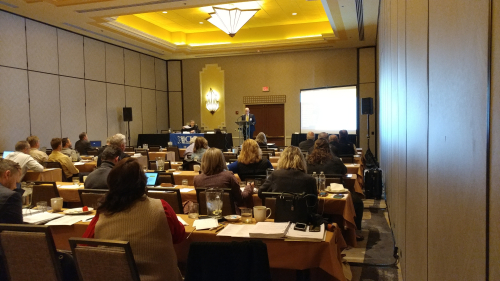
A very good and active crowd for today’s Eminent Domain Conference (CLE International) in Scottsdale, Arizona. It was good to visit with some old friends, and also to get to meet some new colleagues.

Our talk focused on national trends, and this year’s most interesting condemnation and takings cases. Here’s the links to the cases I mentioned that are not in the written materials:


Continue Reading Link’s From Today’s Eminent Domain Conference (Scottsdale)

Here’s the final brief for Ms. Knick, replying to the Township’s and the Solicitor General’s supplemental letter briefs.

It’s very short, so you should read it yourself. But here’s what we think is the highlight:

Williamson County is irreconcilable with the traditional view that a Takings Clause claim accrues (and is actionable in federal court) the moment government injures property without securing compensation. The Solicitor General ultimately concurs. SG Suppl. Brief at 6. Williamson County is also irreconcilable with the original understanding of Section 1983 as a law opening federal courts to unconstitutional takings suits, Monell v. Dep’t of Soc. Servs. of City of New York, 436 U.S. 658, 687, 687 n.47 (1978), and with exhaustion of remedies doctrine.

Br. at 4. 

Ms. Knick’s argument focuses — correctly, we think — on Kirby Forest Industries, Inc. v. United States, 467 U.S. 1 (1984), pointing out that “[s]ignificantly, a suit

Continue Reading Knick’s Supplemental Reply Brief: Injury To Property Triggers Right To Come To Federal Court

1205181530f_HDR

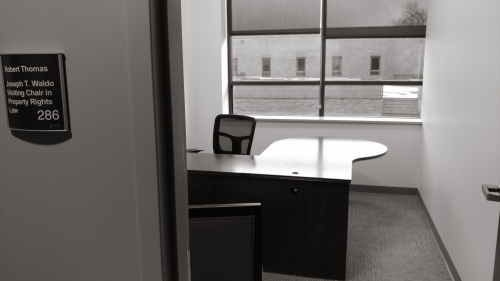
With the first snow of the season beginning to fall in Williamsburg, today was the final day of classes at the William and Mary Law School. Which means that my time serving as the inaugural Joseph T. Waldo Visiting Chair in Property Rights Law is beginning to wrap up. There’s still the reading period, exams, and grading, but today was the last day we met as a class.

What a great law school, and wonderful students. I learned way more than I conveyed. A welcoming administration, faculty and staff, too. This was the best experience of my professional life.

A huge thank you to law school dean Davison Douglas, and Professors Lynda Butler and James Stern, for guiding and supporting me, and making me feel like I belonged. And to my students, who challenged me. And, of course to Joe Waldo, who made it all possible.Continue Reading End Of The Term For Law 608: Eminent Domain And Property Rights