Mulvaney_front_page.jjpg

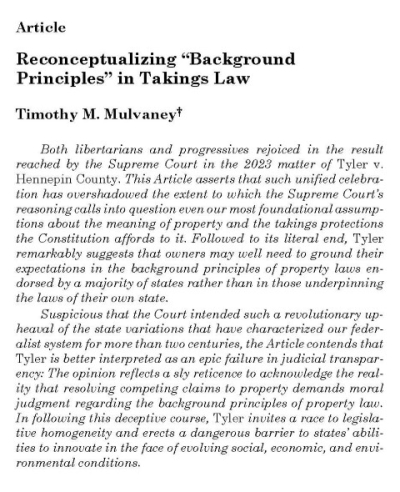
Lawprof Timothy Mulvaney has published “Reconceptualizing ‘Background Principles’ in Takings Law,” 109 Minn. L. Rev. 689 (2025). 

If the title alone doesn’t grab your interest, here’s the summary from the article’s introduction:

Both libertarians and progressives rejoiced in the result reached by the Supreme Court in the 2023 matter of Tyler v. Hennepin County. This Article asserts that such unified celebration has overshadowed the extent to which the Supreme Court’s reasoning calls into question even our most foundational assumptions about the meaning of property and the takings protections the Constitution affords to it. Followed to its literal end, Tyler remarkably suggests that owners may well need to ground their expectations in the background principles of property laws endorsed by a majority of states rather than in those underpinning the laws of their own state.

Suspicious that the Court intended such a revolutionary upheaval of the state variations that have characterized our federalist system for more than two centuries, the Article contends that Tyler is better interpreted as an epic failure in judicial transparency: The opinion reflects a sly reticence to acknowledge the reality that resolving competing claims to property demands moral judgment regarding the background principles of property law. In following this deceptive course, Tyler invites a race to legislative homogeneity and erects a dangerous barrier to states’ abilities to innovate in the face of evolving social, economic, and environmental conditions.

Check it out.
Continue Reading New Article: “Reconceptualizing ‘Background Principles’ in Takings Law,” 109 Minn. L. Rev. 689 (2025)
Here’s the latest in a case we’ve been following. This is GHP Management Corp. v. City of Los Angeles, No. 24-435, the cert petition which asks whether a local ordinance which allowed non-paying tenants to remain in the lessor’s property is a physical taking, or merely the regulation of the lessor/lessee relationship under the Yee theory, which posits that once an owner voluntarily rents property to a tenant, the government then allowing that tenant to remain rent free isn’t facilitating an unauthorized physical occupation, but rather is merely a regulation of the existing lessor/lessee relationship. 

The petitioner property owner has filed its cert stage Reply, which means that all the briefing is in, and next up is for the Supreme Court to set the conference date. Here’s the summary of the issues from the Reply:

Respondents prefer a world where government enjoys absolute immunity from

Continue Reading Eviction Moratorium As A Physical Taking All Teed Up

You should already know Short Circuit is the Institute for Justice’s frequently-updated podcast on important and interesting decisions from the federal courts of appeals (the “Circuit” part of the title, we assume).

If you are not already a regular listener you are missing out, because it is a fantastic and easy way to keep up with what is going on, and to hear insightful analysis.

We’ve visited the SC studios in the past, and this week made a return visit, joining host Anthony Sanders (Director of the Center for Judicial Engagement), and guest Justin Pearson (Managing Attorney of IJ’s Florida offices), to talk cattle feedlots, “new” vs. “old” property, North Carolina’s Law of the Land Clause, and methods of constitutional interpretation.

Here’s the episode summary, and show notes, from the Short Circuit site:

A long-time friend of the Institute for Justice, Robert Thomas, joins us this week. For

Continue Reading “I Like Old Property” – We Return To The “Short Circuit” Podcast To Talk Law Of The Land & Magna Carta

PLF_PR_event

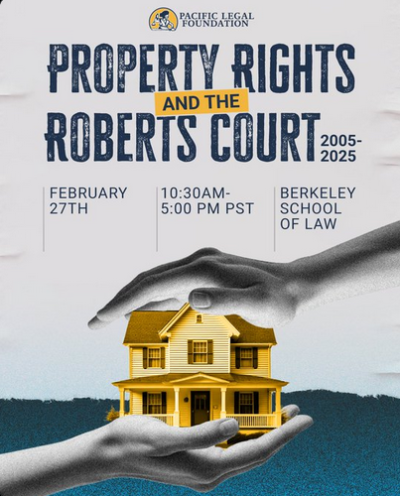
If you are looking for us tomorrow but we don’t respond, that’s because we’ll be in the audience in rapt attention at “Property Rights and the Roberts Court, 2005-2025” at the U.C. Berkeley Law School (fka “Boalt Hall”).

Here’s the description:

For much of the past century, property rights were relegated to second-class status compared to the rest of the Bill of Rights. However, under the Supreme Court leadership of Chief Justice John Roberts, this trend has begun to shift.

In recognition of the 20th anniversary of the Chief Justice’s elevation to the Supreme Court, Pacific Legal Foundation is partnering with Berkeley Law’s Public Law and Policy Program to host a day-long conference exploring the major property rights developments and future of property rights law in the Roberts Court.

We’ll hear from two different panels of renowned legal scholars and accomplished litigators, as well as a keynote lunch

Continue Reading “Property Rights and the Roberts Court, 2005-2025” (Feb. 27, 2025, UC Berkeley Law School)

PXL_20230509_183011703

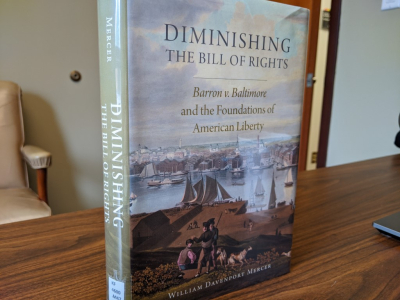
This Sunday, February 16, 2025, will be the day, 192 years ago, when — a mere 5 days after oral arguments — the U.S. Supreme Court issued its (in)famous opinion in Barron ex rel. Tiernan v. Mayor and City Council of Baltimore, 32 U.S. 243 (1833).

Generations of law students study this decision in their Con Law classes, and it is mostly known as the case in which the Court held that the Bill of Rights limits only the federal government and does not limit the power of states. For the latter, one must look to state constitutions. Barron, of course, was overruled or otherwise neutralized by the Fourteenth Amendment (privileges or immunities clause or the due process clause, take your pick). And it was formally abrogated in Chicago, Burlington and Quincy Railroad Co. v. City of Chicago, 166 U.S. 226 (1897) (states and their instrumentalities are bound

Continue Reading Feb. 16, 1833: Unhappy 192d Birthday To The First SCOTUS Takings Case, Barron v. Baltimore

You remember when in grade school you learned that your teacher was out for the day, and you were getting a substitute? It could be a very good day, or a very not-so-good day. Maybe the sub was cool, and you end up watching filmstrips. But if you drew the short straw, the sub acted like a real teacher and did real teacher stuff like give you homework.

That’s what it must’ve felt like when the advocates showed up for arguments in the First Circuit as it considered 29 Greenwood, LLC v. City of Newton, No. 24-1518 (Feb. 4, 2025), and there on the bench was none other than Justice (ret.) Breyer, sitting by designation. Was it going to be filmstrips, or homework?

The case was an appeal of the district court’s rejection of a federal takings claim on the grounds that “this case amounts to an

Continue Reading When The Substitute Teacher Gives You Homework: Justice Breyer Says Federal Court Needs State Court Decision Before Considering Takings Claim

Blevins

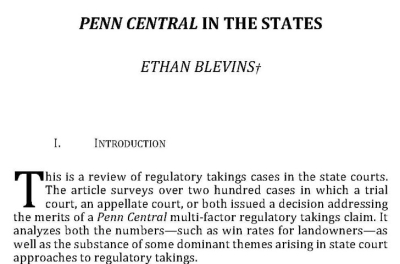
Our Pacific Legal Foundation colleague Ethan Blevins has published the lead article in the latest edition of the Wake Forest Journal of Law and Policy, and it is on a subject that makes it a must-read for you takings mavens.

The title says it all: “Penn Central in the States.” How do states treat the U.S. Supreme Court’s Penn Central test? Find out here, as Ethan surveys over 200 state court applications of that notorious test. Do they do better than federal courts? What court should you file in?

And if that doesn’t grab you enough, here’s his conclusion:

I conclude that most of these problems do not stem from unfaithful applications of the Supreme Court’s regulatory takings doctrine, but rather are a direct consequence of the Supreme Court’s failure to establish a clear, reliable test rooted in sound principles. I hope this article’s findings can assist

Continue Reading New Article: Ethan Blevins, “Penn Central in the States,” 15 Wake Forest J.L. & Policy 105 (2025)

1992 Aerial Photo Island2
Shands Key, with the City of Marathon in the background

This just in: in Shands v. City of Marathon, No. 3D21-1987 (Fed. 5, 2025), Florida’s Third District Court of Appeals sitting en banc held that the city’s downzoning of property (Shands Key, shown above in an exhibit from the Key West trial we participated in in June 2021) from General Use (density: one home per acre) to Conservation Offshore Island (one home per 10 acres; Shands Key is just under 8 acres) effected a Lucas taking because it deprived the owners of economically beneficial uses of their land. This, notwithstanding the possibility of the owners selling the property to a third party, who could have donated the property to city in return for a chit to move up in the city’s development queue.

We’re not going to go into too much detail or offer our opinion because this

Continue Reading Fla Ct App (en banc) In Takings Case: “failing to vindicate a right expressly stated in the Constitution is not judicial restraint but judicial abnegation. That we must not do.”

Property_rights_and_the_roberts_court_Agenda_

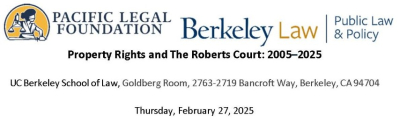
Register now and plan on joining us on Thursday, February 27, 2025 at the U.C. Berkeley Law School for a one-day conference: “Property Rights and the Roberts Court: 2005-2025.”

Here’s the agenda. Here’s a description of the program:

For much of the past century, property rights were relegated to second-class status compared to the rest of the Bill of Rights. However, under the Supreme Court leadership of Chief Justice John Roberts, this trend has begun to shift.

In recognition of the 20th anniversary of the Chief Justice’s elevation to the Supreme Court, Pacific Legal Foundation is partnering with Berkeley Law’s Public Law and Policy Program to host a day-long conference exploring the major property rights developments and future of property rights law in the Roberts Court.

We’ll hear from two different panels of renowned legal scholars and accomplished litigators, as well as a keynote lunch discussion between

Continue Reading Join Us: “Property Rights and The Roberts Court: 2005-2025” (Feb. 27, 2025, UC Berkeley Law School)

Screenshot 2025-01-23 at 15-10-58 Takings and Choice of Law After i Tyler v. Hennepin County _i by Eric R. Claeys SSRN

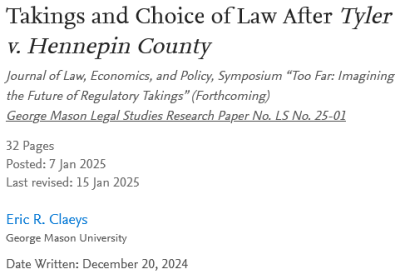
Check out this article, forthcoming in the George Mason Journal of Law, Economics, and Policy from lawprof Eric Claeys, “Takings and Choice of Law After Tyler v. Hennepin County.”

This is one of the pieces coming out of the recent symposium “Imaging the Future of Regulatory Takings” at George Mason Law School.

Here’s the Abstract:

This Essay contributes to a symposium on the future of regulatory takings. It focuses on choice of law in eminent domain disputes. When claimants bring eminent domain claims in federal courts, the courts must determine whether the claimants have constitutional “private property” in the entitlements allegedly taken. Should that determination be made with federal law, with the law of the state allegedly taking property, or law from some other source?

The 2023 Supreme Court decision Tyler v. Hennepin County addressed that issue. Under Tyler, it is a federal question whether an eminent domain claimant has constitutional private property. To answer the question, federal courts usually consult the law of the state where the alleged taking took place. But that presumption applies only if state law seems to secure and not to circumvent the federal right. And if that reservation is not satisfied, federal courts may consult a wider pattern of legal sources—Anglo-American history, the general law of the several United States, federal court precedents, and a broader cross-section of law from the state allegedly taking property. That approach resembles the approach taken generally for federal constitutional rights—especially in Indiana ex rel. Anderson v. Brand (1938)—but varies from the general approach in the sources it makes relevant to settle what counts as private property under the Fifth Amendment. This Essay interprets Tyler, and it offers a normative justification for Tyler’s approach to choice of law in eminent domain. 

Don’t miss this one.

Continue Reading New Article (Eric Claeys): “Takings and Choice of Law After Tyler v. Hennepin County”