One more lesson on the speed of the interwebs: we were all set to take a deep dive into the California Court of Appeal’s opinion in an inverse condemnation case, Bottini v. City of San Diego, No. D071670 (Sep. 18, 2018), when our colleague Brad Kuhn analyzed the case at his California Eminent Domain Report blog. 

The title of Brad’s post, “Improper CEQA Determination Does Not Trigger Regulatory Taking,” tells you most of what you need to know. The short story is that the City asserted that Bottini’s planned demolition of a beach bungalow as part of a project to build a new house required assessment and analysis under California’s environmental reporting statute, CEQA (California Environmental Quality Act). Bottini disagreed, asserting the demolition was exempt from CEQA, and, by the way, the delay caused by the City’s wrongful assertion of CEQA authority was a temporary taking. 
Continue Reading Cal App: Landgate’s “Substantially Advance” Standard Isn’t The Takings Test (But The Property Owner Still Loses)

BK header

Come join us for one of the best conferences on property rights and property law at the 2018 Brigham-Kanner Property Rights Conference, October 4-5, 2018 at the William and Mary Law School in Williamsburg, Virginia.

Register here

We’ve attended and presented at the Conference in past years, including when it went international in Beijing and at the World Court in The Hague. This year it is back home, and will focus on the work of the 2018 B-K Prize winner, Professor Stewart Sterk of Cardozo Law School

The B-K Prize is awarded to a legal scholar, judge, or practicing lawyer who “has advanced the cause of property rights and has contributed to the overall awareness of the important role property rights occupy in the broader scheme of individual liberty.” The list of past prize winners is a pantheon of property law greats. 

We will be speaking

Continue Reading 2018 Brigham-Kanner Property Rights Conference: Williamsburg, Oct. 4-5, 2018

An interesting and thought-provoking new article from Professor Donald Kochan that is definitely worth your time: The [Takings] Keepings Clause: An Analysis of Framing Effects from Labeling Constitutional Rights, 45 Fla. State U. L. Rev. ___ (forthcoming 2018). 

As the title suggests, Professor Kochan doesn’t quite care for the phrase the “Takings Clause” when it comes to that part of the Fifth Amendment we like so much. Instead, he prefers “Keepings Clause” because that term better embodies the right protected, and does not focus on the governmental power being exercised. 

Best tidbit: the phrase “takings clause” isn’t of ancient origin. Indeed, it is pretty modern. (Count us among those who didn’t know that.) From the article’s Introduction:

It will probably surprise most people that the label “takings clause” is a moniker of modern invention. In fact, the provisions in the U.S. Constitution’s Fifth Amendment that identify the rights and obligations

Continue Reading New Article: The [Takings] Keepings Clause: An Analysis of Framing Effects from Labeling Constitutional Rights

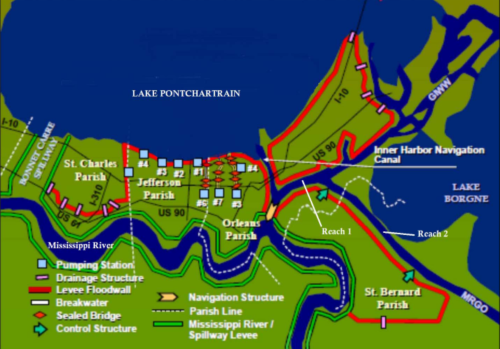
MRGO

Here’s the cert petition we’ve been waiting to drop in a case we’ve been following closely

Last we checked in, the Federal Circuit (any guess on which judge?) held that the catastropic Katrina flooding — caused mostly by the federal government’s construction and maintenance of a navigation project, the Mississippi River Gulf-Outlet canal (known as MR-GO) — could only result in tort liability, for which the federal government has already been determined to be immune. MR-GO was an attempt to improve navigation, and it obviously wasn’t the sole cause of the flooding, but by all accounts (and the proof in the Court of Federal Claims) it ended up worsening dramatically and magnifying the effect of Katrina. The CFC concluded this was a taking, and awarded just compensation.

Now, St Bernard Parish has asked the Supreme Court to step in. Here are the Questions Presented:

In

Continue Reading New Cert Petition (MR-GO Katrina Case): Can Government *Inaction* Lead To A Taking?

Ah, the speed of the interwebs: we were all set to write something up about the California Court of Appeal’s recent opinion in Black v. City of Rancho Palos Verdes, No. B285135 (Sep. 6, 2018), when our friend and colleague Bryan Wenter beat us to it.

His post, “Court Rejects Residents’ Takings Lawsuits for Failure to Exhaust Administrative Remedies” pretty much tells the story. This same court a decade earlier concluded the City’s earlier version of a development moratorium was a Lucas taking. As Bryan writes,

Based on their interpretation of Monks II [that 2008 decision noted above], none of the landowners even filed an application for an exclusion from the moratorium. Instead, the landowners argued that Monks II absolved them of the need to exhaust administrative remedies or, alternatively, that exhausting administrative remedies would be futile.

Because the City might allow development if the owners

Continue Reading Cal App: No Taking For Development Moratorium Because Owners Had Not Asked For Development Permits

After a short hiatus to allow Clint to set up at his new firm, the Eminent Domain Podcast is back. 

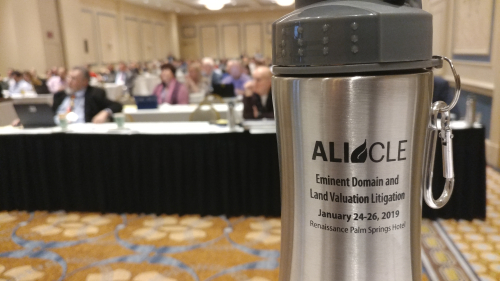
Clint was kind enough to ask me to be his first second-time guest, and we had a wide-ranging discussion: everything from this semester’s teaching assignment at the William & Mary Law School, the will-they-or-won’t-they-overturn-Williamson-County case to be argued in early October Knick v. Township of Scott, to the upcoming Brigham-Kanner Conference, the ALI-CLE Eminent Domain and Land Valuation Litigation Conference in Palm Springs, Elvis, and … Kevin Bacon (again).  

Adhering to the same format, including the fun “lightning round” style Cross-Examination, the podcast is a great (and easy) way to keep up on the issues. And at just under an hour, its the perfect length for your commute, also.

We look forward to Clint’s lineup of interesting and insightful guests and topicsContinue Reading Clint Schumacher’s Eminent Domain Podcast Is Back – Six Degrees Of Williamson County Ripeness … And Elvis

Here’s the cert petition, filed yesterday, in a case we’ve been following closely. Here’s our short summary of the case, written up when it was ready for argument in the Hawaii Supreme Court. That court’s ruling against the property owner added to the the lower court split on the issue of whether the Takings Clause protects an owner’s use of property, or the value of property. 

Here’s the Question Presented:

In 2000, Douglas Leone and Patricia Perkins-Leone bought beachfront property in Hawaii on which they planned to build a home for their family. The land was zoned for single-family residences, but the County of Maui decided it should be used as a public park. Instead of buying the land, however, the County wielded its regulatory authority to prevent the Leones from developing their property in any way.

The Leones challenged the County’s refusal to allow them to

Continue Reading New Cert Petition: Is Holding Land With No Present Use In The Hope The Government Allows Some Use In The Future An “Economically Beneficial Use” Of Property?

The result in Roberts v. Bondi, No. 8:18-cv-1062 (Aug. 21, 2018) should not be terribly surprising, we suppose. After all, the plaintiff was asking the U.S. District Court to — among other things — conclude that a Florida statute banning a device which makes a semi-automatic rifle “somewhat mimic” fully-automatic fire, violated the plaintiff’s constitutional rights. [Note: you can do this with just about any semi-auto rifle even without the special stock, although it can be somewhat awkward.] 

In these type of cases, courts are hard-pressed to do much but uphold the ban, even if the thing being banned was, as they say, “perfectly legal” prior to the prohibition. That the courts do so may or may not sit well with you (mostly depending upon your view of the Second Amendment) but it is, nevertheless. As Holmes famously remarked, “The life of the law has not been

Continue Reading Federal Court: Florida Statute Outlawing “Bump Stocks” Is Not A Taking

20180126_111558_HDR

You’ve known for a while that Palm Springs, California, specifically the Renaissance Palm Springs Hotel (a resort facility, but right in town, so you will have many options for “off campus” activities like art museums, the aerial tram, golf, and whatever suits your fancy, and close-in to the Palm Springs Airport), is the venue for our 2019 ALI-CLE Eminent Domain and Land Valuation Litigation, January 24 through 26, 2019.

Of course, you also knew that the programming would be the usual spread of topical and cutting-edge topics, presented by some of the nation’s experts. But we didn’t give you the details. So here are some of the programs we’re having: 

  • Keynote Address: “Property Rights: Foundation for a Free Society” – Taylor Revley, most recently the past President of the College of William and Mary, and also former law school Dean (as well as a


Continue Reading ALI-CLE 2019 Eminent Domain And Land Valuation Litigation Conference, Palm Springs Agenda – Register Now!

A quick one today because we’re offline (more on that later). Pacific Legal Foundation (the folks who are representing the property owner in the pending case challenging the continuing viability of the Williamson County ripeness doctrine), has posted this entry on their blog, “This monkey got his day in court. Property owners still can’t.”

The post focuses on the brief we filed in the case on behalf of the Citizens’ Alliance for Property Rights Legal Fund, which notes the disparity between a monkey having standing to bring a suit in federal court to protect its (alleged) (intellectual) property rights, but human property owners like Ms. Knick having no right to do the same when asserting her plain old property rights. 

Our brief didn’t focus on the monkey background, so here it is:

In 2011, nature photographer David Slater set up camera equipment for a group of wild

Continue Reading Monkey Selfies And Takings Ripeness