Check this out: according to this article (“This SC man won a Supreme Court case. He wants to know why he can’t talk about it“), David Lucas, the lawyer-property owner behind the big reg takings case Lucas v. South Carolina Coastal Council, 505 U.S. 1003 (1993), was apparently not invited to speak at the (ongoing) event at the University of South Carolina law school marking the 25th anniversary of the decision. The local paper reports:

The University of South Carolina law school is holding a three-day event to mark the 25th anniversary of a S.C. man’s legal victory in the U.S. Supreme Court. But the victor in that case, Davis Lucas, isn’t invited, and he’s upset.

. . . .

Lucas, who sued for the right to build on two lots on the Isle of Palms, is upset neither he nor his attorneys were invited

Continue Reading Lucas Not Invited To Lucas Conference

20170918_190120
No soup for you!

Update: our colleague Bryan Wenter has his take on one of the cases denied review here (“U.S. Supreme Court Again Declines to Consider Important Property Rights Issue Regarding the Unconstitutional Conditions Doctrine“) (“Because the current composition of the U.S. Supreme Court leans ideologically conservative by any traditional measure and it takes only four of nine Justices to grant certiorari, on the surface it is surprising that the Court has yet to take up a case, such as CBIA or 616 Croft Ave., that would finally resolve this distinction between sweeping legislative takings and particularized administrative takings. The surprise is enhanced to a degree by the fact that the Court considered both cases in conference four times, which suggests a serious interest in the issue.”).

* * * *

To bring you up to speed on cases of interest in the Supreme Court’s cert pipeline

Continue Reading Cert Denied, Denied, Denied, Denied In Property Cases (But Don’t Give Up The Ship Just Yet)

-fronts-N-6450-00-000012-WZ-PYR

We usually don’t post trial court decisions, preferring instead to wait until the issue works its way up the food chain. But we make exceptions to that general rule when a case catches our eye and is either unusual or otherwise interesting. The U.S. District Court’s opinion in Williams v. The National Gallery of Art, London, No. 16-CV-6978 (Sep. 21, 2017) is one of those cases.

It’s the facts of the case which compel us to post it, since it involves a somewhat famous painting (Portrait of Greta Moll, above), by the famous painter Henri Matisse. Commissioned and purchased by two of Matisse’s art students, the painting was privately owned until just after World War II, when Greta entrusted it to another former student to take the painting to Switzerland to protect it from looting. Well the former student didn’t take it to Switzerland, but sold it

Continue Reading A Different “Takings Clause” – Art Museum Immune Under FSIA’s Expropriation Exception To A Claim That Matisse Painting Wrongly “Taken”

The complete agenda and faculty list has now been posted on the ALI-CLE website, and early registration is open! Go now and reserve your spot. 

We paid a visit to Charleston recently, the venue for our January 2018 conference, to scout it out. We can report that we’re going to have a great time, for sure. When we polled you last year, you selected Charleston as your first choice (a new city for the Conference), and it is shaping up to be a very good selection. In addition to the usual lineup of CLE programming, there are a ton of things to see and do in the area. We recorded a short video down at the “four corners of law” (the intersection of Meeting Street and Broad Street), to give you a preview (the weather was much better than in our 2016 preview video, too).

As an added

Continue Reading 2018 ALI-CLE Eminent Domain Conference – Agenda And Faculty Now Posted

This just in: the Hawaii Supreme Court has rendered a unanimous opinion in Leone v. County of Maui, No. SCAP-15-599 (Oct. 16, 2017), a case we’ve naturally been following because it involves regulatory takings (and we were involved in a similar case on a neighboring property). 

We haven’t had a chance to review the 48-page opinion in detail (once we do so, we will post a more detailed review), but the issue the court was presented with was, as we noted here, whether leaving land in its vacant state court be considered an economically beneficial use. Short story is that the court held yes, it could, thus seeming to create a lower court split (hello, cert petition) with at least one other court, the Federal Circuit in Lost Tree, concluding that economically beneficial use means more than someone might buy it down the road. 

There’s

Continue Reading Conflict Check: Hawaii Adds To Lower Court Regulatory Takings Split: Is Leaving Land Vacant On The Hope It Is Worth More In The Future “Economically Beneficial Use”?

IMG_2931

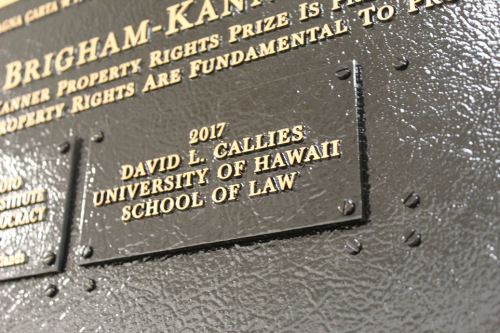
University of Hawaii Law School Professor David Callies last night was presented with William and Mary Law School’s Brigham-Kanner Property Rights Prize which is “presented annually to a scholar, practitioner or jurist whose work affirms the fundamental importance of property rights.” 

As W&M notes about Professor Callies, a “prolific scholar whose work explores land use, property, and state and local government law, Callies has lectured around the world and authored or collaborated on about 90 articles and 20 books. He has been a member of the prestigious American Law Institute since 1990 and is the Benjamin A. Kudo Professor of Law at the University of Hawaiʻi at Mānoa. Prior to entering academia, he was an attorney in private practice and an assistant state’s attorney.”

IMG_3028

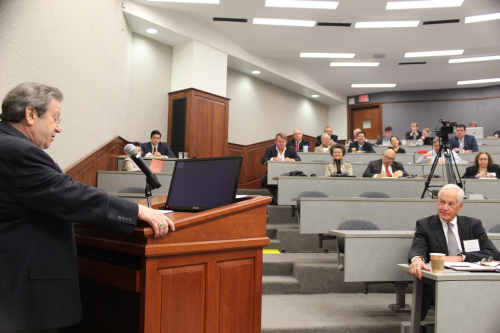
We’re spending today in a series of panels which explore and build upon Professor Callies’ lifetime of work. Michael Berger, a past Prize winner, kicked off

Continue Reading Professor David Callies Awarded William & Mary Law’s Brigham-Kanner Property Rights Prize

ALI-CLE2018

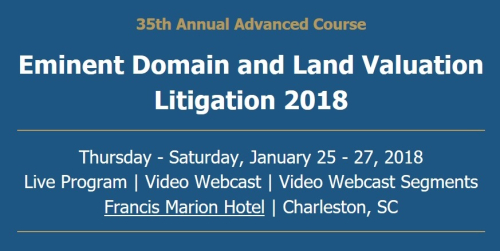
It’s not too early to reserve your spot at the 35th Annual ALI-CLE Eminent Domain and Land Valuation Litigation Conference, to be held at the Francis Marion Hotel in historic downtown Charleston, South Carolina, January 25-27, 2018. 

We’re finalizing the Conference details, but can report that the program will, as usual, feature expert presenters from across the nation, and both an in-depth update on the subjects we love, and a “101” track for those new to the field or who would appreciate a refresher. Check out some of the topics:

  • Takings and Damaging by Flood: Case Selection Advice For Savvy Practitioners
  • Quarterbacking the Case: Blocking Defenses, Controlling the Witnesses, and Converting for Verdicts
  • We’ve Been Working on the Railroad: Utility Crossing Disputes
  • Protecting Your Record,and Anticipating Appeals
  • Lucas 25 Years Later: Property Rights in the Age of Global Warming
  • Building and Growing Your Eminent Domain Practice With


Continue Reading 2018 ALI-CLE Eminent Domain Conference: Early-Bird Registration Discount Now Posted

It’s no secret: along with a lot of our colleagues, we have thought for a long time that the Supreme Court needs to address the “final decision” prong of the Williamson County ripeness test. Ever since four Justices in 2005 concurred in San Remo Hotel to say so, we’ve been anticipating the case which presents the Court with the vehicle to finally present that issue. There have been a lot of attempts in the interim, but none so far successful (here’s the latest, a case asking the Court to overrule Williamson).

Meanwhile, the lower courts have been steadily chipping away (see this decision, for example) at Williamson County, concluding it is a prudential doctrine, that further applications would be futile, that it doesn’t apply to facial claims, and similar. 

Here’s another cert petition, recently filed, that doesn’t call for overruling Williamson County outright

Continue Reading New Williamson County Cert Petition: How Far Down The Rabbit Hole Does The “Final Decision” Requirement Take Us?

DSCF3369

Back when the opinion was first released, we posted a list of Murr v. Wisconsin links. Now that Court is nearly back from its summer vacation, here’s an updated list:

Will there be more? No doubt. Murr is the takings case that keeps on giving. Continue Reading The Takings Case That Keeps On Giving: Murr Round-Up, Continued

Here’s a recently-filed cert petition involving property in the Florida Keys. The city allegedly downzoned the property to virtual worthlessness, but the lower courts concluded that it was not a Lucas take because the owners could still camp on the land, and the city gave them something called “ROGO points.” 

Which reminds of us the science-fiction trope of “credits” instead of money.  You can see why we find the case interesting, no? 

Here are the Questions Presented:

When Gordon and Molly Beyer purchased the nearly nine-acre Bamboo Key in Monroe County, Florida, zoning rules allowed them to put one residential home on each acre. In 1996, the local government adopted a Comprehensive Plan that deemed Bamboo Key a “bird rookery.” The only allowable use for the property became temporary camping. The Beyers challenged the application of this zoning change to their property; the courts concluded no taking occurred because

Continue Reading New Cert Petition: Is It Just Compensation To Be Paid In Space Bucks?