Load this one up for your morning drive, or workout: the Federalist Society’s podcast on “Lucas v. South Carolina Coastal Council at 25.” Featuring Professor Eric Claeys, Professor Michael Wolf, and Pacific Legal Foundation’s James Burling. Well worth your time.

Here’s the description:

This spring marks the 25th anniversary of the U.S. Supreme Court’s decision in Lucas v. South Carolina Coastal Council. In Lucas, a 5-4 Court majority held that a state law can effect a “regulatory taking” and trigger inverse condemnation requirements if it deprives an owner of all viable uses of his land. Join our panel to hear a discussion of questions such as: Did Lucas mark a major change in Supreme Court regulatory takings doctrine? Was the decision about right, or did it go too far or not far enough? Is Lucas still relevant to regulatory takings law today, and what are the
Continue Reading A Quarter-Century Of Lucas: What’s Next?

In Brott v. United States, 959 F.3d 425 (6th Cir. May 31, 2017), a Sixth Circuit panel — after acknowledging the Fifth Amendment right to just compensation is “self-executing” — held that it really wasn’t: the federal government can take private property but the owner can only recover compensation if Congress agrees to allow them to do so. Thus, takings plaintiffs must try their cases in the Article I Court of Federal Claims, and do not merit a jury trial in an Article III court.

The property owners/plaintiffs have now sought en banc review:

After the panel issued its opinion, the Supreme Court granted certiorari in Oil States Energy Services, LLC v. Greene’s Energy Group, LLC, 639 Fed. Appx. 639 (2016), cert. granted, 2017 WL 2507340 (June 12, 2017). In Oil States the Supreme Court will decide “[w]hether inter partes review violates Article III or the Seventh Amendment

Continue Reading Property Owners (And Amici) To Sixth Circuit: En Banc Review: “Self-Executing” Compensation Clause Means Congress Doesn’t Need To Consent

SSRN

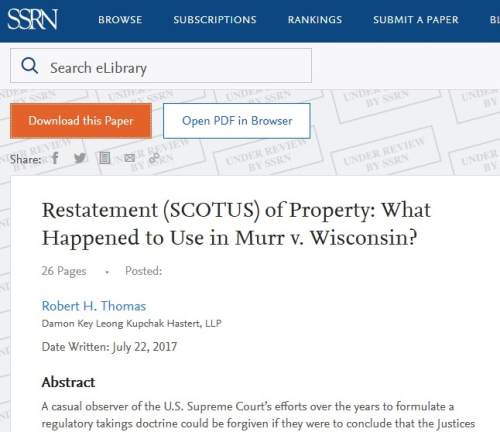
 A couple of weeks ago, we noted that the Supreme Court’s recent decision in Murr v. Wisconsin would no doubt be a boon for law review editors. To avoid shirking our duty, we’ve spent the interim doing some writing, adding a drop to the flood. First draft done, posted on SSRN here

Emphasis on “draft,” so send your comments. Continue Reading Restatement (SCOTUS) of Property: What Happened to Use in Murr v. Wisconsin?

Here’s a newly-filed cert petition which asks the Supreme Court to review a Sixth Circuit decision in which the county auctioned the Church’s property to satisfy a tax lien, then kept the difference between the owed taxes plus costs, and the proceeds from the sale. The court dismissed the claim under Williamson County because it concluded that the Church could have pursued compensation from the county under state procedures.  

Here are the Questions Presented:

When Wayside Church fell behind on the property taxes for its youth camp, Van Buren County foreclosed and sold the youth camp for $206,000. After satisfying the church’s $16,750 in penalties, taxes, and fees with the proceeds from the sale, the County pocketed the remaining 91% of the property’s value as a windfall required by Michigan’s property tax law. Likewise, the County kept the surplus when it seized and sold Myron Stahl’s land and Henderson

Continue Reading New Cert Petition: Overrule Williamson County!

ALI Murr Title Card

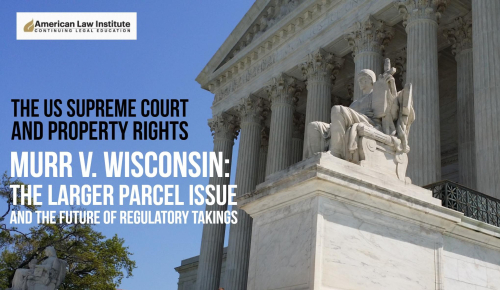
One last reminder: next Tuesday, July 25, 2017 at 2:00 pm Eastern, is “The U.S. Supreme Court and Property Rights: The ‘Larger Parcel” Issue and the Future of Regulatory Takings,” ALI-CLE’s first look at the U.S. Supreme Court’s recent decision on the “larger parcel” or denominator issue in regulatory takings cases where the plaintiff owns more than a single parcel, Murr v. Wisconsin.

Please come and join Sara BeachyMichael BergerSteven Eagle, and John Groen for lively and informative analysis and discussion. I will be introducing and moderating the panel. 

Details, including registration and CLE credit information here. Registration is $199, or, if you have attended one of our in-person Eminent Domain and Land Valuation Conferences in the past (the 2018 Conference in set for Charleston, SC, January 25-27, 2018, at the Francis Marion Hotel, stay tuned here for details shortly)

Continue Reading ALI-CLE: The Larger Parcel Issue and the Future of Regulatory Takings (July 25, 2017)

20151205_145920

If you “get” this headline and the decision by the Federal Circuit, then congratulations, you are a super takings nerd. King of the Nerds. Off-the-charts nerd. Your takings law geek certificate is in the mail. 

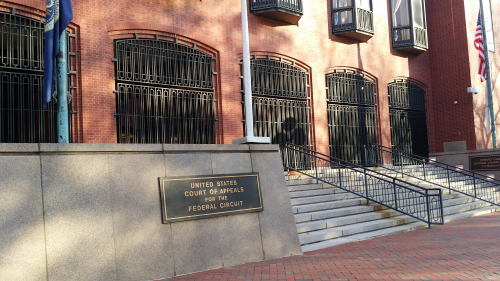
In Petro-Hunt, LLC v. United States, No. 16-1981 (July 13, 2017), the U.S. Court of Appeals for the Federal Circuit considered Tohono, § 1500, takings statutes of limitations, judicial takings, Quiet Title, temporary takings, physical vs regulatory takings, Louisiana law mineral servitudes, and related contract claims. Lots of issues, and we leave it to you to read the whole thing. Well worth it. Bottom line: property owner loses. 

But even in the midst of a loss on all substantive and procedural fronts, this bright point: the Federal Circuit concluded that if the plaintiff had followed the first-to-file process, the court would have upheld the jurisdiction of the Court of Federal Claims against the government’s  § 1500

Continue Reading Federal Circuit: Property Owners, Continue To File Your CFC Takings Claims Before You File Your District Court Action

Update 7/24/2017: Here is our contribution to the article scene.

—————————————–

Someone (I think it was Professor Ilya Somin [update: confirmed – he noted it here]) recently noted that if nothing else, the U.S. Supreme Court’s decision in Murr v. Wisconsin will be a boon for law professors looking for something to fill up law journals. Sidebar: here’s a link to some of the commentary so far on Murr.

And not only for lawprofs, we hope. Their stuff can be useful, but we think there’s a need for those of us in the practicing Bar to contribute as well. We often complain that legal scholarship isn’t of much use to us down in the trenches, so here’s one chance to address that. Stop kvetching and start writing! I’ll do my part, and am currently underway with an article that I anticipate will make three main points:

First

Continue Reading Murr: The Law Review Editors’ Full Employment Act

A very short one from the Connecticut Appellate Court, Santos v. Zoning Board of Appeals, No. AC37281 (July 11, 2017) in a Penn Central-style takings challenge to local land use regulations. We’re going to set out the facts, then let you guess who prevailed.

The plaintiff purchased an unimproved parcel of land in Stratford at a tax sale conducted by the town in May, 2002. The prior owner had owned the property for approximately seventeen years, but had never attempted to develop the property. The town had never formally approved the property as a building lot. In noticing the sale of the property, the town included a warning that the property had not been guaranteed to be buildable under the town’s current zoning regulations. The property was sold to the plaintiff for approximately one half of its assessed value, and the prior owner made no attempt to exercise his

Continue Reading Conn App: Because Owner Can Easily Correct The Problem With Confiscatory Regulation, His Reasonable Expectations Have Not Been Thwarted