


There’s a lot of backstory in Reoforce, Inc. v. United States, No. 15-5084 (Mar. 17, 2017), involving mining claims, federal patents, and public lands. An interesting read, we won’t go into the details.

But suffice it to say that Reoforce thought it had a pretty decent chance of obtaining a patent for federal land because there was a market for what Reoforce thought was a valuable mineral, pumicite. In the end, Reoforce didn’t get the patent because there wasn’t as much of a market for the pumicite as it believed, but under federal law, Reoforce still had a limited property right to mine the stuff in remote Kern County, California. 

Eventually, the BLM entered into an agreement with the California Parks Department to turn that land into Red Rock Canyon State Park. Certain mining claims were allowed to continue, but others were temporarily prohibited. Reoforce’s were among the

Continue Reading Fed Cir: BLM’s Temporary Prohibition On Mining Not A Penn Central Taking
It’s flashback to Property I class today, folks.

Yesterday’s opinion from the U.S. Court of Appeals for the Eighth Circuit in Barfield v. Sho-Me Power Elec. Coop., No. 15-2964 (Mar. 29, 2017) was about easements, and there wasn’t really a takings issue presented, but we thought we would post it anyway since it is a good reminder of your traditional “Blackacre” property law principles, and because we have had easements on the brain lately, due to that topic being at the center of a cert petition we recently filed

As the caption of the case might inform you, this was a case about Missouri law, in federal court presumably under diversity jurisdiction. The plaintiffs had granted Sho-Me, a rural electric cooperative, easements which gave it “the right to construct and operate an electric transmission line. Some grant the right to construct appurtenances or do things ‘necessary and useful to

Continue Reading 8th Circuit: Not Using Easement For Granted Purpose = Trespass And Inverse Condemnation, But Not Unjust Enrichment

Here’s what we’re reading this Friday:


Continue Reading Friday Round-Up: Murr Arguments, Exactions Cert Petition, Houston “Zoning”

Here’s the cert petition, docketed yesterday, in a case we’ve been following on legislatively-imposed permit exactions, an issue in dire need of Supreme Court resolution. 

Here’s the Question Presented:

A City of West Hollywood ordinance requires that builders of a proposed 11-unit condominium pay a $540,393.28 “affordable housing fee” to subsidize the construction of low-cost housing elsewhere in the City. The ordinance imposes the fee automatically as a condition on the approval of a building permit, without any requirement that the City show that the project
creates a need for low-cost housing.

The question presented is: 

Whether a legislatively mandated permit condition is subject to scrutiny under the unconstitutional conditions doctrine as set out in Koontz v. St. Johns River Water Management District, 133 S. Ct. 2586 (2013); Dolan v. City of Tigard, 512 U.S. 374 (1994); and Nollan v. California Coastal Commission, 483 U.S. 825 (1987).

Stay tuned, folks. 

Petition for

Continue Reading New Cert Petition: Are Legislatively-Imposed Permit Conditions Subject To Nexus/Proportionality?

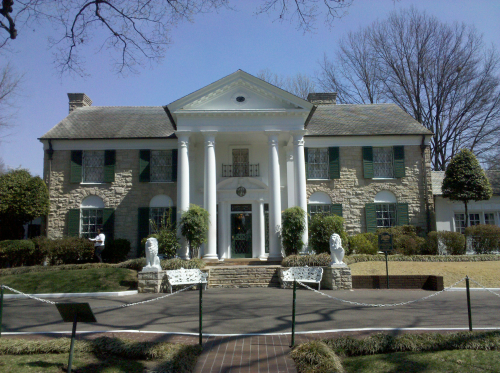
2010-03-19 13.36.36
No, this isn’t the Supreme Court, it’s Graceland,
purchased by Elvis in March 1957.

(We’re just checking whether you are paying attention.) 

Appellate oral argument, as they say, is supposed to be a “conversation” between the bench and counsel. But the overall impression we were left with after reviewing the transcript of yesterday’s Supreme Court oral arguments in Murr v. Wisconsin, the case about the “larger parcel” or “denominator” in regulatory takings cases, was that just about everyone in the courtroom was talking on different wavelengths. 

Don’t get us wrong — arguing counsel for all the parties and amicus did a pretty good job, in our view. They are advocates, after all, and their job is to champion their clients’ position, not to solve the Court’s confusion, and problems that appear entirely self-inflicted.

Two of the parties (the Murrs and the State of Wisconsin) urged the Court to adopt

Continue Reading Affirmed By An Equally Confused Court? Some Thoughts On The Oral Arguments In The “Larger Parcel” Case

As takings mavens are no doubt already aware, next Monday, the 8-Justice Supreme Court will hear arguments in Murr v. Wisconsin, the regulatory takings case which asks whether the county can avoid application of the Lucas wipeout standard on one parcel by taking advantage of the fact that the plaintiffs also own the adjacent parcel. Thus, the county argues, both parcels should be combined to determine how the regulation has impacted the property. 

Others have done a better job at previewing the issues than we could hope to (see SCOTUSblog, the National Constitution Center, and the Federalist Society), so we won’t do a big summary here, but will limit ourselves to pointing out what we think will be the key areas of contention. Go read the voluminous briefing as well. And with the Court one-Justice-down for this case, we’re certainly not going to even venture

Continue Reading SCOTUS Argument Preview: Does Fee Simple Absolute Mean Anything? The “Larger Parcel” Issue In Regulatory Takings

Here’s what we’re reading this Monday:

  • Preview of SCOTUS oral arguments in Murr v. Wisconsin. This is the “larger parcel” case which will be heard next Monday, March 20. The Cato Institute is having a session on it at its DC facility, “Rethinking Regulatory Takings.” If you can’t be there in-person, it will be live streamed. More here. We’ll have our own preview later this week. 
  • Our colleagues at the Massachusetts Land Use Monitor comes this report (“Regulatory Taking, Anyone?“) about a recent jury verdict which concluded that denial of a variance resulted in a loss of all beneficial use of property. And you know what that means, don’t you? 
  • Professor Ilya Somin writes about the “Potential pitfalls of building Trump’s Great Wall of eminent domain” in the Washington Post
  • Professor Gerald S. Dickinson adds his thoughts on the Wall:


Continue Reading Monday Links: Murr SCOTUS Preview, Mass. Reg Takings Verdict, Great Wall Of America, Train Takings

Here’s an article, recently published by the Urban Lawyer (the law review produced by our ABA section, the Section of State and Local Government Law), with our take on the most interesting and important eminent domain and takings rulings from the past year. 

Many of the cases discussed will be familiar to regular readers, but here it is in one place, and in print. 

Recent Developments in Eminent Domain, 48 Urb. Lawyer 939 (2016)

Continue Reading New Article: Recent Developments In Eminent Domain

This year, the University of Hawaii Law Review is devoting one of its issues to a symposium on issues related to the sharing economy

On Friday, February 17, 2017, the law review is sponsoring a series of presentations from 9:00 am – 4:30 pm at the law school (lunch included if you RSVP ahead of time), followed by a reception in downtown Honolulu.

Presenters include national experts such as Professor Stephen Miller (who is also the founding Chair of the ABA State and Local Government Law Section’s Sharing Economy Committee), Christina Sandefur of the Goldwater Institute, local players such as Michael Formby, the Director of Transportation Services for the City and County of Honolulu and Greg Kugle of my law firm, and industry insiders such as Timothy Burr Jr., Senior Public Policy Manager for Lyft. 

The day will see presentations on Housing, Transportation, and Discrimination, as

Continue Reading U. Hawaii Law Review Sharing Economy Symposium (Feb. 17, 2017)