Nothing to do with the case, beyond the owner’s name.
But c’mon, its ABBA.

Ms. Money and her spouse own a home in San Marcos, Texas. That home is in a historic district.

But it turns out that some of that history isn’t pretty: one of the previous owners was “notoriously associated with the Ku Klux Klan.” Yikes. And to make it worse, that owner, a certain Frank Zimmerman, branded the home by installing a Juliet balcony with a big ol’ wrought iron “Z” on the front of the house.

Very understandably, once they found out this detail (after they purchased the home), Ms. Money and her spouse wanted the Z gone. First the good news: although the home is in a historic district, the structure itself isn’t historic. So there’s that. But game not over, because even though it isn’t historic, the home nonetheless
Continue Reading Show Me The Money: Reg Takings Claim Ripe Because City Made Its Decision Even If Owner Could Have Administratively Appealed

Screenshot 2025-01-04 at 08-42-51 Revisiting Palazzolo The Blurry Lines Between Ripeness and Standing that Enable Windfalls by Timothy Harris SSRN

Check out, the latest from Professor Timothy Harris, “Revisiting Palazzolo: The Blurry Lines Between Ripeness and Standing that Enable Windfalls,” 73 Kan. L. Rev. 289 (2024). He dives into the question of whether an owner who acquires property already subject to regulations that allegedly work a taking may assert a claim, or does that claim belong only to the prior owner?

Here’s the Abstract:

When property changes hands, the pre-existing right of the seller to bring an inverse condemnation claim against the government does not always pass to a subsequent owner. Sometimes it does. If valid takings claims expire on sale, the government may experience a windfall. But if a buyer gets a deal on burdened property and then sues under a prior owners’ takings claim, the new property owner gets a windfall. Established Supreme Court rules draw distinctions between the character of various “takings” to determine whether

Continue Reading New Article: Timothy Harris, “Revisiting Palazzolo: The Blurry Lines Between Ripeness and Standing that Enable Windfalls,” 73 Kan. L. Rev. 289 (2024)

We’ve been following a Second Amendment case, Hawaii v. Wilson, as it awaited the U.S. Supreme Court’s decision whether to accept review. Not because it is relevant to the usual subjects of this blog, but because a friend and colleague is Counsel of Record for the petitioner, and we’re just naturally interested in cases from the 808 that involve locally-disfavored rights. In that case, the right to keep and bear arms.

The Hawaii Supreme Court refused to consider a criminal defendant’s defense that to prosecute him for carrying a firearm publicly violated the Second Amendment, concluding he lacked standing under Hawaii law because he had not sought a license to carry a firearm.  

Today, in this Order, the Court denied certiorari. But three Justices issued or joined statements (Thomas, Alito, Gorsuch). And Justice Thomas’s statement revealed this Fifth Amendment nugget:

Our rejection of state procedural restrictions on

Continue Reading A Takings Clause Vibe In A Second Amendment Case

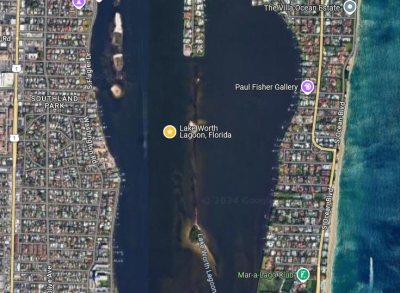
Screenshot 2024-11-20 at 09-16-50 Lake Worth Lagoon - Google Maps
Lake Worth: the “lago” in Mar-a-Lago

You know his name. He’s taken on the City of Riviera Beach twice at the U.S. Supreme Court. And won both times. The houseboat that isn’t a boat. The government can’t shut you out from speaking your mind simply because you irritate them.

That’s right, it’s Fane Lozman. A “Florida Man” that you can like and admire. And he’s back for Round 3.

He owns property that’s mostly in (in, not near) Lake Worth. Two-tenths of an acre is uplands, and the rest (7.75 acres) is submerged. As the Eleventh Circuit noted, “[o]nly a sliver of Lozman’s property is above water.” 

The city, in accordance with the usual approach to land use regulation has a comprehensive plan. That plan designates submerged lands as “Special Preservation Future Land Use,” a label which should set off your Lucas

Continue Reading CA11: Takings Claim Not Ready Despite Govt’s Enforcement Actions

2025 San Diego

Get ready to join your colleagues and friends in San Diego for the 42d ALI-CLE Eminent Domain & Land Valuation Litigation Conference.

The 41st Conference was in New Orleans. Here’s a report of that event, and here are our reports from prior conferences in Austin and Scottsdale.

Here are some of the highlights of the upcoming Conference:

  • Property Rights at the Supreme Court: DeVillier and Sheetz and What’s Next
  • Slow Take: Possession, Rent, Relocation, and Offset
  • The Jury’s View: How Jurors See Your Case
  • From Penn Coal to Penn Central: How to Prove “Too Far”
  • Leveraging Expertise in Eminent Domain Litigation: Working with Land Planners, Engineers, and Other Predicate Experts
  • Kelo at Twenty: What Changed, What Didn’t, and What’s on the Horizon
  • Viva Las Vegas: How the Nevada Judiciary Upheld Property Rights in 180 Land’s Inverse Condemnation Taking
  • Ethics: Guiding the Trolley: Perspectives on Professional Ethics in


Continue Reading Registration For The 42d ALI-CLE Eminent Domain & Land Valuation Litigation Conference Is Underway (Don’t Miss Out!)

Here’s the latest takings cert petition. This one seeks review of the Seventh Circuit’s affirming the district court’s sua sponte abstaining from considering a property owner’s challenge to a Wisconsin municipality’s exercise of eminent domain.

The court concluded that federal courts could — but shouldn’t — consider the owner’s public use challenge because there were ongoing parallel state proceedings (this this case, an eminent domain case in a Wisconsin court). That alone doesn’t seem terribly controversial.

But as the petition points out, there was not actually a “parallel” state court proceeding here, because Wisconsin law apparently doesn’t permit an owner to challenge public use in the proceeding the Village filed. As the Petition puts it:

The Seventh Circuit Court of Appeals’ particularly broad approach to the Colorado River doctrine stands out among the circuits. In the case at hand, the court of appeals expanded the doctrine even

Continue Reading New Cert Petition: When State Law Bars Owner From Challenging A Taking, Can Federal Court Abstain?

You remember that old adage (or maybe its a cliché?) that “a conservative is a liberal who has been mugged?” Well, here’s your environmentalist analog.

In Echeverria v. Town of Tubridge, No. 23-AP-291 (Aug. 2, 2024), the Vermont Supreme Court held that property owners’ lawsuit asserting their right to prohibit the town from allowing bicycling on hiking trails on their land, and to prohibit it from allowing members of the public onto the property to maintain the trails, is ripe. The owners asserted that as the owners, they alone have the authority “whether and how to maintain the legal trails that cross their property.” Slip op. at 2. Here are the details: the owners assert

sole and exclusive authority to decide whether and how to maintain the legal trails that cross their property. They alleged that the expected entry onto their property by volunteers seeking to exercise

Continue Reading A Property Rights Advocate Is An Environmentalist Who Has Been Overregulated: Anti-Takings Advocate Argues For The Right To Exclude

Check this out, the latest takings cert petition from the Pacific Legal Foundation shop.

Since this is one of ours (our colleague Chris Kieser is in the lead), we’re not going into too much detail, but will say that this involves ripeness in a regulatory takings claims, a topic we’ve been focused on a lot lately.

The question here is once the government says “no” to a development plan, must the owner keep on asking? What’s that old adage? If at first you don’t succeed, try and try again? We know that in land use, that means as long as the government says it is willing to “clarify” or “change” its decision (something it almost always asserts it is able and willing to do), most courts will very likely never hold it to task. Planning authorities know this, and as a consequence are hardwired to almost never say no

Continue Reading New Cert Petition: After Permit Denial, To Ripen A Takings Claim Do You Have To Keep On Trying?

Check out City of Kemah v. Crow, No. 01-23-00417-CV (July 25, 2024), from the Texas Court of Appeal (First District).

This is yet another takings ripeness case — here, the so-called “final decision” requirement — the second recent opinion on this issue from the Texas court. SeeFinal Decision Takings Ripeness Is Based On All Circumstances, Not Hard-And-Fast Requirements (Read That Again: A Factual Question)” for our write-up of the other case.

In this one, the owner asserted that the city issued her a building permit for her “barndominium” and and two other structures to be used as short-term rentals, but later issued a stop work order. This resulted in a Penn Central taking, she asserted.   

The city sought ripeness dismissal, asserting the owner didn’t actually have a permit issued by the city council as its ordinances require. The owner didn’t have the actual

Continue Reading Relying On Complaint’s Allegation That City Issued A Permit As Confirmed By Chief Building Officer Email, Texas App Holds Takings Claim Ripe Even Though City Said Council Must Issue Permits

On the surface, the U.S. Court of Appeals for the Ninth Circuit’s opinion in Stavrianoudakis v. U.S. Fish & Wildlife Svc., No. 22-16788 (July 25, 2024) is about Article III standing (a highly technical gateway issue that is very federal courts wonky).

But taking a deeper look offers an insight into ways other than the usual Fifth Amendment arguments for protecting property rights. [Before we go on, a disclosure: this is one of our cases, argued and won by PLF colleague Daniel Woislaw].

This is a case involving the sport of falconry. Can’t say that we knew too much about that — until maybe the occasional movie — until this case. First (and this may not come as a surprise to you who have been observing what things the government finds worthy of regulations and licensing), did you know that every state government except Hawaii has

Continue Reading CA9: Unannounced Inspections As Condition Of Falconry License Are Subject To Nollan/Dolan Challenge