IMG_20190925_175845

Although it is set to launch this Friday, October 2, 2020, there’s still more than enough time to register (and room at the inn) for you to join us for the 17th Annual Brigham-Kanner Property Rights Conference at the William and Mary Law School.

Like everything else this season, the Conference is online (register here), and although we would have preferred to gather in-person of course, the online format has some advantages: the number of attendees isn’t limited by the classroom size (this year’s registrations are at record levels), you don’t need to travel to Williamsburg, and the Conference is free if you don’t want Virginia CLE credit for attending. What a deal.

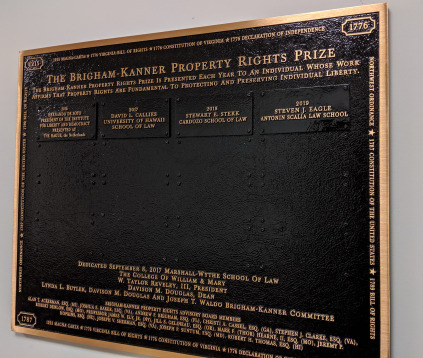
In our opinion, this is the best legal academy/practicing bar conference on property law. This year, the Conference honors the Brigham-Kanner Prizewinner, Harvard Law School Professor Henry Smith.

Here are the panel topics
Continue Reading There’s Still Room: Join Us For The 17th Annual Brigham-Kanner Property Rights Conference (Online, Free!)

Please join us and a panel of expert speakers including our friend and colleague Tony Della Pelle (see the flyer for the complete list), this Thursday, September 10, 2020 at 1pm Eastern Time for the ABA-produced webinar “Governmental Emergency Powers and the Constitutional Implications Arising from Pandemic Orders.”

Free to ABA members, a modest cost for those who are not. Register here.

Here’s the plan:

In the wake of the unprecedented global pandemic, every level of government has taken steps to address the public health crisis. These steps have manifested in orders which impact businesses and individuals alike including quarantine orders, travel restrictions, occupancy limitations, and restrictions on movement. This is the not the first pandemic, nor the first national crisis, faced by the United States. There have been several lawsuits filed challenging the constitutionality of the COVID-19 orders, including challenges based on the right to

Continue Reading This Thursday, Sept 10: “Governmental Emergency Powers and the Constitutional Implications Arising from Pandemic Orders” (Free to ABA Members)

News just in: we’ve just received confirmation that the Conference will not be in-person in Scottsdale in January 2021, and we’re going online.

Not a big surprise, but still a bit disappointing, and it’s a shame that the circumstances won’t allow us to meet in-person to talk shop and to renew our friendships like we do every year. 

But rest assured we’re making lemonade out of these lemons, and we’d appreciate everyone holding the dates on your calendars to join your colleagues from across the nation for the online Conference. And no, we’re not going to do two-and-a-half-days remotely, we’re paring down the agenda and will be focusing on hot topics, and great presenters. The remote format has some advantages, and we’re taking advantage of the circumstances to plan a conference more interactive and a bit different than usual.

This will also be a great program for first-time Conference participants.

Continue Reading Breaking: News About The 2021 ALI-CLE Eminent Domain & Land Valuation Litigation Conference (Jan. 28-29, 2021)

IMG_20200817_104808

We’re done with our first day of class for the upper-level students at William and Mary. We’re teaching two courses this semester, the usual Eminent Domain and Property Rights, but also Land Use Law. We were set to begin a semester of “hybrid” instruction (some students in the classroom, with distancing in place, while others attend remotely). But late last week, due to some administrative difficulties unrelated to the law school, we had to postpone the in-person part until next week.

So we did our first two classes today via Zoom. It went as well as you might expect. We’ve had to make some adjustments to the usual law classroom, but so far, everyone is taking it in stride and adapting well. We expect to do the same and adjust and readjust as the semester progresses.

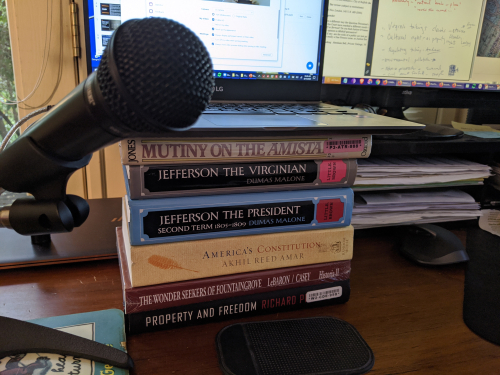
What you’re looking at above is our set-up, a remote “podium” on which we

Continue Reading What Books Do You Use For Your Remote Podium?

20181003_180531_HDR

Registration is up and online. Join us (online) for the 2020 Brigham-Kanner Property Rights Conference. Tuition: free, unless you want CLE credit (in which case it is a very modest $100). Because this conference has gone virtual, the usual Wren Building awards banquet to honor this year’s B-K Prize winner, lawprof Henry Smith, obviously won’t happen, but the speaking panels are a “go.” 

Sign up now and hold the date on your calendar. This is, in our opinion, the best one-day Academy-Bar-Bench conference about property rights that there is. And at such a great deal this year makes this one a “can’t miss.”

Here are the panel topics:

  • Where Theory Meets Practice: A Tribute to Professor Henry E. Smith Recipient, 2020 Brigham-Kanner Property Rights Prize
  • The Housing Crisis
  • Roundtable: Emerging Issues in Takings and Eminent Domain Law
  • The Reach of Government’s Confiscatory Powers Over Exigencies and Emergencies
  • The


Continue Reading Register Now: William and Mary Law’s Brigham-Kanner Property Rights Conference – Oct 1, 2020 (Virtual)

Please plan on joining us on Wednesday, July 22, 2020, at 1pm ET (10am PT) for a long-form program on “Emergency and Police Power: Property Claims in Times of Crisis.”

Our speakers are Professors Craig Konnoth (Colorado) and John Nolon (Pace), and one of the lawyers on the forefront of the nationwide legal challenges, Harmeet Dhillon (San Francisco). I’ll be moderating, along with Professor Sarah Adams-Schoen (Oregon).

Here’s the program description:

On the eve of the centennial of Pennsylvania Coal Co. v. Mahon (US 1922), this panel will revisit the question: How far can the police power be stretched to protect the public against dangers? The panel will evaluate the scope of state and local authority to respond to emergencies and the implications for private property rights—asking, how far is too far? What is the scope of implied limitations on private property rights in times of crisis? When

Continue Reading July 22, 2020: “Emergency and Police Power: Property Claims in Times of Crisis” (ABA Webinar)


Here’s the recording of last month’s Federalist Society’s Environmental Law & Property Rights Practice Group teleforum, “Just Compensation: A Suggestion or a Requirement?

Can states unilaterally decide not to pay takings judgments? Some states think so. Louisiana and Florida have laws that say no takings judgment can be paid unless money is specially appropriated to do so—and then they never get around to appropriating the money to pay. These laws are currently being challenged in the Fifth Circuit and the Florida Supreme Court. Please join us for an interesting discussion of this litigation.

Featuring:

Robert McNamara, Senior Attorney, Institute for Justice

Daniel Woislaw, Attorney, Pacific Legal Foundation

Stream above, or download it here.Continue Reading What If Govt Is Obligated To Pay … But Doesn’t? Podcast: “Just Compensation: A Suggestion or a Requirement?”

Please join us tomorrow, Tuesday, June, 23, 2020 (12 noon Hawaii Time) for a (free!) webinar. We’ll analyze the latest on “Lockdowns, testing and tracking: Are they all really legal?

We’ll be joining constitutional lawyer Jeff Portnoy and Dr. Keli’i Akina for the program, sponsored by the Grassroot Institute of Hawaii. Sign up now, space limited!

We’ll be discussing the legal questions that have arisen from the shut-down orders, including takings, state-law limitations, and the two federal court lawsuits that are pending. supplemental orders under the automatic termination provision (among other claims) (see here and here for the complaints).

We’ve written up our thoughts on these issues in two articles, “Hoist the Yellow Flag and Spam® Up: The Separation of Powers Limitation on Hawaii’s Emergency Authority,” 43 U. Haw. L. Rev. ___ (forthcoming 2020) (download from SSRN at the link), and Evaluating Emergency Takings:

Continue Reading Upcoming (Free) Program: “Lockdowns, testing and tracking: Are they all really legal?” Tuesday, June 23, 2020 (12 noon Hawaii Time)

Here’s the recording of last week’s program we did for the King Kamehameha V Judiciary History Center, “Constitutional Law and States of Emergency: Lessons from Hawaii’s Judicial History for the COVID-19 Pandemic.”

Links to the cases and other materials we referred to in the presentation are posted here.

Tomorrow, we’ll be joining Honolulu lawyer Jeff Portnoy, and Dr. Keli‘i Akina for a free, open-to-the-public program sponsored by the Grassroot Institute of Hawaii, “Lockdowns, testing and tracking: Are they all really legal?

Jeffrey Portnoy and Robert Thomas will talk about what we can expect as the state and counties slowly lift their seemingly endless stay-at-home orders, which have discriminated between “essential” and “nonessential” workers, mandated “social distancing” and mask-wearing, and imposed 14-day quarantines on arriving airport passengers, both tourists and residents returning home.

During the hourlong event, Portnoy and Thomas will consider whether businesses destroyed or

Continue Reading Judiciary History Center Program Recording: “Constitutional Law Lessons from Hawaii’s Judicial History for the COVID-19 Pandemic”

KamV Jud History Center

Here are the links and other materials which we spoke about in this afternoon’s program for the King Kamehameha V Judiciary History Center, “Constitutional Law and States of Emergency: Lessons from Hawaii’s Judicial History for the COVID-19 Pandemic.”

“Emergency does not create power. Emergency does not increase granted power or remove or diminish the restrictions imposed upon power granted or reserved. The Constitution was adopted in a period of grave emergency. Its grants of power to the federal government and its limitations of the power of the states were not determined in the light of emergency and they are not altered by emergency. What power was thus granted and what limitations were thus imposed are questions which have always been, and always will be, the subject

Continue Reading Links And Materials From Judiciary History Center Program: Constitutional Law and States of Emergency: Lessons from Hawaii’s Judicial History for the COVID-19 Pandemic