There’s still time to register and attend the upcoming seminar,”Hawaii’s Shoreline and Coastal Law and Regulation.” It’s scheduled for Friday, July 18, 2014, in downtown Honolulu at the YWCA. Here’s the description:

This program will cover recent Hawaii case law, including the recent Hawaii Supreme Court decision regarding identifying the certified shoreline. Now, more than ever, with the realization that we need to plan for the impacts caused by our changing climate, existing regulations and policies will need to change.

Join Program Chair Jesse K. Souki, First Deputy of the State of Hawaii’s Department of Land and Natural Resources. He leads an outstanding faculty for these topics:

  • Natural and Anthropogenic Shoreline Change in Hawaii and Field Methods for Locating the Certified Shoreline
  • Land Use Laws Affecting Coastal Development in Hawaii
  • Recent Hawaii Case Law
  • The Changing Face of Public Policy: Legislative Issues and Dilemmas
  • Understanding the Regulatory


Continue Reading Upcoming CLE: Hawaii’s Shoreline and Coastal Law and Regulation
In 1993, in order to protect seagrasses, the city of Sanibel adopted an ordinance prohibiting the new construction of docks and piers in certain areas of town. Plaintiffs, littoral owners who bought their land after the ordinance was in place, thought that — this being Florida, and an island — it was their right to build docks and the like (because doesn’t everybody in Florida have a boat?). They challenged the ordinance in state court as a violation of due process and did not substantially advance a legitimate state interest, asserting they possessed riparian rights, incluidng “reasonable docking rights.” The city removed the case to federal court, which dismissed the complaint because riparian rights, having their source in state law, are not “fundamental” rights, and thus form no basis for a substantive due process claim. 

In Kentner v. City of Sanibel, No.13-13893 (May 8, 2014), the Eleventh Circuit agreed.

Continue Reading 11th Circuit: Riparian Rights Not “Fundamental,” And Not Subject To Lingle

No, not that Madison County, but rather Madison County, Montana

In Public Lands Access Ass’n v. Bd of County Commissioners of Madison County, No. DA 12-0312 (Jan. 16, 2014), the Montana Supreme Court held that a riparian owner’s efforts to fence his land to keep the public from crossing it and accessing the Ruby River were not effective. Montana has a statute that allows public access to and use of streams up to the high water mark, and the property owner asserted that the lower court’s ruling allowing access across his land and use of the River under the statute was an unconstitutional taking. The Supreme Court rejected this argument. As the court’s synopsis stated:

The Court also explained that Kennedy’s takings argument is precluded by well-settled law in Montana. Montana’s well-settled law provides that the State owns all waters in trust for the people; that a

Continue Reading The Fences Of Madison County: No Judicial Taking

Our thanks to a new colleague from the U. Maine Law School, who gave us the heads-up about a recent decision from that state’s supreme court about private ownership of beaches, Almeder v. Town of Kennebunkport, No. Yor-12-599 (Feb. 4, 2014).

Littoral property owners sued the Town to determine who owns certain portions of the beach. You know the usual drill in beach cases: the wet sand beach, the dry sand beach, uplands, and the water are the usual dividing lines. Some states like Hawaii mandate that all beaches are public, and up to the highest reaches of the wash of the waves. Others say the public beach extends only to the mean high water mark. In others, some beaches may be privately owned down to the low water line.

Maine appears to be one of the latter, and the owners sought declaratory judgments that they owned or had

Continue Reading Maine: Beach Property Not Subject To Special Rules

Looks like they’re at it again, a solution in search of a problem: a bill has been proposed in the Hawaii Legislature to create an “Environmental Court,” whose mission would be to handle “environmental disputes” arising under a wide range of state statutes:

…administrative proceedings and proceedings for declaratory judgment on the validity of agency rules authorized under chapter 91, arising under chapters 6D, 6E, 6K, 54, 58, 128D, 128E, 201N, 205, 205A, 220, 269, 339, 339D, 340A, 340B, 340E, 340F, 342B, 342C, 342D, 342E, 342F, 342G, 342H, 342I, 342J, 342L, 342P, 343, 508C, and 664, and Titles 11 and 12.

(And the regulations promulgated by state agencies, and ordinances and regulations promulgated by the counties, no doubt.) The bill (SB 632) would task this new court with “maintenance and improvement” of the environment and with exercising “constant vigilence” to “promote and protect Hawaii’s natural environment through consistent

Continue Reading Does Hawaii Need An “Environmental Court?” (Part II)

Property

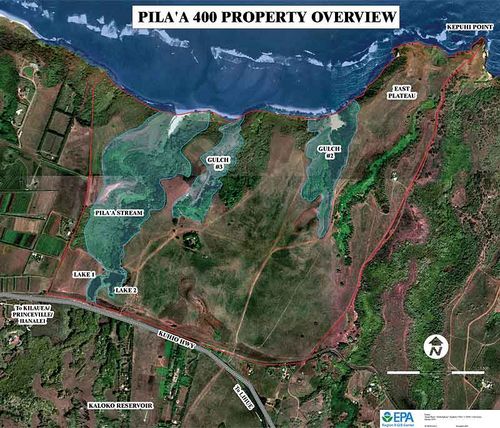
There’s not much doubt that the now-notorious large-scale unpermitted upland grading and grubbing by a Kauai property owner on its private land caused the runoff that catastrophically damaged the adjacent beach and the reef offshore. The damage was pretty bad, and resulted in the “largest storm water settlement [with the federal EPA] in the United States for violations at a single site by a single landowner.” See also the photo above (much larger version here).

The state also pursued the owner, and after a contested case, the Board of Land and Natural Resources assessed approximately $4 million in damages, and $70k for administrative costs. To reach this assessment, It did not apply a preexisting damage formula, but used a method it crafted for the case:

The value of Pilaa beach, bay and reef includes use value, option value, commodity value, existence value, bequest value, cultural values, including

Continue Reading HAWSCT: Damage To Unique Property Subject To Unique Rules

Today, the Hawaii Supreme Court issued an option in Diamond v. Dobbin, No. SCWC-30573 (Jan. 27, 2014), a case about shoreline certifications that we’ve been following.

It’s a beach case, obviously, but not about ownership. Shoreline certifications approved by the State Department of Land and Natural Resources are used as the baseline from which to measure building setbacks on littoral parcels, and do not involve the boundary between public and private property on beaches.

The DLNR certified the shoreline on a Kauai parcel, and two nearby residents who claimed the shoreline was further mauka (landward) administratively appealed to the Board of Land and Natural Resources. The Board rejected the appeal and approved the certification, and the two neighbors appealed to the circuit court under HAPA. The circuit court concluded the BLNR’s findings of fact were wrong, and vacated the certification.

The property owner who sought the certification appealed to the

Continue Reading HAWSCT: State Agency Must Consider “Historical Evidence” Of “The Upper Reaches Of The Wash Of The Waves” When Certifying Shorelines

Usually, in disputes about who owns oceanfront property (in Waikiki, the really nice part of Waikiki, down on the Diamond Head side), each party claims ownership. Beachfront property, after all, is pretty valuable.

But sometimes, it can be a liability. 

So maybe “hot potato” is more accurate in this case, since it involves an old seawall that is badly in need of repair, and it seems everyone is claiming they don’t own it, and that it belongs to someone else. The seawall is located partly on private property and partly on state land, and no one wants to pay to fix it. The private landowners claim the seawall is a public thoroughfare, and argue it was surrendered to the State because they had not exercised ownership for at least five years.

The trial court agreed, and issued these findings of fact and conclusions of law. The most interesting part of

Continue Reading Hawaii Trial Court: Seawall No One Wants Belongs To State

IMLA
On Monday, September 30, 2013, we’ll be speaking along with Dwight Merriam and Cecily Barclay at the International Municipal Lawyers Association’s annual meeting in San Francisco, about three important cases/issues: Koontz, Harvey Cedars, and Lost Tree.

That’s a pretty wide range of cases, but we have some time and we’re sure we’ll have a good discussion. If you are attending the IMLA conference, please be sure to join us: 2:15 – 3:15pm, Hilton San Francisco Union Square (Plaza B, Lobby Level). Continue Reading Upcoming IMLA Panel On Koontz, Harvey Cedars, And Lost Tree