


oral Several justices (Justice Acoba, Justice Pollock) appeared quite hostile to the DLNR’s position. Their questions went beyond the usual “devil’s advocate” type questions where the questioner is testing a theory, or speaking through counsel to the other justices.

The Judiciary’s web site summarized the issues argued:

On January 11, 2008, Respondents Craig Dobbin and Wagner Engineering Services, Inc. filed a shoreline certification application with the Department of Land and Natural Resources (the DLNR) to certify the shoreline location on property owned by Dobbin. The DLNR approved the shoreline, and Petitioners Caren Diamond and Beau Blair appealed the certification to Respondent Board of Land and Natural Resources (the BLNR). The BLNR subsequently denied Petitioners’ appeal and certified the shoreline. Petitioners appealed the certification to the circuit court of the fifth circuit. The court held in favor of Petitioners, and remanded the case to the BLNR with instructions to give due

Continue Reading Hawaii Supreme Court Gets Into The Weeds On Shorelines
In “Why big development is so difficult in Hawaii,” Hawaii Business magazine tackles an issue first raised by U. Hawaii lawprof David Callies in recently-published law review article (and follow-up interview), where he labeled the record of the 1993-2010 Hawaii Supreme Court on property issues “appalling” (80% overall success rate for environmental and native Hawaiian litigants, 65% of cases reversing the Intermediate Court of Appeals). As Callies said in an earlier presentation, “ninety percent of the time, government and the private sector are wrong? Give me a break.” (Remember, this is the court that concluded that “western concepts” of property law such as exclusivity are “not universally applicable in Hawaii.”)

Callies’ conclusions sparked reaction from his academic colleague environmental lawprof Denise Antolini, who defended the court’s environmental jurisprudence in an article on the grounds that it wasn’t so much focused on outcome, but on process.

Continue Reading Hawaii Business Mag Story Misses The Big Issue On Development, Environmental Law, And Land Use

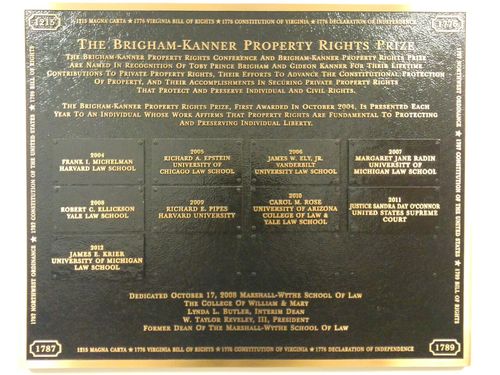
IMG_20121012_135714

William & Mary Law School, host of the annual Brigham-Kanner Property Rights Conference, has announced that Columbia Law School Professor Thomas W. Merrill will receive the 2013 B-K Prize at the conference (October 17-18, 2013, Williamsburg, Virginia). The photo above is of the plaque on the wall at the William & Mary Law School listing B-K Prize winners.

The Conference agenda and speakers have yet to be finalized, but here’s the tentative list of topics:

  • The Impact of a Leading Property Scholar: Defining the Essence of Property
  • Promoting Government Forbearance
  • The Implications of the Court’s Recent Takings Cases
  • Property Rights in Times of Transition

We spoke at the 2012 Conference in Williamsburg, and attended the 2011 Conference in Beijing. The 2013 lineup sounds pretty good, so mark your calendars. Continue Reading 2013 Brigham-Kanner Property Rights Prize: Professor Thomas Merrill

Our state courts may be closed on this Good Friday, but the courts of most other states’ are not, Texas courts included. So here’s an opinion issued today by the Texas Supreme Court, El Dorado Land Co. v. City of McKinney, No. 11-0834 (Mar. 29, 2013).

[Update: more on the case here from the Supreme Court of Texas Blog, including links to the briefs and the oral arguments.]

El Dorado sold the city some land for use as a park. The conveyance required that the land “shall be used only as a Community Park,” and if not used for that purpose, then El Dorado would have the right to buy the land back.

Ten years later the city built a public library on part of the land, which resulted in El Dorado reminding the city about that “park” use requirement by giving notice that it was

Continue Reading Texas: A Future Interest Is A Property Interest

If this article — Christie tells beachfront owners to sign easement for dunes or face ridicule — accurately relays the entire context of the situation, then something is seriously off here.

The article quotes New Jersey Governor Chris Christie as declaring that if shoreline property owners do not voluntarily surrender easements and allow the construction of sand dunes on their land (presumably without compensation) very soon, then he’s going to “call them out” and publicly name them:

“We’re going to start calling these folks out in the next few weeks if they haven’t signed the easements to let us build the dunes because they need to be called out and they need to be told that there is something more important than their own self interests,” he said during a town hall-style event in Middlesex Borough.

He followed that up with his reasoning:

“I’m not going to put up with

Continue Reading Tail Gunner Christie: What’s Next, The Pillory And The Stock?

Undercutting the trope that the lawsuit by a Marin County, California oyster farm to keep operating is all a right-wing plot (see also this story), famed Berkeley chef and food guru Alice Waters has asked the Ninth Circuit to file an amicus brief in support of Drakes Bay Oyster Company in its appeal of the District Court’s denial of its request for a preliminary injunction. As we noted here, the Secretary of the Interior denied the Company’s efforts to renew its license for its decades-old farming operation in the Point Reyes National Seashore. The Ninth Circuit has issued an injunction pending appeal, and ordered expedited calendaring.

Joining Waters on the brief is another nearby oyster farmer (located on private land), a San Francisco restaurant, the California Farm Bureau and two county farm bureaus, and “Food Democracy Now,” “Marin Organic,” and the “Alliance For Local Sustainable Agriculture.”

Continue Reading Food Fight: Environmentalist Top Chef Supports Oyster Farmer Against Other Enviros In Ninth Circuit

In a recently-published law review article, U. Hawaii lawprof David Callies found that “the Moon Court [1993-2010] decided some of thestate’s most important property and related environmental and Native Hawaiianrights cases in favor of the various non-governmental organizations bringingthem (Sierra Club, Earthjustice, Hawaii’s Thousand Friends, and the NativeHawaiian Legal Corporation) approximately eighty-two percent of the time,sixty-five percent of which reversed the Intermediate Court of Appeals,” a result he concluded was “appalling.”

Well here’s the counterpoint, a paean to the Moon Court from another U.H. lawprof, who asserts that the court’s environmental jurisprudence wasn’t so much focused on outcome, but rather on process. Yes, plaintiffs won a whole lot, but don’t be fooled the results, she writes, because the court was only insuring that the doors to the courthouse remain open to all comers under the environmental standing doctrine:

At first blush, the Hawai‘i Supreme Court’s environmental review jurisprudence under

Continue Reading A Partial Rebuttal To Professor Callies: 1993-2010 HAWSCT Environmental Record Most Concerned With Public Participation

The oral argument calendar of the Hawaii Supreme Court  looks pretty interesting:

  • Thursday, February 7, 2013, 11:00 a.m. – Sierra Club v. Land Use Comm’n, No SCWC-11-0000625, a case about the qualifications of holdover Land Use Commissioners, which we previewed here
  • Thursday, February 21, 2013, 10:00 a.m. – Kanahele v. Maui County Council, No. SCWC-29649, a case involving the “Sunshine Law” and the council’s consideration of a development project on Maui. More here from Record on Appeal.
  • Thursday, February 21, 2013, 11:00 a.m. – County of Hawaii v. UNIDEV, LLC, No. SCWC-10-0000188, a case about contracts between a private developer and the County to build affordable housing. It’s more about arbitration and appellate jurisdiction, but an interesting case nonetheless. More here from Record on Appeal.
  • Thursday, March 14, 2013, 9:30 a.m. – State of Hawaii v. Woodhall, No. SCWC-11-0000097, in which the court


Continue Reading Upcoming Hawaii Appellate Arguments Of Interest

Here’s the inevitable reaction to U. Hawaii law Professor David Callies’ recently-published law review article (and follow-up interview) about the stunning success rates certain parties enjoy in the Hawaii Supreme Court. In that article, the good professor labeled the record of the 1993-2010 Hawaii Supreme Court on property issues “appalling,” so it should come as no surprise that two of the beneficiaries of those rulings have now rallied to that court’s defense.

In “Hawaii Court Upholds Public Responsibility In Environmental Cases,” an opinion piece in Honolulu Civil Beat, an Earthjustice lawyer and the Director of the Hawaii Sierra Club jointly write:

Callies complains that the Supreme Court “created out of whole cloth” the requirement that the Turtle Bay Resort supplement its 25-year old Environmental Impact Statement. He was on the losing end of that argument before the Court, and he’s still wrong now. Supplemental EISs are

Continue Reading The Empire Strikes Back: Reaction To UH Lawprof’s Study Of Success Rates In Hawaii Supreme Court Cases

The Hawaii Supreme Court has accepted certiorari and agreed to review the Intermediate Court of Appeals’ unpublished memorandum opinion in Diamond v. Dobbin, No. 30572 (Aug. 31, 2012). The Supreme Court’s order is here.

It’s another beach case, this time involving a shoreline certification. Shoreline certifications approved by the State Department of Land and Natural Resources are used as the baseline from which to measure building setbacks on littoral parcels, and do not involve the boundary between public and private property on beaches. The DLNR certified the shoreline on a Kauai parcel, and two nearby residents who claimed the shoreline was further mauka (landward) administratively appealed to the Board of Land and Natural Resources. The Board rejected the appeal and approved the certification, and the two neighbors appealed to the circuit court under the Hawaii Administrative Procedures Act.

The circuit court concluded the BLNR’s findings of fact were

Continue Reading Another HAWSCT Shoreline Cert Grant