The week before last, the Hawaii State Bar Association’s Real Property and Financial Services Section held a session on recent developments in land use law of interest to local dirt lawyers.

We were not able to attend (we were teaching a seminar on water law), but our Damon Key colleagues Mark Murakami, Greg Kugle (who Chairs the Section), and Ken Kupchak were able to go, and reported that the following decisions were discussed and debated:

  • County of Hawaii v. Ala Loop Homeowners, No. 27707 (July 9, 2010). In that case, the Hawaii Supreme Court concluded that state zoning statutes are “environmental laws” as defined in the Hawaii Constitution, and therefore a private right of action exists. We suggested that


Continue Reading Land Use And Takings Cases Discussed At The HSBA Real Property Session
Last Friday, I was on the faculty of Integrating Water Law and Land Use Planning, a seminar on Hawaii’s unique water law.

My session covered “Water Rights, Property Rights and the Law of Settled Expectations,” and provided a crash course in Hawaii land use law, the interrelationship between land use law and water law, and the limitations of the public trust doctrine.

Other sessions included “Hawaiian Water Rights – Where Culture and the Law Merge,” “Amendments to the Instream Flow Standards in East and West Maui,” and “County of Hawaii Water Use and Development Plan.” Also on the faculty were my Damon Key colleague Christi-Anne Kudo Chock; Dr. Lawrence Miike, Commissioner on the State Commission on Water Resource Management; and Lawrence Beck, Civil Engineer with the County of Hawaii Department of Water Supply. Dr.

Continue Reading Materials And Links From “Integrating Water Law and Land Use Planning” Seminar

Just in: the Texas Supreme Court has issued an opinion in Severance v. Patterson, No. 09-0378 (Nov. 5, 2010). In that case, the court ruled on “whether private beachfront properties on Galveston Island’s West Beach are impressed with a right of public use under Texas law without proof of an easement” when an avulsive event causes dramatic changes to a beach. Slip op. at 2.

The court concluded no, and answered these questions which were certified by the Fifth Circuit:

  • Does Texas recognize a “rolling” public beachfront access easement, i.e., an easement in favor of the public that allows access to and use of the beaches on the Gulf of Mexico, the boundary of which easement migrates solely according to naturally caused changes in the location of the vegetation line, without proof of prescription, dedication or customary rights in the property so occupied?
  • If Texas recognizes such an easement,


Continue Reading Texas: Public’s Beachfront Easement Does Not “Roll” With The Vegetation Line

The U.S. Supreme Court has declined to review Maunalua Bay Beach Ohana 28 v. State of Hawaii, 122 Haw. 34, 222 P.3d 441 (Haw. Ct. App. 2009). That’s the case in which the Hawaii Intermediate Court of Appeals concluded that ownership of beachfront property includes only a partial right to accreted land.

The ICA held that held that “Act 73” (codifed here and here), the statute in which the Hawaii legislature redefined accretion as public property was a taking of existing accreted land, but held that Act 73 did not affect a taking of what it called “future” accretion, because the right is simply a contingent future interest and not a “vested” right. The Hawaii Supreme Court denied discretionary review.

Under the ICA’s view of “unvested future interests,” the legislature would be free to enact a statute abolishing the right to pass property to one’s heirs at death

Continue Reading Cert Denied In Hawaii Beach Taking Case

Slough Remember that now-iconic scene in The Fugitive, where Harrison Ford’s character has turned the tables on Tommy Lee Jones, and while holding Jones at gunpoint proclaims, “I didn’t kill my wife!”

Jones’ response — I don’t care! — could just as easily apply to regulatory takings law, especially where a property owner alleges a regulatory action results in a per se taking (either a Lucas interference with all economically beneficial use, or a deprivation of a fundamental aspect of property such as the right to exclude).

In those cases, it generally does not matter what justifications the government may have for the regulation — the only thing relevant is the impact of the regulation on the property. In other words, even a regulatory action that might be a very good idea (from the government’s perspective) results in liability for compensation if it results in a taking

Continue Reading Wash. App: “I Don’t Care!” – Regulatory Takings Are About Impact, Not Justification

Banner_300x68 Mark your calendars: as a follow up to the panel discussion of Stop the Beach Renourishment, Inc. v. Florida Dept. of Environmental Protection, 130 S. Ct. 2592 (2010) at the ABA Annual Meeting in San Francisco in August, the ABA Section of Real Property, Trust and Estate Law is sponsoring (along with the Section on State & Local Government Law) a teleconference on the case and the issue of “judicial takings.”

In “Is There Such a Thing as a Judicial Taking? The Lessons of the Supreme Court’s Ruling in Stop the Beach Renourishment, Inc. v. Florida Department of Environmental Protection,” I will be moderating a panel of legal experts to discuss the case, and more importantly, where we might go from here. Here’s a description of the program:

This program will discuss the 2010 United States Supreme Court decision in Stop the Beach Renourishment v. Florida Dept.


Continue Reading October 20, 2010: ABA Teleconference On Judicial Takings And The Stop The Beach Renourishment Case

Yesterday, on behalf of the Land Use Research Foundation of Hawaii, we filed this brief amicus curiae in the U.S. Supreme Court in Maunalua Bay Beach Ohana 28 v. Hawaii, No. 10-331 (cert. petition filed Sep. 7, 2010). The Supreme Court’s docket entry on the case is here.

This is the case in which the Hawaii Intermediate Court of Appeals concluded that ownership of beachfront property includes only a partial right to accreted land. In Maunalua Bay Beach Ohana 28 v. State of Hawaii, 122 Haw. 34, 222 P.3d 441 (Haw. Ct. App. 2009), the ICA held that held that “Act 73” (codifed here and here), the statute in which the legislature redefined accretion as public property was a taking of existing accreted land, but held that Act 73 did not affect a taking of what it called “future” accretion, because the right is simply a contingent future interest. The cert petition is available here.

The Cato Institute and Pacific Legal Foundation also filed an amicus brief urging the Court to review the case. See If Only Hawaii’s Government Were as Beautiful as Its Beaches.

The LURF amicus brief poses this Question Presented:

In 2003, the Hawaii legislature adopted Act 73, which declared that the private right to own accretion on beachfront parcels was public property. The statute did not provide for compensation, and upon challenge by the Petitioners, a state trial court invalidated Act 73 as a regulatory taking.

The Intermediate Court of Appeals of Hawaii partially affirmed, concluding that Act 73 was a taking of accreted land in existence in 2003 when the Act became effective. It also concluded, however, that the statute was not a taking of “future accretion,” or land that might be accreted after 2003, because there was no certainty that accretion would occur, and littoral owners’ right to accretion was therefore not “vested.” The court concluded the legislature was free to recharacterize the private right to accretion as state property without compensation because Petitioners never owned it. In other words, the right to accretion is not “property” as that term is used in the Fifth and Fourteenth Amendments.

The question presented is whether the right to accretion is property within the meaning of the Fifth and Fourteenth Amendments, and therefore protected from ipse dixit redefinition into public property.

Here’s a summary of the brief:

To rescue Act 73 from total invalidity under the Takings Clause, the court below created a distinction never before recognized in Hawaii law between “vested existing accretions” which are constitutionally protected property, and “unvested future accretions,” which are not. The latter, the court concluded, could be transformed ipse dixit by the Hawaii legislature into public property without compensation. After all, how could a littoral owner possess a property interest in land that had not yet accreted?

The supposed distinction between “existing” and “future” accreted land is illusory, however, and overlooks the critical private property interest which Act 73 redefined as public property. Hawaii law had for over a century recognized that littoral owners possessed the right to accretion. That right was a present right, was “vested,” and, as surely as interest follows principal, cannot be transformed by the stroke of the legislature’s pen into public property. The Constitution – in addition to recognizing as property the accreted land in existence at the time of the adoption of Act 73 in 2003 – also protects the right to all accretion. Thus, when Act 73 declared that accretion belonged to the state, it confiscated private property without due process or condemnation, and violated the Fifth and the Fourteenth Amendments.

This brief focuses on two issues. First, the right to accretion is a present property interest protected by the Fifth and Fourteenth Amendments from uncompensated legislative redefinition as public property. This right is not limited merely as accreted land in existence on the day the legislature adopted Act 73, and the court below strayed far afield from this Court’s established precedents when it concluded that the only property interest protected by the Constitution was the land already accreted. Second, to provide context to the lower court’s decision and how it reached its conclusion, this brief summarizes the decades-long experiences of Hawaii’s property owners who have seen their established common law property rights eroded into public property. The case at bar is only the latest example.

Brief at 3-4 (emphasis original) (footnote omitted).

The State of Hawaii has waived its right to file a brief in opposition (unless the Court orders a BIO be filed), and the case will be considered at the Court’s conference on October 29, 2010.

More to follow.

Continue Reading Amicus Brief In Hawaii Beach Takings Case: Is The Right To Accretion A “Property” Interest?

11.LULHI Mark your calendars for January 13 and 14, 2011 for the 5th Hawaii Land Use Law Conference, to be held in Honolulu. Yes, it’s a few months away, but this is the Big One, it only comes around every two years, and you don’t want to miss it. 

The program chairs are Professor David Callies and land use attorney Ben Kudo, and they have assembled an expert and diverse faculty, including keynote speaker Professor Gideon Kanner (no stranger to readers of this blog).

  brochure

, which contains all the details and a registration form.

Here’s the program description:

The Hawai`i system of land use is complex and private land use is highly regulated. Attorneys and legal staff, planners, government officials, land owners and developers need to understand the complex federal, state and local requirements and procedures.

An expert faculty of land use practitioners, planners and regulators will explain the

Continue Reading January 13 & 14, 2011: 5th Hawaii Land Use Law Conference

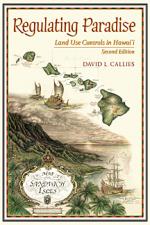
Regulatingparadise University of Hawaii lawprof David L. Callies needs no introduction to the readers of this blog. He’s one of the deans of the national and international land use bar and professoriate, but those of us who practice land use law in Hawaii consider him our special mentor (dare I say guru?) when the topic of Hawaii land use law is raised. Virtually every dirt lawyer practicing here has studied under or with him.

Those of us who consider this area of law our calling have for years looked forward to an update of Regulating Paradise, his seminal book on Hawaii’s complex and multi-layered system of land use and regulation.

Well wait no further. The University of Hawaii Press has published the second edition of Professor Callies’ essential work. Purchase your copy here (a mere $22). Here’s the Introduction.

We haven’t had an opportunity to pore through the nearly 400 pages of text (illustrated with the irreplaceable Corky Trinidad‘s editorial cartoons), so a more complete review will follow once we’ve had a chance to do so. In the meantime, voices more eminent than our own have weighed in:

“A masterful analysis of [Hawai‘i’s] land use laws.” —Daniel R. Mandelker, Stamper Professor of Law, Washington University, St. Louis

“Essential reading for all who seek to understand how land use is regulated in Hawai‘i or to apply the lessons learned there to other states.” —Dan Tarlock, Distinguished Professor of Law, Chicago-Kent College of Law

“A must-read for both neophyte and veteran legal practitioners. Callies’ in-depth and insightful explanations and commentaries on Hawai‘i’s complex land use and planning laws provide a road map for understanding the state’s multi-layered regulatory scheme.” —Benjamin A. Kudo, Ph.D.

“With this magnificent new work, and its far ranging, comprehensive analysis – from the feudal land holdings of the monarchy to regulating McMansions – Professor Callies teaches and entertains us with tales of success and failure in Hawaiian land use and development law. There are lessons here for every one of us, all across this country.” —Dwight Merriam, Robinson & Cole

If the second edition is anything like the first, Regulating Paradise will occupy an frequently-used spot on our back bookshelf. More to follow.
Continue Reading New Book: Callies, Regulating Paradise – Land Use Controls In Hawaii (2d ed. 2010)

No, thankfully this post is not about the MTV show, but who owns the new dry sand created when the government “replenishes” beaches. In a case reminiscent of the U.S. Supreme Court’s decision in Stop the Beach Renourishment v. Fla. Dep’t of Envt’l Protection, 130 S. Ct. 2592 (2010), the New Jersey Supreme Court unanimously concluded that a beachfront property owner was not entitled to compensation for the city’s taking of his property — a beach created by the city’s beach replenishment program — because the replenished beach was a common law “avulsion” and therefore belonged to the public.

In City of Long Branch v. Liu, No. A-9-09 (Sep. 21, 2010), as part of a redevelopment project, the city condemned littoral property owned by the Liu family. The parcel was described by metes-and-bounds, with the easternmost boundary being described as the “high water mark of the Atlantic

Continue Reading Jersey Shore Belongs To The Public, Not Private Owners