All the topics you want to know about, presented by top-notch faculty from across the nation. Sessions include:

  • Property Rights as Civil Rights
  • Eminent Domain National Update
  • Just Relocation: Understanding the Law and Regulations to Ensure Fairness
  • Challenging Public Use: Lessons From a 67-Day Trial
  • COVID Takings
  • Federal Court and the Daubert Challenge: How to Prepare
  • Did the Supreme Court Signal a New Direction in Property Rights in Cedar Point Nursery?
  • How to Position Your Client for the Fallout When Projects Don’t Get Built
  • Rural Broadband and the Emerging Constitutional Challenges
  • Are Precondemnation Entry Statutes Still Valid After Cedar Point Nursery?
  • How Condemnor and Property Owners’ Counsel Prepare the Battlefield
  • How Will the Trillion Dollar Infrastructure Bill Impact Your Practice?
  • Ethics
  • …and more, including a full slate of networking and social events!

We’ve sold out the last few years, so don’t miss out. Room block now taking reservations. Continue Reading Join Us For The 39th Annual ALI-CLE Eminent Domain & Land Valuation Litigation Conference, Jan 26-29, 2022 (Scottsdale, AZ)
In Protect and Preserve Kahoma Ahupuaa Ass’n v. Maui Planning Comm’n, No. SCWC-15-0000478 (June 16, 2021), the Hawaii Supreme Court reaffirmed the idea that all members of the public have a right under the Hawaii Constitution to a “clean and healthful environment,” and that this is a “property” right entitled to due process protection under the state constitution. We say “reaffirmed” because this is merely the latest case so holding (see here for the first).

Like a lot of important Hawaii cases, this one came up in the context of standing to participate in the administrative review process. A Maui developer sought a permit under the Hawaii Coastal Zone Management Act from the Maui Planning Commission for an affordable housing project near Lahaina. Members of the Association, all of whom asserted they owned property adjacent to the project, asked the Planning Commission to intervene in the

Continue Reading HAWSCT: Anyone Claiming That An Affordable Housing Project Might Impact Their Property Interests In A “Clean And Healthful Environment” Has Standing To Object

PASH symposium

Back in February, we were honored to be part of the University of Hawaii Law Review’s symposium “25 Years of PASH,” a retrospective of one of the Hawaii Supreme Court’s most famous (or infamous) decisions, Pub. Access Shoreline Haw. v. Haw. Cnty. Plan. Comm’n, 79 Haw. 425, 903 P.2d 1246 (1993), cert. denied sub nom., Nansay Haw. v. Pub. Access Shoreline Haw., 517 U.S. 1163 (1996) (PASH). 

At the conference, we spoke on the panel about “PASH and the Changing Coastal Environment” (see video here at the 2:02:25 mark if you want to watch our panel’s summations).

The speakers also produced short written comments for the Law Review’s upcoming issue, and ours is finally in a shape where we think it is OK for public consumption, so we’ve posted it on SSRN here (or you can download the pdf “Takings,

Continue Reading New Article: “Takings, PASH, and The Changing Coastal Environment” (U. Haw. L. Rev., forthcoming)

We suggest you take a read through the California Court of Appeal’s opinion in Felkay v. City of Santa Barbara, No. B304964 (Mar. 18, 2021). It’s all there: Lucas wipeout takings, futility and exhaustion, coastal zone property rights.

This is an inverse condemnation case, seeing compensation for the city denying the owner any economically beneficial use of his property, because it was on a bluff face. Under the city’s ordinances, bluff faces can’t be built on. The planning commission staff said so, but they also recommended to the commission that this would be a taking, and the commission should therefore employ the takings safety-valve provision in the ordinance which allows the city to approve development if denial would be a taking (to paraphrase that old lung-dart commercial, “it’s better to switch than to fight”).

“No deal” the commission said, rejecting staff’s recommendation, “we’ll show ’em who is boss!

Continue Reading Cal App: Taking Verdict Affirmed – When City Asserts That Its No-Development Law “trumps whatever you might submit,” It Would Have Been Futile For Property Owner To Submit Development Application

25 Years of PASH_Schedule

Mention the term “PASH” to any dirt lawyer in the 50th State, and they’ll nod in understanding. It’s an 808 shibboleth — a kind of local property password — that signals that you’ve been around the block and know your stuff.

On one hand, it is simply an acronym for Public Access Shoreline Hawaii, the plaintiff/petitioner in the (in)famous case Public Access Shoreline Hawaii v. Hawaii Cnty. Planning Comm’n, 903 P.2d 1246 (Haw. 1995). On the other, however, it has evolved into shorthand for a number of things: from the technically accurate – native Hawaiian customary and traditional rights and practices under the Hawaii Constitution (“I was chasing a pua’a on private property, so I cannot be convicted of trespass because I was exercising my PASH rights”); to generically and cheekily – the ability to access the beach and shoreline (“Surf’s up today, let’s go practice some PASH rights!”)

Continue Reading PASH Bash: U. Hawaii Law Review Symposium – “25 Years of PASH” (Feb. 5, 2021)

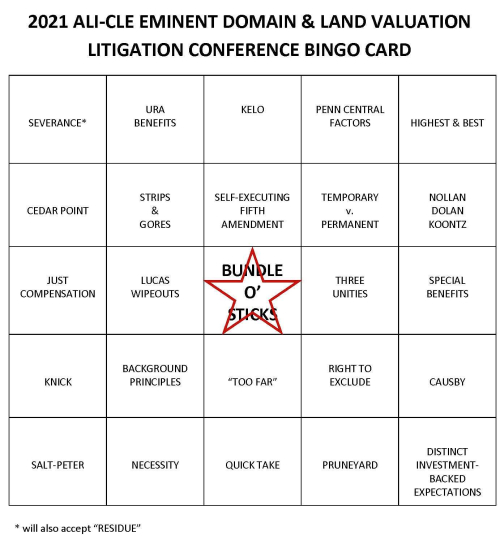
ALI-CLE 2021 Bingo card

If you “get” this, you should be registered for the 38th Annual Eminent Domain & Land Valuation Litigation Conference, to be held remotely on Thursday and Friday, January 28-29, 2021.

The list is growing rapidly, and you need to join us!

This is the “big one” where the nation’s best practitioners, scholars, jurists, and other industry professionals gather to talk shop about the subjects we know and love. We’re having programs with intriguing subjects such as “Planning to Win: Practical Strategies for a Successful Inverse Condemnation Case,” “How Do I Keep My Firm’s Doors Open When the Courthouse Doors Are Closed? Making Your Practice More Efficient When You Can’t Try Cases,” “Where Is the Supreme Court Headed on Takings Cases? Regulatory Takings Update and Cedar Point Preview,” “No Show and All Tell: Breaking News in Property Rights and Takings,” “More Than the Fifth Amendment: Other Tools for Upholding

Continue Reading Your 2021 ALI-CLE Eminent Domain & Land Valuation Litigation Conference (Jan 28-29, Remote) BINGO Card

We listened live last week, but the court has now made the recording available in Johnson v. City of Suffolk.

This is what we call the “oyster takings” case in which Nansemond River oystermen claim that their property was taken when the City of Suffolk and the Sanitation District dumped sewage into the river and declared a “condemnation zone” (i.e., no oyster harvesting).

This is a case at the intersection of property and takings law, and environmental protection. And the public trust concept of jus publicum. The oystermen own a lease from the State of Virginia for the riverbed, which among other things, allows them to harvest some of the oysters that Virginia is so well known for. But they were forced to bring an inverse condemnation claim in state court, asserting that the City’s dumping of wastewater in the river — and prohibiting the

Continue Reading Recording Now Available In Virginia Supreme Court Oral Arguments In Takings, Property, And Public Trust Case

In Altman v. Brevard County, No. 5D19-1839 (July 10, 2020), the Florida District Court of Appeal considered a host of owner objections to a taking of easements over five beachfront lots:

(1) the County was required to obtain separate resolutions for each taking; (2) the County’s petition in eminent domain did not strictly comply with the Florida Statutes; (3) the resolution on which the County based its petition was nullified by an amended resolution; (4) the trial court crafted takings outside of the pleadings; (5) the County failed to establish a reasonable necessity for the takings; and (6) the County failed to present a good faith estimate of value for each easement.

Slip op. at 2.

The court rejected most of the objections, but agreed with three: “[w]e find that the County’s petition failed because it did not provide clear legal descriptions of the properties to be acquired and

Continue Reading Condemnor Protip From Florida: Choose Wisely (Make Clear What You Want To Take)

Our shut-in time has got us to thinking.

We’re all environmentalists now. This is the precautionary principle writ large. In a way, this is only part of a greater problem.

Welcome to the Twitterverse. We now have access to a vast amount of data — very often on a granular level — and this moves faster than the ability

Americans like to work

Americans are pretty wiling to give our elected leaders a lot of slack

playground Constitution has serious legs

Most don’t understand that their rights are, in normal time, highly restricted, at least in courts

takings lawyers are not really surprised as everyone else – we’re used to courts deferring to what may look like excessive and unwarranted assertions of governmental power. Unlike a lot of other litigation involving the government, representing property owners in eminent domain or takings cases

basic takings doctrine is really incoherent

we already

Continue Reading Things I’ve Learned (Am Learning) About #CoronavirusLaw

WMdoor2

This fall, we’ll be back at the William and Mary Law School (hopefully in-person, depending on the circumstances and the yet-to-be-announced approach to be taken by the College of William and Mary), teaching two of our favorite subjects.

Not only will this be the third time leading Eminent Domain and Property Rights (Law 608), but we’ll also be undertaking another subject, Land Use Control (Law 425). This semester, we’re stepping into the (big, figuratively speaking) shoes of Professor Lynda Butler who recently retired after a stellar and trailblazing career. Thankfully, Lynda is continuing to lead the Brigham-Kanner Property Rights Project and is underway with planning October’s Brigham-Kanner Conference, honoring Harvard lawprof Henry Smith.

Land Use is, of course, related to Eminent Domain and Property Rights, but the law school understands that they are each worthy of separate study, and they should not be folded into a single course (or

Continue Reading Land Use Also On The Fall Semester Agenda At William And Mary Law