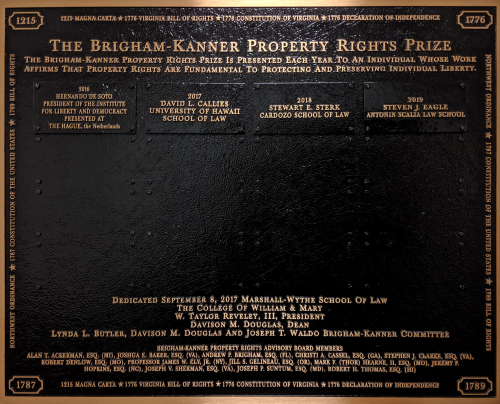
Here’s the video of our October panel at the 2019 Brigham-Kanner Property Rights conference during which we spoke about “The New New Property: Public Resources and Private Rights.”

Our panel also discussed judicial takings, Stop the Beach, (a case in which speaker Ken Bell — then a Justice on the Florida Supreme Court) ruled on), and Professor Henry Smith’s work. 

As the law school’s YouTube channel describes it: Panelists include Ken Bell, Robert H. Thomas and Henry E. Smith. Katherine Mims Crocker of William & Mary Law School serves as moderator. The Brigham-Kanner Property Rights Conference is hosted each year by the William & Mary Property Rights Project at William & Mary Law School. Recorded at the Law School on October 4, 2019.

Check it out. The videos of the other panels are posted hereContinue Reading Brigham-Kanner Video: The “New New” Property, Judicial Takings, And More
Untitled Extract Pages

Here’s the Complaint filed earlier this month in an Indiana federal court, which alleges that the State of Indiana is liable for a judicial taking in a case we’ve been following. Yes, a judicial taking! 

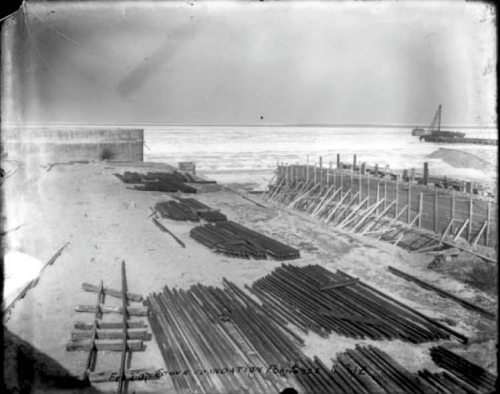
You recall that in Gunderson v. Indiana, 90 N.E.3d 171 (Ind. 2018), the Indiana Supreme Court concluded that the public owns up to the ordinary high water mark on Lake Michigan and had done so all the way back to statehood in 1816. Problem is, according to the plaintiffs here, “undisputed local, state, and federal acknowledgement over the years” was otherwise – the law said that the property was private, not public. Thus (again, according to the Complaint), “the Gunderson judgment changed the law of the State of Indiana, as recognized by prior Indiana court precedent as well as federal, state, and local authorities.” Complaint at 2.

We suggest you read the entire Complaint. It

Continue Reading New Fed Ct Judicial Takings Complaint: Indiana Supreme Court “Transformed Established Law” Of Shoreline Ownership

Yesterday, our friends and colleagues at the Institute for Justice (Diana Simpson and Bob McNamara) welcomed us to their studios to record an episode of the Short Circuit” podcast.

We talked property, takings, Virginia oysters, the cert petition about Colorado eminent domain abuse, and how the Supreme Court of the Republic of the Philippines would handle cases like Berman v. Parker and Hawaii Housing Authority v. Midkiff

Listen in, and subscribe to the podcast (we don’t miss an ep). 

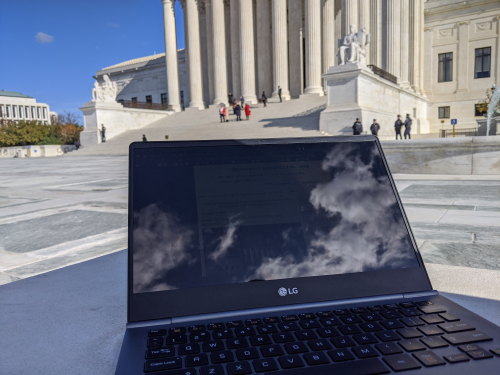
And yes, we really did write up yesterday’s blog post from the Supreme Court steps. Proof:

IMG_20191203_125502 (1)Continue Reading We Join IJ’s “Short Circuit” Podcast To Talk Virginia Oyster Takings, Colorado Wild Eminent Domain Abuse Cert Petition, And Berman International

Following up on the petition, filed last Friday, asking the Virginia Supreme Court to review a trial court’s demurrer which failed to recognize that the owners of a state lease to harvest oysters in the Nansemond River have a property interest . The court concluded that the city and santitation district possess a superior right to pollute the river with sewage.

The case arose when the city and sanitation district declared the oysterbeds “condemned” during certain times of the year because they put sewage into the river. They denied compensation, and the trial court held that Darling v. City of Newport News, 249 U.S. 540 (1919) subjected the lease owners to the city’s superior right to pollute.

We paid a visit to the site a couple of weeks ago to see the pollution source, and how the oysters are harvested in the river. The above video is from that

Continue Reading Videos: Oyster Takings On The Nansemond River

MVIMG_20191108_125325

Just filed: this Petition for Appeal in a case which our William and Mary Law class has a special interest in.

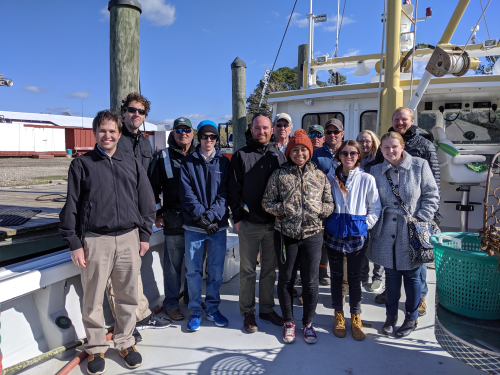
The above photo was taken a couple of weeks ago, when we paid a visit to the property owner/plaintiffs, the owners of a long-standing oyster business operating out of the City of Suffolk, Virginia. The oystermen own a lease from the state for the riverbed, which among other things, allows them to harvest some of the oysters that Virginia is so well known for. But they were forced to bring an inverse condemnation claim in state court, asserting that the City’s dumping of wastewater in the river — and prohibiting the harvesting of oysters during those times — was a taking under both the U.S. Constitution, and Virginia’s taking or damaging clause.

The trial court sustained the City’s demurrer, accepting the City’s argument that it has the right

Continue Reading City: We Have The Right To Pollute – Virginia Oystermen’s Petition Asserting A Taking

IMG_20191106_112246

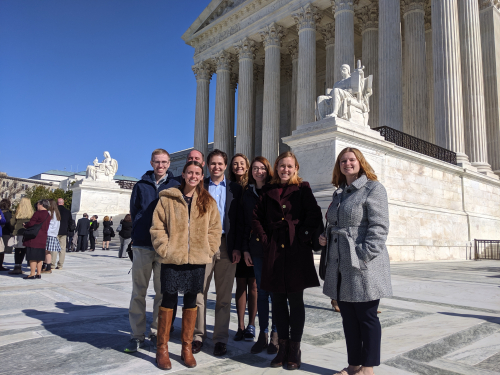
Protip for the public line for SCOTUS arguments: you have to get there really early. As in really early. Before 5 am early. Because that’s the time that we, along with some of our William and Mary Law students (pictured above, after the arguments), arrived at 1 First Street NE to take up our place in line yesterday for the arguments in the Maui Clean Water Act case. And we were — literally — the very last allowed in for the full arguments. We roadtripped it from Williamsburg (more on that in a future post), meaning that we awoke long before 5am, leaving the law school at an ungodly hour. It would have been a shame to have taken all that effort, only to not get in. So heads-up line standers: get there early.

Why all this effort, you may ask? After all, you can read the transcript the same

Continue Reading Hot Take On The Maui Clean Water Act Arguments (Protip: ARRIVE EARLY)

Update 10/25/2019: an astute and seasoned correspondent writes that the issue of whether a property owner must raise constitutional issues in the administrative proceedings was settled in a published opinion that involved the same agency, the California Coastal Commission. See Healing v. Cal. Coastal Comm’n (1994) 22 Cal. App. 4th 1158 (we put in in California citation style just because) (“These [the takings questions] are questions for a court of law to decide at an evidentiary trial, not by mandamus review of an administrative record of proceedings where the parties’ right to present evidence was limited by the very nature of the administrative process.”).

Why the Coastal Commission doesn’t know its own law, escapes us.  

++++++

Hat tip to Benjamin Rubin at the California Eminent Domain Report for writing up a recent opinion issued by the California Court of Appeal, Greene v. California Coastal Comm’n, No. B293301 (Oct. 9

Continue Reading Cal App: Agency Has Power To Adjudicate Whether The Agency Itself Is Taking Property (Really)

IMG_20191004_124327

Here is a transcript of the remarks I delivered today at the 2019 Brigham-Kanner Property Rights Conference. I was honored to join lawprof Henry Smith and Florida Supreme Court Justice (ret.) Ken Bell (who authored the Florida court’s opinion in Stop the Beach Renourishment which was challenged in SCOTUS as a “judicial taking”) to speak about “Public Resources and Private Rights” (moderated by Professor Katherine Mims Crocker). After paying our respects to 2019 B-K Prize winner Professor Steven Eagle, we each addressed some part of the question.

—————————-

The New New Property

As always, I bring to you tidings of “aloha” from the state where the legislature thought it was a going to reduce the price of residential housing by taking fee simple interests from “A” and giving them to “B,” the leaseholders

Where now, the median price for a single-family, two bedroom, one bath

Continue Reading 2019 Brigham-Kanner Conference: The New New Property – Public Resources And Private Rights