


20160126_164326

Austin, Texas, is where we’re at for the next few days, for the 2016 edition of the American Law Institute-CLE Eminent Domain and Land Valuation conference, now in its 33d year. First time we’re in Austin, however, and our registration numbers are looking very good, and we haven’t had this big a turnout in years.

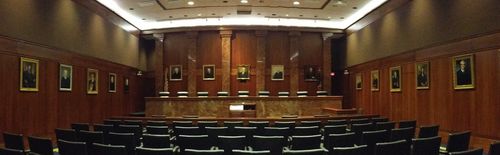
We haven’t been back to Austin in a few years ourselves, so we did what law nerds sometimes do when we go to new towns: visit the local courtroom to check out the scene. So we dropped by the Supreme Court of Texas to take a look. Turns out it was an off-day for the court and it was not in session and the courtroom was locked. But Security suggested that if we asked the Clerk nicely, she might retrieve the key and let us take a look around. And you know what? She did.

Continue Reading ALI-CLE 2016 Eminent Domain Conference: Austin Scouting Report

As the Star-Advertiser reports here (“State pays newspaper for nominees battle“), Hawaii Governor David Ige has signed a bill which appropriates funds for the State to pay a portion of the legal fees and costs incurred by the Star-Advertiser during its lawsuit which compelled former Governor Neil Abercrombie to stop keeping secret the list of judicial nominees which the Judicial Selection Commission presents to the governor. 

We represented the Star-Advertiser in that case, which took several years to fully resolve because of a collateral appeal — ultimately decided in the Star-Advertiser‘s favor by the Hawaii Supreme Court — involving the attorneys’ fees and costs which are required under Hawaii’s public records statute: 

Although the newspaper quickly won on the merits of the case, the long dispute over fees raises new concerns “because most individuals do not have the time and/or money to pursue a case like this

Continue Reading Final Chapter In Judicial Selection Commission List Public Records Case

Remember that case we posted about here, when it was set for oral arguments in the Hawaii Supreme Court a few months ago, where the plaintiff was asserting that the County of Hawaii Planning Department was liable for negligence for not maintaining its subdivision files accurately?

Last month, the Hawaii Supreme Court issued a unanimous opinion which declined to impose a duty of reasonable care on the Planning Department.

The opinion noted that “policy considerations counsel against the judicial creation of such a legal duty under the common law, and also hold that there is no basis under [Hawaii’s open records statute or the Planning Department’s rules of procedure], to impose negligence liability upon the Planning Department based on the temporary absence of a government record from its files. Slip op. at 2. Rebecca Copeland has more background on the case (including the briefs) here at her Record on

Continue Reading HAWSCT: Agencies Have No Duty To Keep Their Records Accurately

Ian Lind has an interesting piece in Honolulu Civil Beat, Hawaii Monitor: Ballot Issue Grew Out of Abercrombie’s Retreat Into Secrecy, about the consititutional amendment, recently approved by Hawaii voters, which requires the Hawaii Judicial Selection Commission to make public its list of judicial nominees at the same time that it transmits the list to the governor. Under Hawaii law, the governor is required to appoint his or her selection to fill judgeships from this list.

In some ways, the constitutional amendment, which the voters ok’d by an overwhelming margin (82% of those voting) was icing on the cake: after a Hawaii circuit court ruled that under state public records laws, the governor must release JSC lists once he makes his appointment (a case in which we represented the plaintiff-newspaper), the JSC amended its rules to require it to disclose the list once it transmits it to the

Continue Reading On Transparency In The Judicial Selection Process

Today, the Hawaii Supreme Court issued a unanimous opinion in Oahu Publications, Inc. v. Abercrombie, No. SCWC-13-0000127 (July 31, 2014).

We represent the prevailing petitioner in the case, so won’t be adding much of anything to the court’s words.But if you are interested in government records laws and the interplay between attorneys’ fee recovery and the Rules of Appellate Procedure, read on.

The court writes:

We consider whether the Intermediate Court of Appeals (ICA) erred in denying Oahu Publications’ request for appellate attorneys’ fees and costs. In brief summary, Oahu Publications filed the underlying suit against The Honorable Neil Abercrombie, in his official capacity as Governor of the State of Hawaii, under the Uniform Information Practices Act (UIPA), Hawaii Revised Statutes (HRS) Chapter 92F, seeking to obtain the list of nominees considered for a vacancy on the Hawaii Supreme Court. After the parties filed cross-motions for summary judgment, the

Continue Reading HAWSCT Clarifies Procedure For Requesting Mandatory Attorneys Fees Under Open Records Laws

Hawaii, like many other jurisdictions, has an open records law. Here, we call it “UIPA” (“yoo-pah” or “wee-pah”) becuase the statute is the Uniform Information Practices Act, and not “FOIA” or “FOIL.” But in substance, it’s mostly the same as our sibling jurisdictions: government records are strongly presumed to be public documents, available to the public upon request. And like many jurisdictions, Hawaii’s UIPA contains a fee-shifting requirement which provides that a complainant who prevails in litigation is entitled to recover attorneys fees and court costs from an agency which wrongly kept documents secret. 

Last week, the Hawaii Supreme Court agreed to review a case about UIPA and the fees and costs incurred by a prevailing complainant while on appeal. Specifically, the case is about the timing of the request for appellate fees and costs. We represent the petitioner in the case, and so won’t be saying much of

Continue Reading HAWSCT To Consider Appellate Fees In Open Record Case

Here’s an interesting case upcoming on the Hawaii Supreme Court’s oral argument calendar that is worth following. (April 29, 2014, at 10:00 a.m. – the court is taking the show on the road, and the arguments will be at the gym at Kealakehe High School, in Kailua-Kona, on the Big Island.)

In Molfino v. Yuen, No. SCWC-10-150 (cert. app. filed Dec. 9, 2013), the petitioner asks whether a county government has any obligation to maintain accurate and complete records. Your first reaction may be “well, duh.” But like many other things in the legal business, it isn’t necessarily as simple as all that. Indeed, the Intermediate Court of Appeals concluded in a Summary Disposition Order (Aug. 28, 2014) that government does not have an obligation to keep its own records accurately. The ICA relied on a 1986 Hawaii Supreme Court case which held:

Without a reasonable and proper limitation of

Continue Reading HAWSCT Considering Whether A County Has A Duty To Maintain Accurate Public Records

The latest front has opened in the ongoing (and spreading) issue about Mortgage Resolution Partners’ efforts to convince municipalities to use their powers of eminent domain to take underwater mortgages.

Here’s the Complaint, filed today in the U.S. District Court for the Nothern District of California, which seeks public disclosure by the Federal Housing Finance Agency of its relationship with banks. As reported in this story, “[t]he agency has threatened legal action against Richmond [California] and other cities planning to use the eminent domain tactic and may deny credit to locals seeking mortgages[.]”   

The article quotes the Executive Director of New Jersey’s ACLU:

Using money from private investors, Ofer said towns would pay the mortgage holders’ fair market value and then restructure mortgages into lower principal payments that are more favorable for homeowners. About 700 to 1,000 homes in Irvington could potentially benefit from eminent domain takeovers

Continue Reading New FOIA Complaint Seeks Information About Underwater Mortgage Eminent Domain Issue

Remember the case from late last year in which the Honolulu Star-Advertiser brought a freedom of information/open records lawsuit against the Hawaii governor to force him to disclose the names of judicial nominees? Abandoning the practice of his two predecessors, the Governor refused to release the list of names of nominees transmitted to him by the Judicial Selection Commission. The trial court ruled in favor of the newspaper and ordered disclosure, and assessed the Governor attorneys fees and costs. Hawaii law makes an assessment mandatory in open records cases. [Disclosure: we represent the Star-Advertiser in this case.]

Well, last week, the Hawaii Intermediate Court of Appeals, in this Summary Disposition Order, rejected the Governor’s appeal of the assessment. The court found no merit in most of his appeal. Judge Ginoza dissented. We won’t comment since we’re in the case, but here is the report on the decision (“Ruling

Continue Reading HAWICA: Attorneys Fee Award In JSC List Case Was Reasonable

Remember the case from late last year in which the Honolulu Star-Advertiser brought a freedom of information/open records lawsuit against the Hawaii governor to force him to disclose the names of judicial nominees? Abandoning the practice of his two predecessors, the Governor refused to release the list of names of nominees transmitted to him by the Judicial Selection Commission.

The circuit court ruled that under Hawaii’s Uniform Information Practice Act the Governor should not have kept the names secret, and that disclosure is required. [Disclosure: we represent the Star-Advertiser in that case.]

Following the ruling, three things happened. First, the Governor released the names on the lists for the vacancies on the Hawaii Supreme Court (eventually filled by Justice McKenna) and on the circuit bench. Second, the Judicial Selection Commission amended its rules to allow for the release of the lists when they are transmitted to the governor. Third, UIPA

Continue Reading State Appeals Attorneys’ Fees Award In JSC List Case