


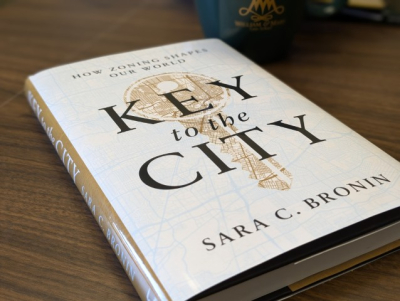
Recently, we read Professor Sara C. Bronin‘s recent book, “Key to the City: How Zoning Shapes Our World.”Continue Reading Book Review: “Key to the City: How Zoning Shapes Our World,” Sara C. Bronin
One Last Chance To Join Us For The 42d ALI-CLE Eminent Domain & Land Valuation Litigation Conference (San Diego & Webcast)
With our tongues firmly planted in cheeks, the Planning Chairs for the upcoming 42d edition of this popular and venerable Conference bring you this “breaking news” report from San Diego!
As you know, in addition to being the best nationally-focused conference on the subjects that we love and a venue that is nearly certain to have some of the warmest winter weather in the continental United States, and we went on-location from some of the local highlights: the beaches, Torrey Pines, the Zoo, Balboa Park, the Gaslamp Quarter, and Coronado to name but a few.
More about the Conference here, including registration information.
Here are some of the highlights:
- Property Rights at the Supreme Court: DeVillier and Sheetz and What’s Next
- Slow Take: Possession, Rent, Relocation, and Offset
- The Jury’s View: How Jurors See Your Case
- From Penn Coal to Penn Central: How to
Adieu To The Highs And Lows Of 2024
As we bid farewell to another calendar year, our mind wanders back over the last 364 days in an attempt to ascribe meaning, or even a theme — some connecting tissue — to what the scientists tell is is just the rotation of the earth.
There were judicial opinions good, bad, and just plain weird, and other events that caught our attention and remained in our consciousness long after they ended. The year was eventful.
But in the end, the thing that provided us both our low point and our high point for 2024 emanated from the same source: our old friend the Eminent Domain Podcast.
- March brought us 2024’s low point: the announcement that after 128 episodes, EDP was signing off. Our rational side understood why our friend and colleague Clint Schumacher believed that he had accomplished all he set out to and it
New Cert Petition: Do A-to-B Transfers By Eminent Domain Require More Than Aliens-Might-Be-Resposible Judicial Review (And Should Kelo Be Overruled)?
Our colleagues at the Institute for Justice–the same firm that represented Susette Kelo in her oh-so-close run at clearing up the Public Use requirement in eminent domain, today filed this cert petition in which they take another run. We will let you savor the wine and find out about the case and the arguments by reading the petition without our filtering.
But the short story is that this case comes from what is perhaps the worst-offender jurisdiction when it comes to public use questions, New York. Here, the County exercised eminent domain to transfer property from A (petitioner Bowers Development was under contract to buy the land with plans to build a medical office building) and give it to B (a different private owner that was planning to build … a medical office building on adjoining property which needed a parking lot).
The Appellate Division concluded that this satisfied
Your 2024 Dirt Lawyer Holiday Gift Guide (Including Last-Minute Gifts)
Too busy writing those briefs and petitioning for those writs, so haven’t found the time to hit your local store or the interwebs and fulfill your seasonal duties? Or maybe you just have gifter’s block about an appropriate present for the dirt lawyer in your life this holiday season?
You could go the last-minute route: Charlie Brown got a bag of rocks for Halloween, so you might also consider the same for this holiday season. Or there is that old reliable, origami boulders. Or you could show your giftee that you are tuned-in by giving them some origami boulders handcrafted with love from old print-outs of important Supreme Court takings cases. Also good for the procrastinators, since you don’t need an open store to show your recipient how much you care.
Recycle a few pages and rescue them from the blue bin, and you are in business!
No
Continue Reading Your 2024 Dirt Lawyer Holiday Gift Guide (Including Last-Minute Gifts)
Cert Denied (With Hints) In SWAT Takings Case
Here’s the latest in a case we’ve been following with keen interest
Yesterday, the Supreme Court denied certiorari in Baker v. City of McKinney, the case where municipal police severely damaged a home in the course of extracting a criminal suspect, after which the owner successfully sought just compensation for a taking. All good, until the Court of Appeals got it. Here’s the district court’s opinion finding a taking. (As we noted in this brief in an earlier similar case, homeowner’s insurance generally does not provide coverage for damages caused by government.)
And here’s the Fifth Circuit’s opinion reversing, concluding (correctly) that there is not a categorical “police power” exception to takings liability, but also that just compensation is not required when the government action and the resulting damage is “objectively necessary” for public safety.
Teed up that way, we thought this one had a chance. But alas, the Cert Fairy left a lump of coal under the pillow.
Perhaps a silver lining to the denial, however: two Justices (Sotomayor joined by Gorsuch – kind of an odd combination) issued a statement noting that the issues in the case, if refined and presented in a different case, could be of interest to the Court.
The very interesting part of the Statement starts on page 3, where Justice Sotomayor writes:
I write separately to emphasize that petitioner raises a serious question: whether the Takings Clause permits the government to destroy private property without paying just compensation, as long as the government had no choice but to do so. Had McKinney razed Baker’s home to build a public park, Baker undoubtedly would be entitled to compensation. Here, the McKinney police destroyed Baker’s home for a different public benefit: to protect local residents and themselves from an armed and dangerous individual.
….
This Court has yet to squarely address whether the government can, pursuant to its police power,require some individuals to bear such a public burden. This Court’s precedents suggest that there may be, at a minimum, a necessity exception to the Takings Clause when the destruction of property is inevitable.
Statement at 3-4.
Note the two cases cited by Justice Sotomayor next: Bowditch v. Boston, 101 U.S. 16 (1879), and United States v. Caltex (Philippines), Inc., 344 U.S. 149 (1952), which “do not resolve Baker’s claim … because the destruction of her property was necessary, but not inevitable.” Statement at 5. In both Bowditch and Caltex, the destruction of the plaintiff’s property was pretty certainly going to happen anyway (in Bowditch by fire, by Caltex by the advancing Imperial Japanese Army — the “fortunes of war,” as the Court put it). The government blowing up the properties in these cases only hastened the inevitable. For more on these cases and the “inevitable” vibe, see the amicus brief our outfit (Pacific Legal Foundation) submitted.
Also worth checking out is Mitchell v. Harmony, 54 U.S. (13 How.) 115 (1851), where the Court held that commandeering property to prevent it from falling into the hands of the enemy in war was not a taking as long as the danger is “immediate and impending,” and waiting around for civil authority would be too late.
We wrote about these cases and the notion that even a compelling police power reason isn’t alone enough to avoid takings liability and the Armstrong redistribution principle, and similar in our article, “Evaluating Emergency Takings: Flattening the Economic Curve,” 29 Wm. & Mary Bill of Rights J. 1145 (2021).
Justice Sotomayor continued, “Whether the inevitable-destruction cases should extend to this distinct context remains an open question.” Statement at 5. The Statement also points out the lower court split in reasoning (but not outcome), and concludes:
All those decisions, save the Sixth Circuit’s, however, predate the Fifth Circuit’s determination that there is an “objectively necessary” exception to the Takings Clause. Whether any such exception exists (and how the Takings Clause applies when the government destroys property pursuant to its police power) is an important and complex question that would benefit from further percolation in the lower courts prior to this Court’s intervention.
Statement at 6.
Count is intrigued.
Continue Reading Cert Denied (With Hints) In SWAT Takings CaseVeterans Day 2024: Our Posts
As we express our thanks today to all those who have served, here are some of our previous posts which feature military-related topics:
- Arlington National Cemetery And The Takings Clause – Did you know the property story behind this sacred ground? And that this story became the basis for our amicus brief?
- Pearl Harbor, Remembered – Our report of our attendance at the 70th Anniversary of the Day of Infamy.
- Jay Massey, Quiet Professional – Little did we know that an appraiser we worked with was a R/T One-Zero. Whoa.
- California Court of Appeal Justice Lynn “Buck” Compton – The Band of Brothers paratrooper became a Judge after the war, and even decided a few eminent domain and property cases.
- Way back in the day, I learned what little I know about bankruptcy law from Judge Jon J. Chinen – But did you know he was decorated with a
READ THIS
Friday, Sep 13 2024
My love: I am writing this just in case. For the past several days since I’ve been in Williamsburg, I’ve had a low-grade fever, which was one of the symptoms Dr. Lee said would indicate something to not let slide. When it wouldn’t go away for a few days, I went to the emergency room at the Williamsburg hospital this morning just to be sure. After a number of tests and scans they say it is an abscess, a collection of pus underneath the ileostomy reversal area. So this afternoon I will be undergoing a relatively minor surgery to drain the abscess. Even though it is relatively minor, it still will require general anesthesia and all the risks that that entails.
Because of that and because I can’t even inform you (damn him), I am writing this note just in case things do not go as
They Say It’s Your Birthday, Well It’s Our Birthday Too, Yeah! Entering Our Eighteenth Year
Every year at this time, it seems, we realize once again that as you get older, you overlook birthdays. Time speeds up, or maybe slows down. Very Proustian. Thus, it occurred to us only yesterday that that this blog’s “birthday” was looming and we almost let it slip by without notice.
It hardly seems like eighteen years ago tomorrow that we posted here for the first time.
In law blog years, that’s quite a while. Thanks to you, our readers and contributors, we’re still here, and still going pretty strong over 4,700 posts and nearly two decades later. We can’t post every day, but we can try.
Because doing this in a vacuum would not be worthwhile, we’d like to recognize those who send us items, who make comments, who give us feedback, who gently prod with suggestions, and who simply read and subscribe. You guys make the
A Century Of Regulatory Takings: Pennsylvania Coal Co. v. Mahon (Part III)
paragraph of the Answer responsible for all this:
Take that, Kohler Act.
Check out some of the history behind the decision. “Pillar robbing.”
In granting the injunction to Mahon, the county trial judge played the “I’m just a simple country lawyer” card:
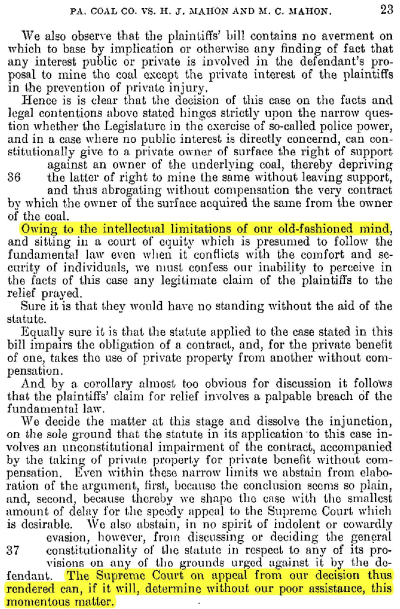
Yeah right, YourContinue Reading A Century Of Regulatory Takings: Pennsylvania Coal Co. v. Mahon (Part III)