


Our post on the subject is located here.Continue Reading Sotomayor On Takings Issues
Professor Van Dyke’s Who Owns The Crown Lands Of Hawaii – Book Review By Paul Sullivan, Esq.
Attorney Paul M. Sullivan, currently a lawyer for the U.S. Navy but formerly an adjunct professor at the U. Hawaii Law School and a member of the Hawaii State Advisory Committee to the U.S. Commission on Civil Rights, has reviewed U.H. lawprof Jon Van Dyke’s book, Who Owns the Crown Lands of Hawaii (U.H. Press 2008) (available from Amazon here). In A Very Durable Myth: A Critical Commentary of Jon Van Dyke’s Who Owns the Crown Lands of Hawaii, 31 U. Haw. L. Rev. 341 (2009), Sullivan writes:
The title question of Professor Jon Van Dyke’s recent book Who Owns the Crown Lands of Hawaii does not require a book to answer. The answer is simple and not seriously contested, even in Professor Van Dyke’s book. Some of the Crown Lands with which the book is concerned are owned by the United States Government, and the rest are
Superferry Part II
Act 2’s Achilles Heel: Short Time Frame
The court also found it significant that Act 2 granted”large capacity ferry vessel companies” benefits for only a limitedamount of time:
In contrast, the Bulgo court considered anAct that was unlimited in duration. As such, it was possible thatfuture circumstances would require another county to exercise the powerconferred by Act 47. Such a possibility is highly unlikely, if notimpossible, in this case. The rights and privileges conferred to “alarge capacity ferry vessel company” by Act 2 exist for a limitedperiod of time (less than twenty-one months) and the possibility that acompany other than Superferry would be able to exercise those samerights before they are extinguished is beyond remote.
Slip op. at 37.
The briefs in the appeal are posted here, and the archive of our live blog of the December 18, 2008 oral arguments is posted here.
Our Superferry Continue Reading Superferry Part II
Bulgo
The court distinguished the lone case in which itinterpreted the term “general law” in a challenge to a statute passed by the statelegislature to allow Maui County to hold a special election after acouncilmember died between his election and taking office. Bulgo v. County of Maui,430 P.2d 321 (Haw. 1967). The statute in that case was drawn verynarrowly, providing that if someone who was elected to “the office ofchairman of the board of supervisors of a county died before January 2,1967,” a special election would be held, unless the county charterprovided otherwise. Id. at 323. The statute also provided that it applied to each county. The Hawaii Constitution (currently Haw. Const. art. VIII, § 1) required the legislature confer powers upon counties “under general laws.”
TheBulgo court held the statute was a general law even though only Maui County hadone of its councilmembers die before January
aaaaaaaaaaaaaaa
In Hauselt v. County of Butte, No. C054927 (Mar. 23, 2009), the California Court of Appeal held
The property owner asserted the County inversely condemned its property by implementing a drainage plan which resulted in the land being flooded more often than usual, and that the County denied his proposal to develop the property. After bench trial, the trial court determined that the County had not acted unreasonably, that its activites did not increase the water flow on the land, and that the landowner was entitled to $1,034 in just compensation for a temporary taking (the County placed material on the land in 1998 to prevent a storm from flooding a neighboring parcel.Continue Reading aaaaaaaaaaaaaaa
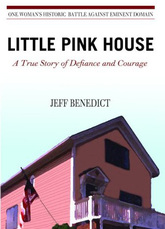
Book Review: Little Pink House — A True Story Of Defiance And Courage
[This review was originally published in the Honolulu Star-Bulletin on September 20, 2009]
You remember that line in the Stevie Wonder classic — “For once I can say this is mine, you can’t take it“?
It turns out they can.
In 2005 in Kelo v. New London, the U.S. Supreme Court held the government can take a home and give it to a developer if the developer is projected to pay more taxes. Your property can be condemned if someone else may make “better” use of it than you do.
A new book, “Little Pink House: A True Story of Defiance and Courage,” tells the story of Susette Kelo, the case’s namesake who owned a little pink house in Connecticut taken by eminent domain. It’s not a dry recounting of legal doctrines, but a fast-paced insider account explaining why property owners resist losing their land even in
Continue Reading Book Review: Little Pink House — A True Story Of Defiance And Courage
Publications
Articles and books
Takings, Eminent Domain, and Land Use: Sublimating Municipal Home Rule and Separation of Powers in Knick v. Township of Scott, 47 Fordham Urb. L.J. 509 (2020)
Takings and Land Use: Restatement (SCOTUS) of Property: What Happened to Use in Murr v. Wisconsin? 87 UMKC L. Rev. 891 (2019) Takings:
Property and Land Use Law: Back to the Future of Land Use Regulation, 7 Brigham-Kanner Prop. Rts. J. 109 (2018)
Takings and Land Use: Murr v. Wisconsin: The Supreme Court Rewrites Property Rules in Multiple-Parcel Regulatory Takings Cases, 41 Zoning & Planning Law Report 1 (2018)
Sharing Economy and Takings: “Property” and Investment-Backed Expectations in Ridesharing Regulatory Takings Cases, 39 U. Haw. L. Rev. 301 (2017).
Appellate Law: Federal Appellate Practice Manual (Haw. St. Bar Ass’n 2014) (chapters on Briefing – Merits and Amicus, and Supreme Court Review)
Eminent Domain and Takings:
SCOTUS Oral Argument Primer
For those not familiar with appellate oral arguments, here’s a short primer/FAQ:
Why oral argument? – Appellate oral argument has been described as the Court’s “conversationwith counsel” about the case and the law. Oral argument can illuminatelegal or logical problems not evident from the briefs and which may nototherwise be discovered, distill arguments by testing them, and allowthe advocates to respond to the Court’s specific concerns. The U.S. Supreme Court hears oral arguments in nearly all cases it reviews.
What’s at issue? – The Supreme Court is a discretionary court, meaning it reviews only cases and issues it want to review. In the course of answering the question presented, the Court may decide related issues. In the ceded lands case, the Court agreed to review the following Question Presented:
In the Joint Resolution to Acknowledge the 100th Anniversary of theJanuary 17, 1893 Overthrow of the Kingdom of Hawaii, Congressacknowledged and
State Of Hawaii’s Reply Brief In SCOTUS “Ceded Lands” Case
The State has filed the final brief in the “ceded lands” case, Hawaii v. Office of Hawaiian Affairs, No. 07-1372 (cert.granted Oct. 1, 2008), available here. The State argues that the Office of Hawaiian Affairs’ (and a majority of its amici’s) argument urging the Court to dismiss certiorari are “as baseless now as when respondents unsuccessfully raised it in opposition to certiorari.” Brief at 1.
Respondents argue at length that the State’s trust obligations towards the ceded lands (which run to all the people of Hawaii, not just Native Hawaiians) arise from state law, even though respondents elsewhere concede that the “ceded-lands trust was established by federal law — and is therefore … a “federal trust.'” Resp. Br. at 47. But no matter how the trust is characterized, the essential point is that respondents argued below — and the Hawaii Supreme Court held — that the legal determinations
Continue Reading State Of Hawaii’s Reply Brief In SCOTUS “Ceded Lands” Case
A Blustery Day Office Swag Contest
 In the winter, everywhere else has “snow days.”
But Hawaii — obviously — has not.
We have “windy days.” Very windy days.
Today is one of those days.
Schools closed. Sporting events canceled. People evacuated. Even the state courts are shuttered.
But we’re here, and through whatever today’s weather may bring, we’re blogging.
As is our custom on days when it seems like no one else is working, we’re distributing some office swag.
But you have to earn it.
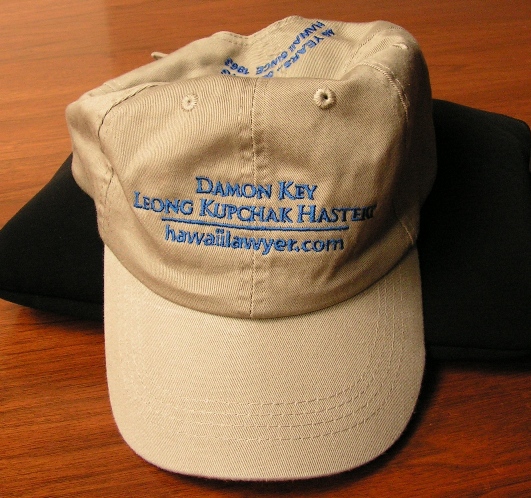
For the first 3 people who email me today, I will send you a Damon Key | hawaiilawyer.com cap, as depicted above. Be sure to include your mailing address in your email.
Color: Island Sand. Sea Blue lettering. The back reads “45 Years – Serving Hawaii Since 1963.” We have.
100% cotton. One size fits all. We pay shipping.
[A bonus tchotchke — a fine Damon Key writing