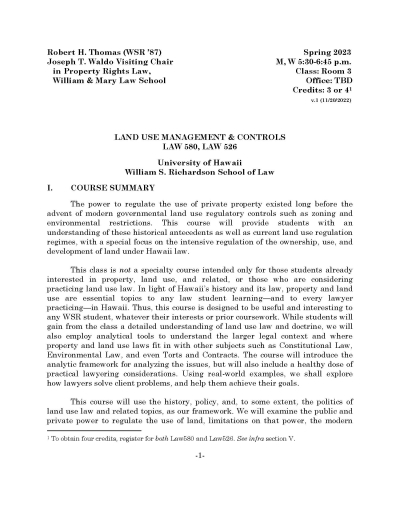
Syllabus

Starting in January, we’ll be teaching the venerated, and oh-so-important Land Use course (Law 580) at the University of Hawaii’s Law School.

We’re at least temporarily stepping into some mighty big slippers (this is Hawaii, so we don’t always wear shoes), as this is the course that our mentor Professor David Callies taught for decades. And is there a better venue in which to teach and study land use law and regulation, and its limits? After all, Hawaii may be the most heavily-regulated land on the planet, and is a focal point for every issue you can think of, from zoning to environmental restrictions to takings to public trust to subdivision to admin law to … well, you get the drift.

We’ll cover those topics, as well as the fundamentals. And we have a few surprises up our sleeve – some impressive guest lecturers, explorations of dirt law careers

Continue Reading Hawaii 5-80: Land Use Law At The University Of Hawaii

Here it is, the official agenda and program for the 40th ALI-CLE Eminent Domain & Land Valuation Litigation Conference, February 2-4, 2023 (with a special event the evening of Wednesday, February 1, 2023 to entice you to arrive early).

Screenshot 2022-11-18 at 13-35-13 ALI CLE PA NY VA TX FL Continuing Legal Education

Here’s the brochure with the complete agenda, schedule, and faculty listing. But to tempt you, here are some of the highlights of the program:

  • Everything Old is New Again: Why Today’s Practitioners Need to Understand the Original Meaning of the Takings and Just Compensation Clauses
  • Private Utility Takeovers – Lessons From a 67 Day Trial

  • Valuation Issues When Billboards and Signs are Condemned

  • Setting Client Expectations and Identifying Red Flags

  • Developing Property Right Issues in Texas – Questions and Answers from the Bench: A View From the Bench (with Texas Supreme Court Justice Jimmy Blacklock)

  • Eminent Domain and Regulatory Takings Updates: Important Decisions You Need to Know

  • Ethics:


Continue Reading Here’s The Program For The 40th ALI-CLE Eminent Domain & Land Valuation Litigation Conference, Feb 1-4, 2023, Austin

Many Honolulu residents don’t like short-term (less than 30 day) rentals. Whether fueled by NIMBY-ism, a genuine belief that tourists should stay out of residents’ neighborhoods and be limited to accommodations built for transients, or the belief that long-term rentals to locals somehow promote more affordable housing, the anti-transient renter vibe is most definitely there.

The no-less-than-thirty-days restriction wasn’t enough, however, and recently the City and County of Honolulu made it illegal to rent for less than three months (90 days). The ordinance stated the reasons:

Short-term rentals are disruptive to the character and fabric of our residential neighborhoods; they are inconsistent with the land uses that are intended for our residential zoned areas and increase the price of housing for O‘ahu’s resident population by removing housing stock from the for-sale and long-term rental markets. The City Council finds that any economic benefits of opening up our residential areas

Continue Reading Federal Court: Honolulu’s 3-Month Minimum Rental Term Preempted By State Law (And Would Be A Taking Of Vested Rights)

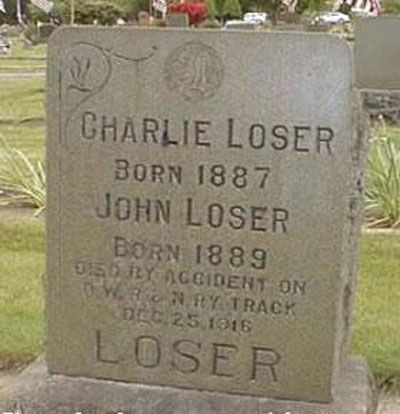
Charlie_loser

If you understand the headline of this post, congratulations: you are officially so deep in the weeds that you deserve both a Federal Courts and a Takings merit badge. 

For those of you not in so deep, here’s the short story behind the U.S. Court of Appeals for the First Circuit’s short opinion in Efreom v. McKee, No. 21-1382 (Aug. 18, 2022).

This is one of those pension cases, where the state (here, Rhode Island) shored up its tottering pension system with a new statute that “altered in various ways the retirement benefits to which public employees were entitled, including by reducing the amount and availability of cost-of-living adjustment (“COLA”) payments to retirees.” Slip op. at 4.

As the court noted, “[l]itigation promptly ensured in state court.” Slip op. at 5. Takings claims were included in the lineup. All of the cases were consolidated for trial. Most of the

Continue Reading CA1: Rooker-Feldman Defeats Federal Court Takings Claim By “State Court Losers”

You’ll definitely want to check out the U.S. Court of Appeals for the Third Circuit’s opinion in Makrilov v. City of Jersey City, No. 21-1786 (Aug. 16, 2022).

Not because it reaches any earth-shattering conclusions — the opinion unsurprisingly concluded that the city’s restricting (but not eliminating) short-term rentals (less than thirty days) was not a taking — but primarily because of the interesting concurring opinion.

So here’s the story. At one time, the city thought that renting residential property for less than thirty days was a good thing, believing that short-term renting “incentivize[d] investment and development in Jersey City.” Slip op. at 3. The city even adopted an ordinance affirmatively legalizing STRs as permitted accessory uses in residential zones. A property owner didn’t even need to obtain a permit, as long as the operation was small-scale (the owner did not have more than five units it rented).

But

Continue Reading Penn Central May Be A “Fuzzy” Test, But What Is A Court Doing Weighing The Factors?

Is there a more appropriate place at which to study property rights and dirt law than William and Mary Law School? After all, it is a stone’s throw from Jamestown, the place where there’s a good argument the concept of property law and property rights first took hold in the New World. As noted by author David Price in “Love and Hate in Jamestown – John Smith, Pocahontas, and the Start of a New Nation” –

The introduction of private property for the common citizen had a salubrious effect on the owners’ sense of initiative, as John Rolfe would observe. By the end of 1619, he reported, the “ancient” (or longtime) colonists had chosen their allotments, “which giveth all great content, for now knowing their owne lande, they strive and are prepared to build houses and to cleare their grounds ready to plant, which giveth …

Continue Reading Ye Olde Law 608: Eminent Domain & Property Rights, S5E1 @ William & Mary Law

Last week, along with my colleagues Deborah La Fetra and Kady Valois, we filed this cert petition in a case we’ve been following (even before we joined as counsel).

The petition seeks review of the Fifth Circuit’s opinion holding that there’s nothing a federal court can do if a local government does not pay a state-court just compensation judgment for an unreasonably long time. Because we are counsel in the case we won’t go into further detail, but will leave it to you.

Here’s the Question Presented:

A fundamental element of just compensation is “certain payment of the compensation without unreasonable delay.” Bragg v. Weaver, 251 U.S. 57, 62 (1919). In 2013, the Sewerage & Water Board of New Orleans inversely condemned the properties of 70 home and business owners for a flood control project. The property owners obtained state court judgments starting in 2018. Louisiana law

Continue Reading New Cert Petition (Ours): Can Condemnor Delay Actually Paying Compensation Indefinitely?

A long-ish opinion from the Alabama Supreme Court in Douglas v. Roper, No. 1200503 (June 24, 2022). But a short post because the good stuff is relatively brief.

Bottom line: property owners have a vested interest in excess money generated from a tax sale of their property, and the Alabama legislature cannot prohibit the owners from claiming that excess equity.

Quick background: the legislature enacted a statute that required property owners who had their properties sold to satisfy tax debts first have redeemed the property before they could claim the excess funds, if any, from the sale. This had the effect of permitting the government in many cases to keep that excess (i.e., the property’s equity), as a little something extra — what our New Orleans friends might call lagniappe. Property owners objected, arguing that retroactively applying the statute would be a taking.

There’s a lot to

Continue Reading Alabama: Government Can’t Keep The Change After A Tax Sale

Here’s what we’re reading today:

Continue Reading Monday Round Up: Aina Lea Out With A Whimper, 30 Years Of Mabo, Seneca Village

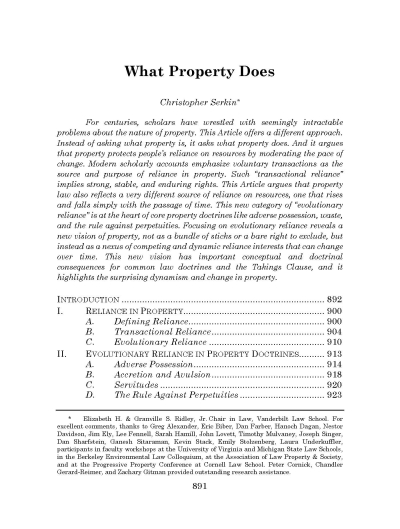
Whatpropertydoes

Worth checking out: Christopher Serkin, What Property Does, 75 Vand. L. Rev. 891 (2022).

Covering (inter alia) property, rule against perpetuities, adverse possession, Lucas background principles, judicial and regulatory takings, Mahon v. Keystone Bituminous, and vested rights and amortization of preexisting uses.

Here’s the abstract:

For centuries, scholars have wrestled with seemingly intractable problems about the nature of property. This Article offers a different approach. Instead of asking what property is, it asks what property does. And it argues that property protects people’s reliance on resources by moderating the pace of change. Modern scholarly accounts emphasize voluntary transactions as the source and purpose of reliance in property. Such “transactional reliance” implies strong, stable, and enduring rights. This Article argues that property law also reflects a very different source of reliance on resources, one that rises and falls simply with the passage of time. This new category

Continue Reading New Article: Serkin, “What Property Does,” 75 Vand. L. Rev. 891 (2022)