Here’s a cert petition that we’ve been waiting to drop in a case we’ve been following. This one asks whether a state legislature’s virtual elimination of a cause of action is a taking.

The harsh reality is that farms and ranches can stink. But in Right to Farm Acts, many state legislatures, Indiana’s included, have concluded that farming and ranching are so important that the consequences (“negative externalities“) that naturally occur have to be accepted. One Indiana court summed up Right to Farm Acts as well as anyone when it noted, “so long as the human race consumes pork, someone must tolerate the smell.” Shatto v. McNulty, 509 N.E.2d 897, 900 (Ind. App. 1987). Let’s call it a “stink easement.”

Indiana’s version stands somewhat apart from others, however. Like many other states, it bars lawsuits which assert that a long-standing agricultural operation is a

Continue Reading New Stinky Cert Petition: By Wiping Out Nuisance Claims, Right-To-Farm Act Is A Taking

Our Louisiana friends have a great word — lagniappe — that we’re not sure we understand precisely, but to us has always meant that little something extra. As Mark Twain wrote, “[i]t is the equivalent of the thirteenth roll in a ‘baker’s dozen.’ It is something thrown in, gratis, for good measure.” As far as we can tell, however, it’s meant to be something you give to others, not a little something extra you keep for yourself.

Maybe that message didn’t make its way up to Michigan, because until the Michigan Supreme Court’s ruling in Rafaelli, LLC v. Oakland, County, No. 156849 (July 17, 2020), local governments apparently were free to treat themselves to a little something extra when they foreclosed on property for the owner’s failure to keep up with their property tax payments. They would sell the property, pay themselves the taxes owed, and then pocket anything

Continue Reading Michigan: Gov’t Keeping The Change From Tax Delinquency Sale Is A Taking

Check this out. In Willowbrook Apts, LLC v. Mayor & City Council of Baltimore, No. 1:20-cv-01818 (July 6, 2020), the U.S. District Court for the District of Maryland denied the plaintiff/property owner’s motion for a temporary restraining order, in a case challenging the COVID orders that pretty dramatically alter the landlord/tenant relationship in Maryland:

Specifically, the Baltimore City Council passed the Rent Increase Protection Act on May 19, 2020 (“Baltimore City Act”). On May 23, 2020, the Howard County Council passed the Rental Protection & Stability Act (“Howard County Act”), and the city of Salisbury followed suit one week later (on June 1, 2020) with Ordinance No. 2599, which amended chapter 15.26 of the city’s Municipal Code (“Salisbury Act”).

These laws (the “Acts”), while enacted in different jurisdictions, have the same three fundamental components, which Plaintiffs contend are constitutionally infirm. First, the Acts prohibit housing providers from increasing a

Continue Reading Fed Ct: Property Owners Not Irreparably Harmed By COVID Rent Orders (Because They Might Be Able To Get Compensation Later)

KingStreet

Breaking! In H.C. Cornuelle, Inc. v. City and Cnty of Honolulu, No. 14068 (Haw. July 17, 1990), the Hawaii Supreme Court held that the City and County of Honolulu inversely condemned a strip of private property in downtown when it prohibited development and use of that land because the City intended to acquire it in the future for a road-widening project.

Wait, what? “Breaking,” you say? This memorandum opinion was issued nearly 30 years ago. What gives? Well, we remember this case from back in the day when we were just starting out, but had long forgotten about it. Plus, the same case resulted in one of the first post-Williamson County Ninth Circuit opinions, because the landowners originally sued for the taking in federal court, but were bounced out for ripeness. So they tried the takings case in a Hawaii state court. The Hawaii Supreme Court’s opinion

Continue Reading HAWSCT: City’s Prohibiting Use Of Property Pending City Acquisition Is Land Banking Taking

A long opinion, but a short post. In Stanford Vina Ranch Irrigation Co. v. California, No. C085762 (June 18, 2020), the California Court of Appeal held that water rights are not really property rights.

That’s a bit of an overstatement, of course. But not a huge one.

In an inverse condemnation case, the court held that the owner of riparian rights did not have a protectable property interest in any amount of water, because riparian use, by definition, must always be reasonable. And the state gets to define what use is “reasonable.” Thus, the logic goes, because the State Water Resources Control Board determined by emergency regulation that any uses which might jeopardize the flow of water into a creek (to protect fish) were unreasonable, there’s no takings claim for an owner who claimed a vested right to the water. No property, no taking:

We have already explained the

Continue Reading Cal App Backs Into The Question: Riparian Rights Are Limited To Reasonable Use, So No Property Right In What Agency Deems Unreasonable Use


Here’s the recording of the Federalist Society’s Environmental Law & Property Rights Practice Group teleforum we did a couple of weeks ago, “COVID-19 & Property Rights: Do Government Actions in Response to the Coronavirus Pandemic Create Compensable Takings?” Stream above, or download it here.

The issue: how should courts evaluate the claims for compensation arising out of emergency measures? This question is on the front burner at the moment (and will continue to be because the courts will likely be confronted from these type of claims as the fallout continues). For example, here are some of the complaints that have been filed in courts around the nation: see here, here, here, here and here.  

The two featured speakers (Professor Ilya Somin and Professor F.E. Guerra-Pujol), not only debated and answered questions for an hour

Continue Reading Podcast: COVID-19 & Property Rights: Do Government Actions in Response to the Coronavirus Pandemic Create Compensable Takings?”

Here’s the latest complaint that alleges a taking arising out of the coronavirus situation. It joins a long list of similar lawsuits (See here, here, here, here, here, here, here, here, here, here and here, for example.

This one challenges the State of New York’s executive order that bars property owners from pursuing residential evictions for nonpayment of rent and requires the owners to apply security deposits towards rent.

Some interesting elements in the case:

  • The complaint was filed in federal court against the Governor.
  • It avoids the Eleventh Amendment issue by not seeking compensation, only declaratory and injunctive relief.
  • Does that raise the issue of whether such relief is available for a taking?

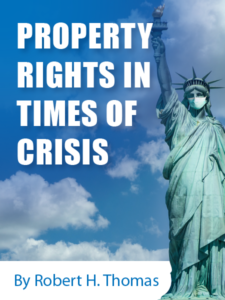
Stay tuned, this isn’t going to be the last of these things. We wrote up how we think these type of claims should be handled

Continue Reading Latest Coronavirus Complaint: NY State’s Order Suspending Evictions Is A Taking

BLOG-article-RHThomas-2020-05_450x600-225x300

Here’s what we’re reading today as we enter a long weekend (who can tell?):


Continue Reading Saturday Readings: Commandeerings, Business Reopenings, #coronalaw Property Rights

WMdoor2

This fall, we’ll be back at the William and Mary Law School (hopefully in-person, depending on the circumstances and the yet-to-be-announced approach to be taken by the College of William and Mary), teaching two of our favorite subjects.

Not only will this be the third time leading Eminent Domain and Property Rights (Law 608), but we’ll also be undertaking another subject, Land Use Control (Law 425). This semester, we’re stepping into the (big, figuratively speaking) shoes of Professor Lynda Butler who recently retired after a stellar and trailblazing career. Thankfully, Lynda is continuing to lead the Brigham-Kanner Property Rights Project and is underway with planning October’s Brigham-Kanner Conference, honoring Harvard lawprof Henry Smith.

Land Use is, of course, related to Eminent Domain and Property Rights, but the law school understands that they are each worthy of separate study, and they should not be folded into a single course (or

Continue Reading Land Use Also On The Fall Semester Agenda At William And Mary Law

Here’s the latest complaint asserting that a state governor’s business shut-down order (under which certain businesses are deemed “essential,” while others not) is a taking, inter alia, that joins a growing list of similar lawsuits (see here, here, here, here, here and here).

This one is by licensed beauty professionals and has a slightly different flavor than other similar complaints, because the plaintiffs are alleging a specific property right in their licenses, raising the question of whether a state-granted or state-recognized license is a property interest that needs to be condemned if the government prohibits the licensee from actually using it. The plaintiffs argue a Lucas taking:

113. The regulatory actions taken by the Defendants have resulted in Plaintiffs being deprived of all economically beneficial or productive use of their property including, without limitation, their licenses, their leased property, and their business property, and

Continue Reading Another Federal Takings Complaint For Business Shut-Down Order (California)