


20160722_141908

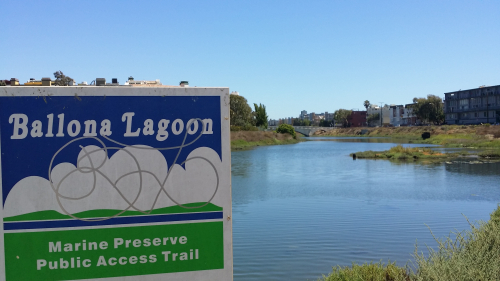
Petitioner owns the fee title to property known as the Ballona Lagoon, a narrow body of water connected to Marina del Rey, a manmade harbor located in a part of the city of Los Angeles called Venice. Venice is located on the Pacific Ocean between the Los Angeles International Airport and the city of Santa Monica.”

Summa Corp. v. Cal. State Lands Comm’n, 466 U.S. 198, 199-200 (1984). 

As you know, when we’re in the neighborhood, we like to visit the sites of famous cases. In the past, we’ve stopped by the sites of the Hadacheck, Kaiser Aetna, Nollan, Dolan, and PruneYard cases.

Here’s the latest, the location of a somewhat obscure case (if any Supreme Court case can be called “obscure”), smack dab in the middle of urban Los Angeles. As the above quote from the case notes, Ballona Lagoon lies

Continue Reading Public Trust, Tidelands, And Land Titles: A Short Visit
Here’s the amicus brief we filed yesterday on behalf of lawprof David Callies and our colleagues at Owners’ Counsel of America in an important case involving ownership and use of the “dry sand” beach, now pending in the North Carolina Supreme Court.  

In Nies v. Town of Emerald Isle, No. COA15-169 (N.C. App. Nov. 17, 2015), the court of appeals held that the dry sand portion of the beach — the part between the mean high water mark and the dune or vegetation line — is subject to the public trust. Consequently, the Town was not liable for a regulatory taking when it allowed the public, for a fee, to drive on the beach. The Nies family, which thought it owned the property inland of the MHWM under long-standing North Carolina law, and that the public trust only applied to property seaward of the MHWM, sought compensation.  The North Carolina

Continue Reading Amici Brief: If A Legislature Or Court Moves The Public Trust Shoreline Inland, It’s A Taking

Today’s post is by colleague William Wade, an economist in Nashville, Tennessee, who has thought a lot — and written extensively — about the just compensation and damages available in inverse condemnation and regulatory takings cases.

He provides his thoughts on a recent trial court decision in a closely-watched Texas water case, in which the appellate court earlier applied the Penn Central test to find liability, resulting in a remand to determine just compensation. As the title reveals, Bill takes issue with the way the issues were framed, and the conclusions the court reached. You may or may not agree with his conclusions, but Bill always considers these issues deeply, and his writings are always thought-provoking.  

Find him online at energyandwatereconomics.com

Bragg:  Wrong Question, Wrong Result in Texas to the Detriment of Sustainable Water Supply

by William W. Wade, Ph. D.[1]

Earlier in March, the Medina County Texas

Continue Reading Guest Post: Bragg – Wrong Question, Wrong Result In Texas, To The Detriment Of Sustainable Water Supply

When people think of “Hawaii,” many of them, me included, think of sugar. Those of us of a certain vintage who were raised in the islands, and whose families were tied to the sugar plantations once so ubiquitous (my mother’s family was from the Halawa Plantation and lived on what is now the site of Aloha Stadium), share a certain nostalgia for those days.

But things inevitably change, and most of the sugar and pineapple plantations (ask me about my pre-law days working at “the cannery,” a now-defunct summertime ritual for many local kids) are long-gone, save one, Hawaiian Commercial and Sugar’s Puunene plantation on Maui.

Earlier this week the other shoe dropped, and HSC’s parent company, Alexander and Baldwin, announced that at the end of the year, Hawaii’s sole remaining sugar plantation will be closed. There are a lot of reasons — labor costs

Continue Reading Lawsuits Have Consequences: Aloha To Hawaii Sugar

If you want a crash course in Hawaii’s unique (some would say weird) water law, you can’t do better than this video from Think Tech Hawaii, an interview with an old water hand, lawyer William Tam

While he definitely has a perspective (one that, in our view, downplays the role of private property and private rights), you can’t get a better insider primer on the history of the legal battles over Hawaii water that have taken place over the years, and the current state of the law. 

One question we’ve always had about the public trust doctrine as applied to Hawaii water resources: if all water is publicly owned, why aren’t people who use catchment systems to capture and store rainwater for their own use getting hit up for wrongly appropriating public water? 


Continue Reading Hawaii Water Law, In A Nutshell

Space. The final frontier. These are the voyages of the telescope Thirty Meter. Its five year continuing mission: to explore strange new worlds. To seek out a Conservation District Use Permit from the Board of Land and Natural Resources, and navigate the treacherous waters of Hawaii administrative law. To boldly go where twelve other telescopes have gone before

The “the cart before the horse,” is what the majority opinion authored by Chief Justice Recktenwald which invalidated the CDUP held the BLNR did when it “issued the permit before the contested case hearing was resolved and the hearing was held.” But the same might be said about the court’s procedural due process reasoning, because it could have reached the same result by employing a much narrower — and in our view, a much less opaque — statute-based rationale.

Dead Man Walking

Ironically — given the huge public interest in the

Continue Reading Carts Before Horses, And Pearls Before Swine: The Hawaii Supreme Court’s Fractured Rationale For Invalidating The TMT Permit

Mark your calendars for next Thursday, November 5, 2015, at 4:30pm at the University of Hawaii Law School Moot Courtroom for the annual Gifford Lecture in Real Property, sponsored by our colleagues at Carlsmith Ball

This year, the lecture is by Columbia Lawprof Thomas W. Merrill (also a recent Brigham-Kanner Property Rights prizewinner), and he will talk about “The Public Trust Doctrine: Some Jurisprudential Variations and Their Implications.”

The postcard is below, so come on up to the law school and take advantage of having a legal scholar of great renown in town. 

2015 Gifford Lecture – Professor Thomas Merrill

Continue Reading Thursday, November 5, 2015, U.H. Law School: Lawprof Thomas Merrill To Speak About Property And Public Trust

Here are some upcoming events in which you may be interested, in chronological order:


Continue Reading Upcoming Events And CLE’s – Appellate, RLUIPA, Sharing Economy, And More

Photo

Enviro Wars Episode IV: A New Court

You may have heard that the Hawaii Legislature, after an intensive years-long effort by environmental groups, recently created a new court with specialized jurisdiction that could have a big impact on how property and business owners are treated by Hawaii’s courts. 

Known as the “Environmental Court,” this new court has been given the exclusive jurisdiction to hear most civil and criminal cases affecting the environment. Because Hawaii’s court is only just getting off the ground and is in uncharted territory (only one other state—Vermont—has a court with a similar statewide mandate), those who stand to lose the most in this new court—property and business owners—have many unanswered questions.

Here’s what you need to know.

Why A New Court?

According to its proponents, the new Environmental Court is not expressly intended to change outcomes in environmental cases, and is merely designed

Continue Reading What You Need To Know About Hawaii’s New Environmental Court

Our colleague William Wade, in addition to being an economist, is a prolific author on the topic we find fascinating, takings. He looks at the issues with an economists’ perspective, and we’ve found his articles very helpful. We’ve even posted a few over the years:

Bill has graciously sent us a guest post, a preview of what may be his next article.

He focuses on the impact of the Texas Supreme Court’s landmark decision in Edwards Aquifer Authority v. Day, 369 S.W.3d 814, 832 (Tex. 2012), in which the court held that land ownership

Continue Reading Guest Post – Liquid Gold, or Water For Pecans: Valuation of Texas Water