AFBF-annual
On Monday, January 9, 2012, I’ll be speaking to my American Farm Bureau Federation colleagues, who are in town for the AFBF annual meeting.

The title of my presentation is “Agriculture and Property Rights: Why Hawaii Matters.” I’ll be talking water rights, GMO, right-to-farm, eminent domain, and other issues to the lawyers who represent farmers and ranchers. I’ll record it and post it here on Monday.

Check out the AFBF’s annual meeting blog here.Continue Reading Agriculture And Property Rights: Why Hawaii Matters
So you think you’ve seen accretion (the growth of new land on littoral or riparian property)? Check out the above video (also here), showing the latest dramatic lava flow on the Big Island of Hawaii. Now that’s accretion.

Is there a legal angle to this? Of course there is. To start you off, here’s a multiple choice test.

Who owns the new land created when lava flows over private property and into the sea and hardens into fast land:

A.  The property owner over whose land the lava flowed.

B.  The United States.

C.  The State of Hawaii Office of Hawaiian Affairs.

D.  The State of Hawaii.

(And you thought weird hypotheticals only occurred in law school exams.) A hint: the issue was resolved by the Hawaii Supreme Court in 1977, in an opinion authored by Chief Justice William Richardson.

Seriously, do you need to know anything

Continue Reading “Accretion,” Hawaii Style

The old adage is that a waterway is “navigable” for purposes of federal law if it is deep enough to float a Supreme Court opinion. Seriously, though, the less cheeky test of navigability is whether a waterway is capable of being used in its natural state as an avenue of commerce, meaning whether it was actually navigable at the time of a state’s admission into the Union. Really, that’s the test.

But as the Supreme Court reminded more than 30 years ago, when applying this general test for navigability, you must keep in mind the purpose  

T

Wednesday’s oral arguments in PPL Montana v. Montana, No. 10-218 (cert. granted June 20, 2011) started off on familiar territory with Justice Kennedy breaking the ice quickly, asking Petitioner’s counsel Paul D. Clement whether his point is “that there should be a Federal rule of — laches or estoppel, or are

Continue Reading What Does It Mean To Be “Navigable?” – Supreme Court

Here’s the latest in the Casitas case from the U.S. Court of Federal Claims. Casitas Municipal Water Dist. v. United States, No 05-168L (Dec. 5, 2011). This case highlights the importance of identifying the “property” right alleged to have been taken in these type of cases:

This case is before the court following a trial held to determine the compensation, if any, owed to plaintiff under the Fifth Amendment to the United States Constitution for the taking of its property. In an earlier round of litigation in this case, the Court of Appeals for the Federal Circuit ruled that operating restrictions on plaintiff’s water project imposed by the National Marine Fisheries Service “NMFS”) pursuant to the Endangered Species Act (“ESA”), 16 U.S.C. §§ 1531–44 (2006), should be analyzed as a physical taking where plaintiff was required to reroute a portion of the water it had diverted for its own

Continue Reading Court Of Federal Claims: Water Rights Takings Claim Not Ripe (Flashbacks To The Hawaii Water Rights Case)

Tomorrow, the U.S. Supreme Court will hear oral arguments in PPL Montana v. Montana, No. 10-218 (cert. granted June 20, 2011), a case in which the Montana Supreme Court disregarded 100 years of private or federal ownership of the riverbeds under more than 500 miles of river, and held that the state owned them. The net result of the Montana court’s ruling was that the state was owed millions in back and future rent from the owners of hydropower facilities located on those riverbeds. Sound familiar?

We’ve been following the case, and have posted the merits and amicus briefs, and were all set to do a lengthy and detailed preview of the oral arguments. Really, we were just about to do that. But a worthier source than we, Professor Thomas Merrill, beat us to the punch, and posted his detailed preview of the case on SCOTUSblog here.

Continue Reading Montana Navigability Case Preview

Yosemite_conference Here are the links to the cases and other items discussed today at the session Regulatory Takings – Looking Back and Looking Forward at the Cal State Bar’s Environmental Law Section’s Environmental Law Conference at Yosemite.

These cases are also in your written materials.


Continue Reading Links From “Regulatory Takings: Looking Back And Looking Forward” (Cal. State Bar Yosemite Conference)

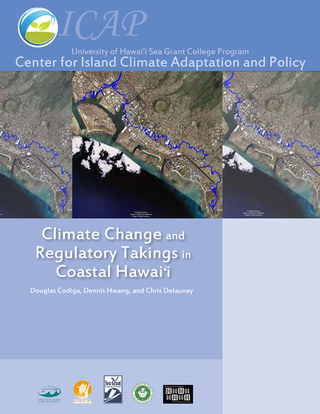
Climatechangemongraphpage

“There is strong consensus in the international scientific community that climate change is occurring and that greenhouse gas emissions from human activities contribute to climate change.”

So begins Climate Change and Regulatory Takings in Coastal Hawaii, a monograph by Douglas Codiga, Dennis Hwang, and Chris Delaunay, published by the University of Hawaii Sea Grant College Program’s Center for Island Climate Adaptation and Policy

We’re not entering into the debate about whether global warming/climate change is or isn’t happening. But the one certain thing is that every regulatory entity from the U.N. on down to your local neighborhood board believes it is real, and seems to want to do something about it. Thus, the question is how property owners may be affected by those actions, and what they can do in response. This report doesn’t really resolve anything, but it does establish the framework and makes some recommenations. From

Continue Reading Climate Change And Regulatory Takings In Coastal Hawaii

12.WATHIWe’ve just finalized the agenda and faculty for the Hawaii Water Law conference, to be held in Honolulu on January 11, 2012. I am the planning co-chair along with Jesse Souki, Director of the State of Hawaii Office of Planning.

In addition to Jesse and me, we’ve assembled a diverse and talented faculty: UH lawprof David Callies will speak with Elijah Yip (Cades) on the latest developments in water law and public trust litigation. State Water Commissioner Lawrence Miike will update us on the latest goings-on at the Commission. My Damon Key partner Greg Kugle is speaking with Leo Asuncion, the Manager of the Coastal Zone Management Program at the State Office of Planning on coastal issues.

After lunch, we have a special guest, Ed Thomas (a lawyer and President of the National Hazard Mitigation Association, and a nationaly known expert in floodplain management and disaster

Continue Reading Mark Your Calendars: Hawaii Water Law Conference (Jan. 11, 2012)

The top-side brief and supporting amicus briefs have been filed in a case we’ve been following, PPL Montana v. Montana, No. 10-218 (cert. granted June 20, 2011).

In PPL Montana, LLC v. State of Montana, 229 P.3d 421 (Mont. Mar. 30, 2010), the Montana Supreme Court disregarded 100 years of private or federal ownership of the riverbeds under more than 500 miles of river, and held that the state owned them.* The net result of the Montana court’s ruling was that the state was owed millions in back and future rent from the owners of hydropower facilities located on those riverbeds.Sound familiar?

In June, the Supreme Court agreed to review this question:

Does the constitutional test for determining whether a section of a river is navigable for title purposes require a trial court to determine, based on evidence, whether the relevant stretch of the river was

Continue Reading SCOTUS Reviewing State Court’s Land Grab In Navigability Case

Yosemite_conference

Mark your calendars for October 20 – 23, 2011. That’s when the State Bar of California will present its 20th Anniversary Environmental Law Conference at Yosemite® (yes, it is trademarked), at the Tenaya Lodge in Fish Camp, California.

Along with U.C. Berkeley law professor Joseph Sax and Deputy California Attorney General Daniel L. Siegel, I will be speaking about “Regulatory Takings: Looking Back and Looking Forward.”

We will be discussing the seminal regulatory takings cases from the past 20 years. “The panelists, who have been involved in several of the most significant takings cases since even before the founding of the annual Yosemite Environmental Law Conference twenty years ago, will highlight key decisions, offer their views on the evolution of takings law, and discuss cutting-edge issues raised by more recent court decisions.”  E. Clement Shute will moderate the panel discussion.

The Yosemite program, sponsored by the CSB’s

Continue Reading “Regulatory Takings: Looking Back and Looking Forward” At The Cal Bar’s Yosemite Conference