IMG_20191004_124327

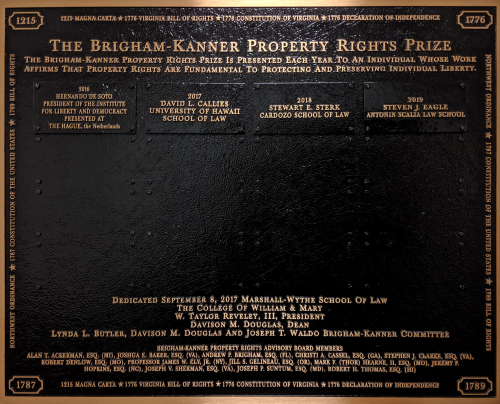
Here is a transcript of the remarks I delivered today at the 2019 Brigham-Kanner Property Rights Conference. I was honored to join lawprof Henry Smith and Florida Supreme Court Justice (ret.) Ken Bell (who authored the Florida court’s opinion in Stop the Beach Renourishment which was challenged in SCOTUS as a “judicial taking”) to speak about “Public Resources and Private Rights” (moderated by Professor Katherine Mims Crocker). After paying our respects to 2019 B-K Prize winner Professor Steven Eagle, we each addressed some part of the question.

—————————-

The New New Property

As always, I bring to you tidings of “aloha” from the state where the legislature thought it was a going to reduce the price of residential housing by taking fee simple interests from “A” and giving them to “B,” the leaseholders

Where now, the median price for a single-family, two bedroom, one bath
Continue Reading 2019 Brigham-Kanner Conference: The New New Property – Public Resources And Private Rights

6a00d83451707369e2022ad3b86fce200d-800wi

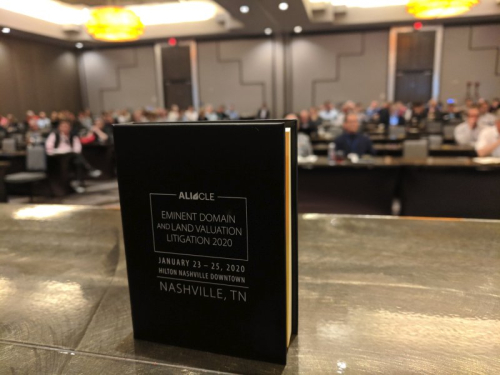
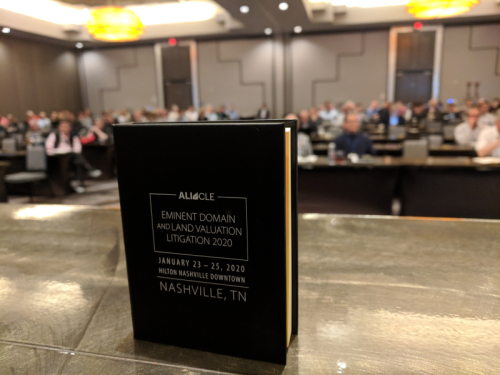
You overwhelmingly asked for Nashville, and we’re bringing it to you!

Get ready, and hold your place now: here’s the list of programs and speakers for the 36th Annual ALI-CLE Eminent Domain and Land Valuation Litigation Conference, to be held at the Downtown Nashville Hilton, January 23,- 25, 2020. Two-and-a-half days with top-notch national faculty (lawyers from both sides, judges, legal scholars, appraisers, relocation experts, and others).  

Early registration and group rates are available now

Here are just some of the programs:

  • Featured Presentation: Property Rights as Civil Rights: Seeking Justice Though the Fourth and Fifth Amendments. Hon. Jonathan Apgar, Jamila Johnson, Alan Ackerman. Moderator: Leslie Fields.
  • Making Sense of the New Rules After Knick v. Township of Scott: Where Do I Go, What Do I Do? David Breemer, Smitha Chintamaneni, Professor Bethany Berger. Moderator: Professor Steven Eagle.
  • When A River Runs Thought It: Water Rights and


Continue Reading Here’s The Agenda And Faculty For The 2020 ALI-CLE Eminent Domain And Land Valuation Litigation Conference, Nashville, Jan 23-25, 2020

ALI Nashville 2020

The final agenda and faculty list will soon be officially published, but we wanted to give you a preview of what is in store at the ALI-CLE Eminent Domain and Land Valuation Litigation Conference, January 23-25, 2020, at the Nashville Hilton (downtown, just a few steps away from everything that Nashville has to offer). 

Don’t miss out: in recent years, we’ve been at-or-near capacity, and the conference hotel has even sold out a couple of times. Visit the ALI-CLE website to register and hold your space

Here are some of the things we’ll be discussing: 

  • Making Sense of the New Rules After Knick v. Township of Scott: Where Do I Go, What Do I Do?
  • The Missing Link in Valuing Fixtures
  • When a River Runs Through it: Water Rights and Takings
  • Responding to Project Changes: Valuation When Government Action is Ongoing
  • Property Rights as Civil Rights: Seeking Justice Through


Continue Reading Get Ready: The 2020 ALI-CLE Eminent Domain And Land Valuation Litigation Conference Agenda Coming Soon

Check this out. What at first appears to be something along the lines of the grainy Zapruder film (this particular piece was recorded on video, not film, and certainly well before the days of high-res camera phones that we now take for granted) is an important piece of takings history.

It is (the late) Anthony Palazzolo driving his famous “wetlands” property, recorded after the U.S. Supreme Court issued its opinion in his favor in Palazzolo v. Rhode Island, 533 U.S. 606 (2001).

Dwight Merriam, who graciously provided the raw footage, became Tony Palazzolo’s friend after interviewing him for an article Dwight was writing on the Supreme Court decision, and they frequently met, dined together, and conversed as Palazzolo’s matter continued on remand. Dwight recorded this video from the back seat of Palazzolo’s car. In the front is John Boehnert of Providence, another longtime friend of Dwight’s and a

Continue Reading Anthony Palazzolo Drives His Property

People like to go to lakes. Lakes are nice. Especially in the summer. Especially Oswego Lake, Oregon (former name “Sucker Lake” — not an auspicious start). Problem is, most of the land surrounding the lake is private property. Some is owned by the municipality, but it limits access to residents of the municipality. 

So like in a similar New York case, a recreational kayaker who does not reside in the City sued, asserting that because the Lake is navigable, the public is allowed to access it. The lower courts agreed with the City and the owners that the general public does not have a right under either the public trust or public use doctrines to access. 

In Kramer v. City of Lake Oswego, No. CV12100913 (Aug. 1, 2019), the Oregon Supreme Court mostly agreed. But not entirely. It concluded that “neither the public trust nor the public

Continue Reading Oregon Hardens “Background Principles” Public Trust Firewall In Lake Access Case

Here’s what we’re reading today:

  • New Ruling In Maui Water Case Still Doesn’t Resolve Old Dispute (Honolulu Civil Beat) – about the Hawaii Intermediate Court of Appeals’ recent unpublished memorandum opinion in a long-ongoing water law fight on Maui. The long and the short of it is the court held that whether a short-term license from the State to use water (month-to-month, max one-year as the statute requires) is “temporary” or not (these licenses have been renewed for 18 years to allow the administrative process to be completed) is a factual question that can be resolved by summary judgment. Court held no. In our view, these things operate much like preliminary injunctions, which although they are temporary in nature, can stretch out for quite a long time while the wheels of justice grind. Cert application to the Hawaii SCT coming, for sure. Any guesses on which way this will come


Continue Reading Thursday Round Up: Hawaii Water Law, “New” Property, The Edge Denied!

On one hand, there’s nothing really new in the Hawaii Supreme Court’s opinion in In re Hawaii Electric Light Co., No. SCOT-17-630 (May 10, 2019), because the court has previously told us the answers to each the component questions in the case:

  • On the ultimate question posed in the title, must the PUC consider whether a power purchase agreement for a Big Island “woody biomass” electric plant might have an effect on a clean and healthy environment by affecting the utility’s willingness to purchase electricity generated by more “pure” means such as wind and solar: you don’t need to read the 66 page unanimous opinion to know the answer: of course it has to. The statute mostly says so, and you didn’t need a deep understanding of the other details in the case to be able to predict about how this one was going to end up, merely the


Continue Reading HAWSCT: PUC Must Consider Whether Renewable Biofuel Energy Plant Might Impact Property Right To Clean And Healthful Environment

0412191003c_HDR

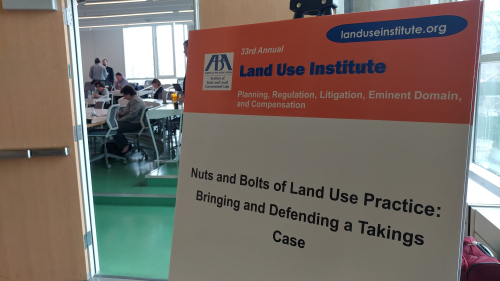
Here are the links from today’s two sessions (the first, federal water issues impacting local land use; the second, Bringing and Defending a Takings Case):

The morning started off with a talk by former Detroit Mayor (and Michigan Supreme Court justice) Dennis Archer, about Poletown, eminent domain, and economic

Continue Reading Links And Materials From Today’s Land Use Institute Sessions, Baltimore

We recommend you pick up the opinion of Maine’s Supreme Judicial Court in Ross v. Acadian Seaplants, Ltd., No. Was-17-142 (Mar. 28, 2019), because it deals with property rights in an area subject to the public trust. We think the court did a pretty good job of setting out the competing claims and the background of the oft-misunderstood public trust doctrine. 

The issue was whether the public (in this instance, Acadian Seaplants) has the right under the jus publicum to harvest living rockweed, a seaweed which anchors itself to “the rocky ledges that accent [Maine]’s coastline.” Slip op. at 1.

Specifically, we are asked to determine whether rockweed is private property that belongs to the adjoining upland landowner who owns the intertidal soil in fee simple, or property that is held in trust by the State through the jus publicum for the public to harvest.

Id.

Continue Reading The Ocean May Be Subject To The Public Trust, But Private Owners Own The Seaweed

You might think from the caption of the Hawaii Supreme Court’s opinion in In re Contested Case Hearing on the Water Use Permit Application Originally Filed by Kukui (Molokai), Inc., No. SCOT-17-0000184 (Dec. 10, 2018), that, oh boy, we were about to get yet another pronunciation on Hawaii’s water law from the court.

Alas, not so. Search as you might, there’s nothing there that helps or hurts in the water law department. It’s only about administrative law. Specifically, when a party to an administrative proceeding has waived their right to demand a contested case (a trial-like proceeding in an administrative agency). 

Long backstory, but here’s the short version: when an applicant writes to the agency and states, “This letter is to inform you that Molokai Public Utilities (MPU) does not intend to continue to pursue this case on remand,” it’s not too surprising that the agency — and

Continue Reading HAWSCT’s Latest Water Case Isn’t About Water