Another must-listen episode of Clint’s Eminent Domain Podcast. He’s joined by Pepperdine Law School Professor Shelley Ross Saxer:

Professor Shelley Ross Saxer joins the show to discuss the role that the damaging clauses found in more than half of state constitutions across the United States play in inverse condemnation claims related to natural disasters such as the recent Hawaii wildfires.

Definitely worth a listen (as always with EDP). Stream above, or download here. Continue Reading Inverse Condemnation And Hawaii’s Wildfires: Lawprof Shelley Saxer Joins Clint Schumacher’s Eminent Domain Podcast
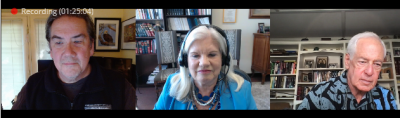

HSBA 10-2023

Yesterday, during the Annual Meeting of the Hawaii State Bar Association, we participated in a program sponsored by the Real Property and Financial Services Section, “Inverse Condemnation & Paying for Disasters.”

As you can see above, we joined lawprofs Shelley Saxer and David Callies to share thoughts about inverse claims, and the difference between these property arguments and tort negligence claims.

Here are some of the key cases and materials which we mentioned (or should have):


Continue Reading Links And Materials From “Inverse Condemnation & Paying for Disasters”

Here’s the latest in a case and an issue we’ve been following.

Recall that the U.S. District Court for the Eastern District of Texas concluded that the City of McKinney, Texas was liable for the taking of Vicki Baker’s home, after city police officers destroyed a large part of it while apprehending a suspect who had taken refuge therein. The court awarded just compensation and the city appealed.

Now, the other shoe drops: in Baker v. City of McKinney, No. 22-40644 (Oct. 11, 2023), the U.S. Court of Appeals for the Fifth Circuit reversed, concluding that because the invasion was necessary and a justified use of the city’s police powers, it does not owe compensation.

We’ve been down this path before, so we won’t go over it in detail (recall that the Tenth Circuit reached the same conclusion and the subsequent cert petition was denied by the Supreme

Continue Reading Fifth Circuit Kicks Down The SWAT Takings Door (And Boots The Issue Upstairs)

Why is it, you ask, that the ALI-CLE Eminent Domain & Land Valuation Litigation Conference (scheduled next February 1-3, 2024, in New Orleans) is an event that seems to be growing in popularity and attendance. In recent years, we have standing room only in the Conference halls, and have sold out the hotel block. After all, this is a pretty niche area of law. So what gives?

When we were in Austin earlier this year, we thought it might be nice to try and answer that question. We asked Conference participants why they come, year-after-year (and in Austin, despite massive travel disruptions). Yes, it is the various venues (Nashville, Austin, Scottsdale, Palm Springs, to name a few recent locations), and yes, it is the excellent and useful programming.

But as we suspected it is more than that. As the above video notes

Continue Reading ALI-CLE’s Eminent Domain & Land Valuation Litigation Conference (Feb 1-3, 2024, New Orleans): Why Attend? Here’s Why.

Screenshot 2023-08-26 at 10-33-05 Brigham-Kanner Property Rights Conference

Heads-up: the registration page for the 20th Brigham-Kanner Property Rights Conference, October 26-27, 2023, at the William and Mary Law School in Williamsburg, Virginia, is now up.

Early registration is a good thing because space is limited, especially at the Wren Building banquet on the 26th, at which the 2023 B-K Property Rights Prize will be presented to Prof. Gregory Alexander.

So please don’t miss out.

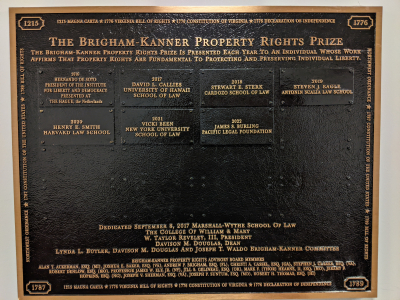
2022 BK plaque
The Property Rights Hall of Fame (second plaque)

If you are not already familiar with the Conference, it is (in our opinion) the best one-day event on property and property rights theory and practice. Expressly designed to bring together the legal academy and the practicing dirt law bar, the conference is where we discuss the burning property and property rights issues of the day. Here’s the 2023 Program:

  • Property and Propriety (or a Well-Ordered Society): A Tribute to Gregory S.


Continue Reading Register Now For The 20th Brigham-Kanner Property Rights Conference, Oct. 26-27, 2023

Here’s our colleague and friend, Pepperdine lawprof Shelley Saxer, an expert on inverse condemnation and its use in mass disaster cases, on the use of inverse condemnation as a theory of recovery for the Maui disaster. Here’s the description from Bloomberg Law Podcast:

“Shelley Ross Saxer, a law professor at Pepperdine University, discusses the Lahaina fire victims using a legal shortcut to secure compensation from Hawaiian Electric. June Grasso hosts.”

Worth a listen.Continue Reading Lawprof Shelley Ross Saxer Joins Bloomberg Law Podcast On Maui Wildfires And Inverse Condemnation

On this morning’s drive-time program, we joined KHVH’s Rick Hamada about whether Hawaii might adopt California’s version of inverse condemnation liability in wildfire cases. We also tried to clear up a few misconceptions (gad, I used “disinformation,” a term I try to eschew).

Here’s the program description:

Inverse Condemnation and Maui Wildfires: A Conversation with Robert Thomas

Tune in to a thought-provoking episode where we engage in a conversation with legal expert Robert Thomas on the topic of inverse condemnation in relation to the recent Maui wildfires. As the community grapples with the aftermath of the devastating fires, we delve into the legal aspects of property rights, government accountability, and compensation for affected individuals. Join us as we explore the implications of inverse condemnation, a legal doctrine that holds governments accountable for taking private property without just compensation. Gain insights into the challenges faced by property owners in the wake

Continue Reading Our Drive-Time Conversation About Hawaii Inverse Condemnation And Wildfires

Well, that was quick. As reported here (“HECO Kept The Power Flowing In Lahaina Even As Poles Toppled“), we’ve already seen the first lawsuit filed seeking recovery for the Maui wildfire that destroyed Lahaina town — a class action even before there’s been any official word about what caused or contributed to the conflagration:

Meanwhile, a group of Honolulu- and California-based law firms filed a class action suit Saturday against HECO on behalf of victims and survivors of the Lahaina fire.

The suit alleges that HECO’s downed power lines caused the fire. Graham Lippsmith of the firm Lippsmith LLP said Saturday that the suit was also largely based on HECO’s decision not to de-energize the power Tuesday in West Maui.

A separate Honolulu attorney also said Saturday that his firm is weighing whether sue HECO on behalf of its clients, also largely based on the downed poles.

They

Continue Reading First Lawsuit Filed (Incl. Inverse Condemnation) For Maui Wildfire: Is California-Style Inverse Condemnation Coming?

Here’s the latest in a case we’ve been following.

In Ideker Farms, Inc. v. United States, No. 21-1949 (June 16, 2023), the U.S. Court of Appeals for the Federal Circuit held that temporary, but recurring government-caused flooding was correctly treated by the Court of Federal Claims as a categorical per se taking, and not under Arkansas Game & Fish‘s Penn-Central-plus multifactor test. The court also held that the property owners are entitled to just compensation for their lost crops.

The opinion is pretty dense (39 single-spaced pages) so we’re not going to provide a blow-by-blow account of the arguments and the court’s reasoning. But we will hit some of the highlights:

  • The Missouri River floods annually. In the 1990s, the Corps of Engineer and Fish and Wildlife Service “began discussions concerning proposed changes to the River designed to mitigate the environmental impact” of the federal flood


Continue Reading CAFED: Temporary But Recurring Flooding Is A Categorical Taking, Not Penn-Central-Plus

Check this out, a recently-filed cert petition in a case we’ve been following, filed by our friends and colleagues at the Institute for Justice. This one involves an issue we’ve been on top of also, most recently in these two cases (see here and here).

That is, what does the Supreme Court’s description of the Takings Clause as “self-executing” actually mean? Do you need statutory authorization in order to bring a takings or just compensation claim, or can you sue directly under the Constitution?

In Devillier v. Texas, No. 21-40750 (Nov. 12, 2022), the Fifth Circuit’s cryptic opinion concluded that “the Fifth Amendment Takings Clause as applied to the states through the Fourteenth Amendment does not provide a right to action for takings against a state[.]” Slip op. at 1-2. Here’s the entirety of the decision (minus footnotes):

The State of Texas appeals the district court’s decision

Continue Reading New Cert Petition: Do You Need Statutory Authorization To Sue For A Taking?