Skip to content

JLEPcover

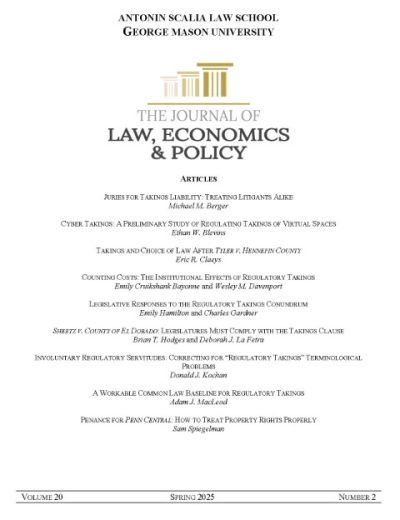
Last year, we attended a conference devoted to the future of regulatory takings, hosted by the Antonin Scalia School of Law (George Mason U), and Pacific Legal Foundation.

The publisher, the Journal of Law, Economics, and Policy has released the articles and essays from that conference, and made them available here

Here’s the list of articles:

  • Michael M. Berger, Juries for Takings Liability: Treating Litigants Alike
  • Ethan W. Blevins, Cyber Takings: A Preliminary Study of Regulating Takings of Virtual Spaces
  • Eric R. Claeys, Takings and Choice of Law After Tyler v. Hennepin County
  • Emily Cruikshank Bayonne and Wesley M. Davenport, Counting Costs: the Institutional Effects of Regulatory Takings
  • Emily Hamilton and Charles Gardner, Legislative Responses to the Regulatory Takings Conundrum
  • Brian T. Hodges and Deborah J. La Fetra, Sheetz v. County of El Dorado: Legislatures Must Comply With the Takings Clause
  • Donald J. Kochan, Involuntary Regulatory Servitudes:


Continue Reading New Property Rights Symposium Published – “Too Far: Imagining the Future of Regulatory Takings”

DSCF3117
If you know, you know.

Sad birthday wishes to what just might be our most un-favorite decision ever, Penn Central Transp. Co. v. New York City, 438 U.S. 104 (1978), which turns 46 today. This in addition to the unhappy Kelo-versary earlier this week. A takings and regulatory takings one-two punch! 

Time has not treated the opinion well. Practitioners, judges, and legal scholars across the spectrum have called the three-factor Penn Central test for an ad hoc regulatory taking “demanding,” “fuzzy,” a four-part test, “neither defensible as a matter of theory nor mandated as a matter of precedent,” and “problematic” and “mysterious.”

No one but the Supreme Court professes to understand what that case means. Courts mess up the basic meaning of the factors, treat what is supposed to be a fact-centric “ad hoc

Continue Reading Not A Great Week For Property Rights Anniversaries: Penn Central Turns 46 Today

Please add this one to your podcast listening queue: the latest episode of Bound by Oath, produced by John Ross at the Institute for Justice. BBO isn’t a typical podcast, but more of an audio documentary as we have noted before. If you aren’t a subscriber, you really should be. 

This episode focuses on regulatory takings, and the sleight-of-law that governments frequently employ to avoid the merits of takings claims, or perhaps worse yet to avoid paying compensation even after ordered to. Cases detailed include DeVillier, Agins, First English, Violet Dock Port, Ariyan. This episode is a great companion piece to BBO‘s episodes on Euclid (zoning), Pennsylvania Coal (reg takings), and Berman (Public Use). 

Put on your “self-executing” hat and take a listen! 

Here’s the description of the episode:

The Fifth Amendment says that the government must pay just compensation when it takes

Continue Reading Must-Listen Podcast: “Neat Takings Tricks” (Bound by Oath, S3, E3)

1000002646

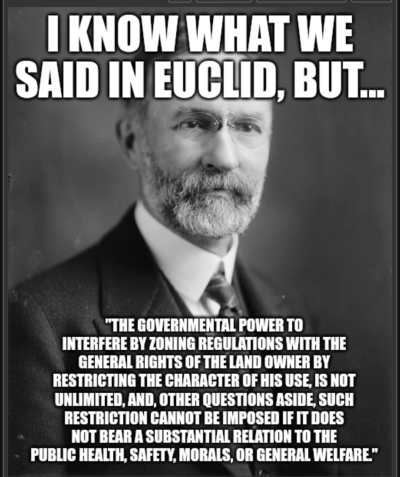
It was on this day in 1928 when the U.S. Supreme Court issued its second most famous decision about zoning, Nectow v. City of Cambridge., 277 U.S. 183 (1928). 

We say “second” because everyone knows that the first is the Court’s decision issued just two years earlier which generally upheld comprehensive use, height, and density regulations as a valid exercise of the government’s police power to regulate property uses to further the public health, safety, welfare, or morals. See Village of Euclid v. Ambler Realty Co., 272 U S. 365 (1926). 

Partly because of the hype surrounding Euclid and the broad governmental embrace of exclusionary land use policies that Euclid unleashed, we think that Nectow has not received the attention it is due. After all, it should be seen as the companion case to Euclid: it was authored by same Justice who wrote Euclid (Justice Sutherland)

Continue Reading Happy 97th Birthday, Nectow v. City of Cambridge!

Here’s the latest in a case we’ve been following.

This is Fane Lozman. You know his name. Yes, the guy who has taken on the City of Riviera Beach, Florida twice at the Supreme Court, and is now coming back for a third shot on goal. Houseboat guy. Public hearing gadfly guy. And now, maybe the ripeness guy.

Lozman has filed a cert petition asking the Court to review the Eleventh Circuit’s opinion which dismissed his regulatory takings claim as unripe.

Here’s the Questions Presented:

Fane Lozman has a contentious relationship with the City of Riviera Beach, Florida. The City’s mistreatment of Mr. Lozman has twice required this Court’s intervention. See Lozman v. City of Riviera Beach, 568 U.S. 115 (2013); Lozman v. City of Riviera Beach, 585 U.S. 87 (2018).

In this third chapter, Mr. Lozman was forced to sue the City

Continue Reading SCOTUS Hat Trick? Houseboat Guy Returns For Shot At Lucas Ripeness

Chart

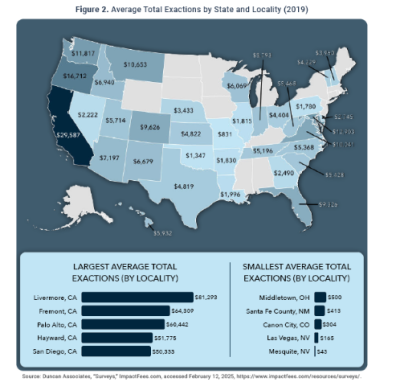
Check out the new report by our Pacific Legal Foundation colleagues Kyle Sweetland and Brian Hodges, “How to Protect Property Rights from Improperly Assessed Exactions” (Apr. 2025).

This research in brief shows how exactions grew and increased home construction costs over a 16-year period. It provides a history of exactions, showing how they have frequently moved away from their original impact-mitigation purpose and how that shift in purpose risks violating the Constitution. It illustrates an improperly assessed exaction and provides examples of how exactions have hampered construction during the present housing crisis. It concludes by examining how state legislatures can help set boundaries on local exactions and protect property rights.

It’s short, its sweet, it’s straightforward and understandable. What more could you want? Oh yeah, unlike exactions … it’s free. No strings attached. Check it out.

Sweetland & Hodges, How to Protect Property Rights from Improperly Assessed Continue Reading New Report: “How to Protect Property Rights from Improperly Assessed Exactions” (Sweetland & Hodges)

We’ve had this one in our queue for a bit, but it seems now is a good time to lay out the U.S. Court of Appeals for the Sixth Circuit’s opinion in McIntosh v. Madisonville, No. 24-5383 (Jan. 21, 2025). After all, the Due Process Clause seems to be in the news a lot lately, and this case explains what process is due property owners before they are deprived of that property.

Here’s the story. The city, after a code enforcement officer’s inspection (responding to a tenant complaint) declared that one of McIntosh’s mobile homes had mold and deemed it unsafe and unsalvageable. Letter followed notifying the owner of the city’s condemnation of the property, advising him that he had 30 days to submit plans for getting things in order, or else the city was going to tear it down. The city also put notice on the property itself.

Continue Reading CA6: The Predeprivation Hearing Required By Due Process Can’t Just Exist On Paper (And An Informal, And Possibly Made-Up Chance To Negotiate Isn’t Enough)

These days, when we have cases where there’s tinkering with the terms of rental agreements, we most often see local governments using their police power to force property owners to rent their properties on a long-term (more than 30 days) basis.

But in Bigelow Arizona TX-344, LP v. Town of Addison, No. 05-23-00642-CV (Apr. 4, 2025), the Texas Court of Appeals was dealing with a town ordinance that went the other way: it redefined the definition of “hotel,” which had the effect of prohibiting an extended-stay hotel from continuing to rent 95% of its rooms on a long-term basis under a nearly 30-year old special use permit, and forced what had been long term stays to become short-term stays.

Why? The town’s “desire for motels and hotels to operate so that rooms are available for the Town’s tourists[.]” Slip op. at 3. Really? Read a bit further and you

Continue Reading Tex App Dismisses Penn Central Claim – But What’s It Doing Weighing The Facts?

Today we have a guest post by New York colleague Jennifer Polovetsky, who writes about an exactions case that is headed for the New York Court of Appeals. Disclosure: our firm represents the property owners in that court. 

Thanks to Jennifer (and to the New York Law Journal) for allowing us to republish her intriguing piece.

_____________________________

NY Zoning Law Mandating Contributions Deemed an Unconstitutional Taking

by Jennifer Polovetsky

A few years ago, on December 15, 2021, the City of New York (the City) amended §143–13 of the City Zoning Resolution (the ZR Amendment). A portion of this ZR Amendment required property owners to pay a mandatory, nonrefundable contribution to the SoHo–NoHo Arts Fund (Arts Fund), as a precondition to filing for a permit to convert joint living-work quarters for artists (JLWQA) to unlimited residential use.

What is the problem with the ZR Amendment, you may ask? Well, according


Continue Reading Guest Post (Jennifer Polovetsky): “NY Zoning Law Mandating Contributions Deemed an Unconstitutional Taking”

Virginia eminent domain 2025

Virginians: now is a good time to register for the Virginia Eminent Domain Conference, May 8-9, 2025, at the Kingsmill Resort in Williamsburg.

We have spoken and attended the Conference in past editions, and can report that it is excellent. We’re looking forward to joining friends and colleagues again in The Burg in the spring. Check out the faculty and agenda, and then register and reserve your spot.

We’ll see you there.Continue Reading Virginia Eminent Domain Conference: May 8-9, 2025, Williamsburg