We don’t usually post trial court decisions. They are, obviously, subject to change by an appellate court, and because many are interlocutory, alteration by the rendering court iself.

But for this order from the U.S. District Court for the Northern District of Florida, we’ll make an exception. It’s a land use case (it’s right there in the first sentence, “This is a land use case.”), in which the plaintiffs are challenging two ordinances adopted by the County. The first prohibited obstruction of the beach with ropes, chains, signs, or fences. The second prohibited anyone from interfering with public use of dry sand beach areas. Under Florida law, the dry sand portion of the beach is privately owned. 

As you might expect, because the effect of the ordinance was to invite the public to use private property (as Laurence Tribe wrote in his treatise on Constitutional Law when discussing Kaiser Aetna

Continue Reading Federal Court: Williamson County Ripeness Not Required In Facial Takings Claims

Here are the full set of petitioner-side amici briefs in 616 Croft Ave., LLC v. City of West Hollywood, No. 16-1137, the case which asks the Supreme Court to determine whether the Nollan-Dolan-Koontz exactions standards apply to conditions on development imposed by a legislature. 

The City waived response, but the Court asked for one. This could get interesting, so stay tuned. 

Continue Reading SCOTUS Amici Briefs In Legislative Exactions Case

Not a lot in Jabary v. McCollough, No. 15-40009 (Apr. 19, 2017) to grab onto, so we’re not really surprised that the Fifth Circuit didn’t publish. But because the case involves Williamson County takings ripeness and is in our wheelhouse, we’re posting it nonetheless.

The first two sentences, “City building inspector Bret McCullough shut down Mike Jabary’s hookah lounge. He did so by leaving a notice on the door of the establishment that summarily revoked Jabary’s certificate of occupancy and informed him that he was violating the city code by doing business without the certificate” give you a clue that this is a procedural due process case as well as a takings case. Jabary met with success with his due process challenge (the district court denied the building inspector’s motion for summary judgment on immunity grounds, after which the inspector appealed), and, predictably, the district court held that Jabary’s

Continue Reading 5th Cir (Unpub) – Takings Claim Not Ripe

Here’s the amicus brief filed yesterday by the National Federation of Independent Business Small Business Legal Center, joined by Owners’ Counsel of America, in a case we’ve been following.

This case asks the Court to resolve a big outstanding issue: are legislatively-imposed exactions (however that term is defined) subject to the same high level of scrutiny under the NollanDolanKoontz test as are administratively-imposed exactions? 

Our brief argues:

The Respondent, City of West Hollywood (“City”), forces property owners into the same unconstitutional dilemma which faced James and Marilyn Nollan, Florence Dolan, and Coy Koontz. Nollan v. California Coastal Comm’n., 483 U.S. 825 (1987); Dolan v. City of Tigard, 512 U.S. 374 (1994); Koontz v. St. Johns River Water Management District, 133 S. Ct. 2586 (2013). Specifically, the Petitioners were forced to choose between their fundamental rights to either (a) obtain just

Continue Reading SCOTUS Amicus Brief: Lawless Legislatures Should Be Treated The Same As Lawless Zoning Boards

IMG_20161026_112153

Here’s what we’re reading today:


Continue Reading Monday Reading: Pirates (Twice), Monet Land Use Pilgrimage

The Indiana Court of Appeals’ recent opinion in Town of Clear Lake v. Hoagland Family Ltd. P’ship, No. 76A05-1606-PL-1241 (Apr. 6, 2017), doesn’t really involve inverse condemnation, except in the background. But we found it interesting nonetheless, because of the way the opinion finishes up, with a plethora of potty puns.

The case involved the town’s attempt to convince a local property owner to abandon his septic system, and connect to the town’s sewer system. At first the town tried cajoling, bargaining, and trying to entice hook up. It laid down pipes beneath the land, it passed ordinances requiring connection. But the owner, for whatever reason, said no. Indeed (and here’s the inverse condemnation connection), he sued the town for inverse condemnation when it put the pipes beneath his property (they eventually settled). Finally, the town sued those who had not connected to the sewer system, including Hoagland, and

Continue Reading Indiana App: Hook Up To City’s Sewer System…Or Else! (Warning, Toilet Puns)

Here’s the recording of the March 20, 2017 oral arguments in Murr v. Wisconsin, the e “larger parcel” or “denominator” case.

The printed transcript is posted here, and our summary of the arguments is posted here. Our preview of the arguments, which includes link to the briefs, is here.

Continue Reading Murr Oral Argument Recording

Here’s what we’re reading this Friday:


Continue Reading Friday Round-Up: Murr Arguments, Exactions Cert Petition, Houston “Zoning”

Here’s the cert petition, docketed yesterday, in a case we’ve been following on legislatively-imposed permit exactions, an issue in dire need of Supreme Court resolution. 

Here’s the Question Presented:

A City of West Hollywood ordinance requires that builders of a proposed 11-unit condominium pay a $540,393.28 “affordable housing fee” to subsidize the construction of low-cost housing elsewhere in the City. The ordinance imposes the fee automatically as a condition on the approval of a building permit, without any requirement that the City show that the project
creates a need for low-cost housing.

The question presented is: 

Whether a legislatively mandated permit condition is subject to scrutiny under the unconstitutional conditions doctrine as set out in Koontz v. St. Johns River Water Management District, 133 S. Ct. 2586 (2013); Dolan v. City of Tigard, 512 U.S. 374 (1994); and Nollan v. California Coastal Commission, 483 U.S. 825 (1987).

Stay tuned, folks. 

Petition for

Continue Reading New Cert Petition: Are Legislatively-Imposed Permit Conditions Subject To Nexus/Proportionality?

2010-03-19 13.36.36
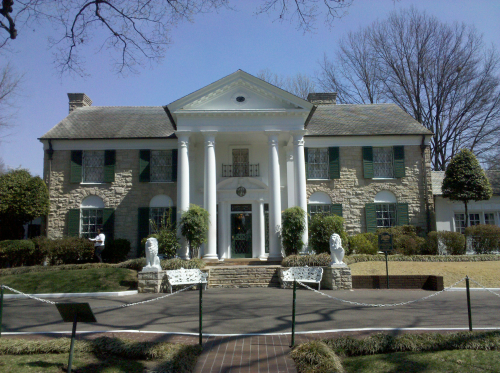
No, this isn’t the Supreme Court, it’s Graceland,
purchased by Elvis in March 1957.

(We’re just checking whether you are paying attention.) 

Appellate oral argument, as they say, is supposed to be a “conversation” between the bench and counsel. But the overall impression we were left with after reviewing the transcript of yesterday’s Supreme Court oral arguments in Murr v. Wisconsin, the case about the “larger parcel” or “denominator” in regulatory takings cases, was that just about everyone in the courtroom was talking on different wavelengths. 

Don’t get us wrong — arguing counsel for all the parties and amicus did a pretty good job, in our view. They are advocates, after all, and their job is to champion their clients’ position, not to solve the Court’s confusion, and problems that appear entirely self-inflicted.

Two of the parties (the Murrs and the State of Wisconsin) urged the Court to adopt

Continue Reading Affirmed By An Equally Confused Court? Some Thoughts On The Oral Arguments In The “Larger Parcel” Case