Here’s what we’re reading today:


Continue Reading Must Read Monday: RLUIPA Ripeness, “The Taking Issue,” Oysters In The Wilderness, Precondemnation Damages

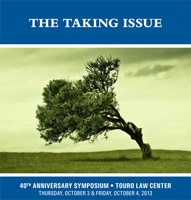
Taking_coverimage_webIf you are anywhere within striking distance of Touro Law School (Central Islip, Long Island), you should make plans to attend a conference that promises two days of fantastic programming on October 3 and 4, 2013.

The Taking Issue – 40th Anniversary Symposium” is dedicated to the memory of the legendary Professor Fred Bosselman, and lead author of The Taking Issue, a 1973 report to the President’s Council on Environmental Quality. While the themes in the book have been overtaken by the Supreme Court’s takings cases, it remains a touchstone work for anyone interested in the subject.

Conference co-Chairs Dean Patricia Salkin and Professor David Callies (a co-author of The Taking Issue) have assembled an excellent faculty and agenda. There will be panels on partial takings, the Nollan/Dolan/Koontz issue, the relevant parcel question, and one on ripeness which we’ll be moderating

Continue Reading Conference Announcement: The Taking Issue – 40th Anniversary Symposium

The U.S. Court of Appeals for the Eleventh Circuit, in Temple B’Nai Zion, Inc v. City of Sunny Isles, No. 12-12094 (Aug. 29, 2013), held that the Williamson County ripeness doctrine did not prevent the Temple from bringing its RLUIPA (and related) claims in federal court. 

The right result for sure. But wait, you say, isn’t Williamson County a ripeness rule for takings claims? After all, it supposedly is based in the language of the Fifth Amendment (the taking isn’t unconstitutional until just compensation has not been paid, and there’s been no “taking” until the government has made a final decision)? No matter, several courts have extended the Williamson County doctrine beyond takings claims, requiring plaintiffs in free speech, due process, and religious land use cases to exhaust administrative remedies before they come to federal court.

The Eleventh Circuit rejected the defense, but not because Williamson County simply doesn’t

Continue Reading 11th Cir: RLUIPA Case Not Unripe Under Williamson County

Just over a month ago, the U.S Court of Appeals for the Fourth Circuit held that a federal takings case could actually proceed in federal court. Well yesterday, the same court issued a similar opinion in a related case, Town of Nags Head v. Toloczko, No. 12-1537 (Aug. 27, 2013).

We won’t go into detail because this post, by J. David Breemer at Pacific Legal Foundation (who also is counsel for the prevailing property owners) sets it all out very well.  But the decision involves abstention (Federal Courts law school flashback), Williamson County, and  beaches and public trust, so it’s well worth a read on its own.

If that doesn’t grab you, then nothing will!

Town of Nags Head v. Toloczko, No. 12-1537 (4th Cir. Aug. 27, 2013)


Continue Reading 4th Cir (Again): Federal Takings Claim Should Be Heard In Federal Court

Word comes that the California Supreme Court has denied review of the Court of Appeal decision in Lockaway Storage v. County of Alameda, No. A30874 (1st Dist. May 9, 2013). The court also rejected a request to “depublish” the First District’s opinion. Congratulations are again in order for colleague Tim Kassouni, who represents the property owners. 

Lockaway is the case in which the First District upheld the trial court’s finding of a Penn Central taking, affirming that the County of Alameda is liable for a temporary regulatory taking, and awarding the property owners nearly three-quarters of a million in attorney fees. This means the only avenue left open is a cert petition to the U.S. Supreme Court. If the County does so, it will probably have as much luck as the private property bar with convincing the Court to take a Penn Central case.

Here’s the (now-denied) Petition

Continue Reading Cal Supremes Deny Review In Property Owner Penn Central Victory

Here’s what we’re reading today:

  • Our Owners’ Counsel colleague from New Jersey, Anthony Della Pelle, has posted some thoughts on the New Jersey Supreme Court’s recent decision in Borough of Harvey Cedars v. Karan, No. 070512 (July 8, 2013). That’s the case about valuation issues when there’s a partial taking of littoral property in order to erect protective dunes. Tony’s thoughts are well worth reading. 
  • In that vein, on Wednesday, August 14, 2013, starting at noon ET, we’ll be joining Tony and other experts to speak at the New Jersey Institute for Continuing Legal Education’s teleseminar on “Eminent Domain and Regulatory Takings:


Continue Reading Wednesday Round-Up: Koontz Recording, Jersey Shore Dunes, Plastic Bag Bans

This really was a “blockbuster” Term for the Supreme Court and takings law: no less than three cases (and four, maybe five, if you expand it slightly to include property-owner favorable cases such as Lozman and last term’s Sackett), and as Gideon Kanner noted recently, the CLE sessions are flying fast and furiously.

Here’s another one, with a great angle: our ABA colleague Ed Thomas, President of the Natural Hazard Mitigation Association and the guy who knows just about everything there is to know about disaster preparedness, disaster response, and property rights, is speaking tonight (Tuesday, July 16, 2013, 7:00 pm MT) along with BYU lawprof Lisa Grow Sun, about the Supreme Court’s takings cases:

This session will explore the legal landscape for community development and hazard mitigation/climate adaptation. Specifically, there has been tremendous press coverage of many U.S. Supreme Court decisions this term. One

Continue Reading Today’s Free Webinar – Mitigation Options Affected by the Supreme Court in 2013: Koontz and Other Game Changers

Here’s one not to miss, not only because it’s free, but because it features our PLF colleague Paul Beard II, arguing and prevailing counsel in Koontz v. St. Johns River Water Mgm’t Dist., No. 11-1447 (June 25, 2013): on Wednesday, July 17, 2013, from 2:00 – 3:30 pm ET, Greenberg Traurig and PLF are sponsoring a live chat:

In Koontz, one of the most important Takings Clause cases in recent years, the U.S. Supreme Court held that the doctrine of  unconstitutional conditions established in the Nollan and Dolan cases applies to all land use permit applications – even if the excessive condition leads to a permit denial, and even if the condition involves the payment of money rather than dedication of real property. This extension of Nollan/Dolan principles has far reaching implications for real estate, environmental, and other federal and state permitting actions. The significance and implications

Continue Reading Upcoming Live Chat: Koontz – How Far Has Nollan/Dolan Been Extended

Late last year, we posted the Complaint in a federal court lawsuit originating on Kauai. In that case, the owner of a property that has been designated for resort development for 35 years asserted that the adoption of a Charter amendment by the County’s voters and a follow-on ordinance adopted by the County Council that together created a new land use classification (“transient accommodation unit”), and severely limit the number of TAU’s was an attempt to restrict the number of visitors and part-time residents.

The Complaint contains three major allegations: (1) the measures are arbitrary and capricious and violate substantive due process as an attempt to limit visitors, (2) they violate the Hawaii Zoning Enabling Act (Haw. Rev. Stat. § 46-4, the state statute delegating zoning authority to the counties in certain areas for all you land use nerds), which prohibits adopting of zoning ordinances by initiative, and

Continue Reading Hawaii Federal Court: Kauai Charter Amendment Limiting Vacation Rentals Is A Prohibited “Zoning Initiative”

On Wednesday, July 17, 2013, from 4:00 – 5:30 pm ET, I will be a panelist in the American Planning Association’s above-titled teleconference.  The session was put together by our ABA and OCA colleague Dwight Merriam, and in additon to Dwight and me, includes Professors David Callies (U. Hawaii) and Carol Brown (U. Richmond), John Baker, an attorney with Greene Espell in Minneapolis, and our ABA colleage and fellow U. Hawaii alum Julie Tappendorf.

Here’s the description of the program:

The U.S. Supreme Court ended its term with a decision that will change planning and regulation — but by how much, and will the change be for better or worse? Koontz v. St. Johns River Water Management District is the most important planning law case in nearly a decade, and already there is widespread disagreement about what it means.

A diverse panel of land use lawyers will examine

Continue Reading Upcoming Teleconference: Lessons from Koontz – Game Changer or Just a Little Rule Refinement?