Sheetz

Get ready for Sheetz v. El Dorado County, No. 22-1074, the “legislative exactions” case at the Supreme Court. [Disclosure: this is one of our firm’s cases, so we won’t be doing an analysis here. Besides, you already know where we stand on the issue.]

With the final merits brief filed last week (Petitioner’s Reply), the case is now teed up for argument next week. Wow, that seemed to come at us very quickly.

Screenshot 2024-01-01 at 15-41-45 Search - Supreme Court of the United States

Here’s the Question Presented:

George Sheetz applied, to the County of El Dorado, California, for a permit to build a modest manufactured house on his property. Pursuant to legislation enacted by the County, and as the condition of obtaining the permit, Mr. Sheetz was required to pay a monetary exaction of $23,420 to help finance unrelated road improvements. The County demanded payment in spite of the fact that it made no individualized determination
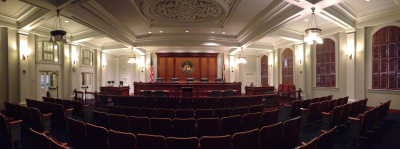
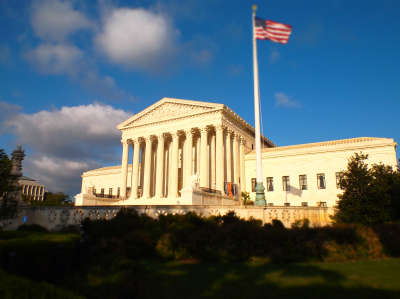
Continue Reading Sheetz v. El Dorado County Argument Preview: Do Blanket Exactions Present The Same Risk As Ad Hoc Exactions?

HAWSCT

We’re not going to go into very much detail or provide commentary on the Hawaii Supreme Court’s unanimous 88-page opinion in an eminent domain case we’ve been following, City and County of Honolulu v. Victoria Ward, Ltd., No. SCAP-22-0000335 (Dec. 29, 2023), because before we departed private practice for public interest law a couple of years ago, this was our client and our case (so we still have a bias).

Update: more on the decision from Jesse Souki, “Hawai’i Court Holds that Consideration of Severance Damages in Honolulu Rail Case Should be Left to the Jury” (“The HSCT was critical of the circuit court’s granting of summary judgment motions where there were genuine issues of material fact that should be decided by the jury[.]”).

Short story: the Honolulu rail agency (we’re still calling it “HART” and not the weird “Skyline” although the latter is

Continue Reading Hawaii SCT: Most Of Those Eminent Domain Issues (Esp. Severance Damages) Are For Juries

Here are the cases that Michael Berger and I discussed in today’s presentation to the ABA State and Local Government Law Section’s Land Use group. It was good seeing everyone, even virtually:


Continue Reading Cases And Links From Today’s ABA State & Local Govt Law Land Use Presentation

DSCF3357
The place hasn’t changed that much since 1980, has it?

As you know, the legendary Gideon Kanner left us in November. The tributes continue to be published. You’ve no doubt seen our remembrance of Professor K, as well as this one from Southern California Appellate News, this memorial from Loyola Law, our colleague Charles McFarland’s thoughts, and Professor Kanner’s colleagues at the Owners Counsel of America.

Or maybe you’ve read his final law journal article, or listened to his final media appearance on the Bound by Oath podcast.

But one of the ways we’re remembering Gideon is by listening to the recording of his U.S. Supreme Court oral arguments in Agins v. City of Tiburon, 447 U.S. 255 (1980) (stream it above, or listen at Oyez here). Professor Kanner at his full-throated best!

Argued in the spring of 1980 and decided two

Continue Reading Listen: Gideon Kanner’s Oral Arguments, Agins v. City of Tiburon (Apr. 15, 1980)

Here’s the latest in a case we’ve been following.

In this Order, the U.S. District Court for the District of Hawaii made permanent its earlier ruling that Honolulu’s ordinance which expanded the minimum rental term to 90 days because it did not account for those owners who were already legally renting their properties for 30 days. The state Zoning Enabling Act requires zoning ordinances account for preexisting uses.

We covered the issues and the court’s preliminary injunction ruling here, and won’t go over those again. About the only difference between that one and this one is that the court rejects the City’s “several new legal arguments[,]” including Pullman abstention, and the claim that this isn’t a zoning ordinance covered by the ZEA, but rather a “rental regulation.” See slip op. at 10.

The City’s attempt to reframe the issue first presented during preliminary injunction proceedings more than a

Continue Reading Hawaii Federal Court: Honolulu Can’t Increase Minimum Rental Term To 90 Days Without Accommodating Existing Uses

PXL_20230223_024826759

Starting in January, we’ll be helping our friend and former law partner Mark M. Murakami with the venerated and oh-so-important Land Use course (Law 580) at the University of Hawaii’s Law School.

We’re temporarily stepping into some mighty big slippers (this is Hawaii, so we don’t always wear shoes), as this is the course that our mentor Professor David Callies taught for decades. And is there a better venue in which to teach and study land use law and regulation, and its limits? After all, Hawaii may be the most heavily-regulated land on the planet, and is a focal point for every issue you can think of, from zoning to environmental restrictions to takings to public trust to subdivision to admin law to … well, you get the drift.

We’ll cover those topics, as well as the fundamentals. And we have a few surprises up our sleeves — some impressive

Continue Reading Hawaii Five-80: More Land Use (Law 580) At The University Of Hawaii

You remember that longstanding trope: that matters of land use are “local” issues, and thus in civil rights claims involving a state or local government interfering with the right of property federal courts should avoid adjudication until the government has had every chance to do the right thing (even where it is patently obvious that it has no intention of doing so)? This trope most often shows up as a part of a ripeness dismissal, where the court says “too soon,” because, well, if given enough time and opportunity, the government might render adjudication unnecessary.

Well, in Ateres Bais Yaakov Academy of Rockland v. Town of Clarkstown, No. 22-1741 (Dec. 8, 2023), the U.S. Court of Appeals for the Second Circuit held a land use case ripe, and in the process blew up this overripe trope. Whoa!

But before you takings mavens get too excited, this is a RLUIPA

Continue Reading “Super-Zoning Board” No More – CA2 Busts The “Land Use Is Local” Trope: Town ZBA Doing Nothing On Variance Application Ripened Constitutional Claim

PXL_20231202_194330453.PORTRAIT

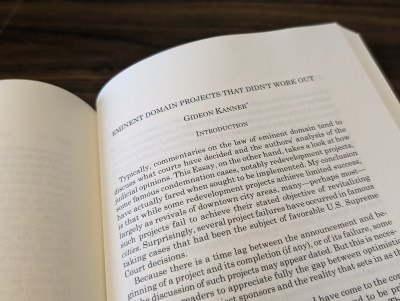
Here it is — Professor Gideon Kanner’s final law journal article, published shortly before his passing:

Gideon Kanner, Eminent Domain Projects That Didn’t Work Out, 12 Brigham-Kanner Prop. Rts. J. 171 (2023).

Appropriately, we think, published in William and Mary Law School’s Brigham-Kanner Property Rights Journal, named in part in Gideon’s honor.

This isn’t a typical law journal article, but an essay collecting Professor Kanner’s thoughts, comments, and (best of all) opinions on, well, eminent domain (and redevelopment) projects that didn’t work out.

In Gideon’s own words, from the Introduction:

But whether you favor widespread use of eminent domain or not, and whether the projects created by its use are sound or not, it is deplorable that the power of eminent domain has been often deployed to the detriment of racial and politically powerless minorities. Typically, redevelopment projects tend to displace middle class and poor people from

Continue Reading Professor Kanner’s Final Article: “Eminent Domain Projects That Didn’t Work Out,” 12 Brigham-Kanner Prop. Rts. J. 171 (2023)

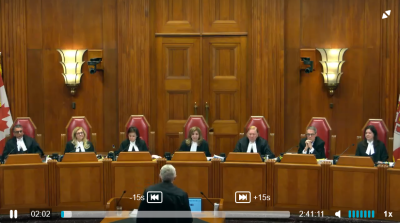
Screenshot 2023-11-27 at 08-13-43 Supreme Court of Canada - SCC Case Information - Webcast of the Hearing on 2023-11-16 - 40302
“Good morning, Justices”

You know that from time to time — mostly thanks to our friend and colleague Shane Rayman and his firm — we cover property goings-on north of the border when a good property rights case comes before the Supreme Court of Canada (see here and here for past examples).

Well, here’s another one, this time involving “de facto [or constructive] expropriation” (or, as we call it, “regulatory takings”), where the question before the Court is how compensation is calculated after it was determined that the application of very restrictive zoning to otherwise developable property was is deemed a taking. Must valuation include or exclude the effects of the challenged regulation?

The oral arguments in the case were held last week (click here to watch a recording [English or French, your pick]).

Applying what in Canada is known as the “Pointe Gourde principle” — the

Continue Reading La Cour suprême du Canada Considering Effect Of “The Scheme” On Takings And Compensation

Pace
22nd annual Alfred B. DelBello Land Use
and Sustainable Development Conference

Come, join us (and others) on Thursday-Friday, December 7-8, 2023, at Pace Law School in White Plains, New York for the Land Use and Sustainable Development Conference (this year’s conference theme is “Balancing Economic Realities with Environmental and Social Concerns”).

We’re speaking about the 100th anniversary of the modern regulatory takings doctrine, which got its start nearly 101 years ago with the Supreme Court’s opinion in Pennsylvania Coal Co. v. Mahon, where the Court held that property may be regulated, but if the regulation “goes too far,” it will be deemed a taking.

Here’s a description of the program:

The 100th Anniversary of Pennsylvania Coal vs. Mahon: How the Takings Clause Became the Primary Check on Government Power When SCOTUS Abandoned Review Under the Due Process and Contracts Clauses During the New Deal

The Takings Clause and 100

Continue Reading Join Us For 100 Years Of Pennsylvania Coal (Pace Land Use Conference, Dec. 8, 2023)